



Egg-scattering fishes.
The vast majority of fish reproduce by spawning. The mating period in the life of egg-scattering fishes is usually called spawning, and the place where this process takes place is the spawning ground. During spawning, the female, accompanied, pursued, or attracted by males in accordance with the mating ritual of a particular fish species, spawns eggs that are fertilized by the male’s milt. The productivity of aquarium fish varies from tens to several thousand eggs.
The number of developing eggs is influenced by the age, condition, and size of the females, hereditary factors, habitat, and proper nutrition. Lower fecundity is typical for species that care for their offspring (livebearers, mouthbrooders, those carrying offspring in brood pouches, on the body, etc.). During artificial incubation of eggs of Malawi and Tanganyika Cichlidae, it is necessary to carefully monitor the cleanliness of the environment, since a single untimely removed dead egg can ruin the entire clutch.
In most fish, parental care for offspring is limited to this. Moreover, many fish greedily eat their own freshly laid eggs, and out of the huge number of eggs produced, not so much offspring actually develops. In addition, some of the eggs remain unfertilized, and of the hatched larvae, only an insignificantly small percentage survives to adulthood. This probably explains the surprisingly large number of eggs produced by the fish.

However, a number of species show care for their offspring by guarding the eggs and fry at the larval stage, and some protect growing fry for a long time. These fish use various shelters, grottoes, ceramic items for spawning, or clean pebbles, plant leaves, or sections of aquarium glass to place eggs on, and then guard the eggs and larvae. Others build bubble nests for this purpose, as Anabantoidei fishes do. And some Cichlidae carry eggs and raise their young in the parental mouth, which serves as both an incubator and a safe refuge for the growing young, much like a kangaroo’s pouch. Of course, such parental care ensures better survival of the fry. Fish prone to such care spawn a smaller number of eggs than their “carefree” relatives.
Producers become optimal only when physiological maturity is combined with body maturity (size at least half the maximum length, constitutional strength, etc.). Males usually mature earlier than females (the maturation process is activated by adding thyroxine to the water). When crossing old males with young females, males predominate in the offspring; when spawning young males with older females, the number of females increases. Large females and small males of the same age produce more males, and the reverse combination produces more females. In general, the first spawnings are low-productive. In batch spawners, sex products mature in portions calculated for the entire cycle.

Readiness for reproduction is judged by the appearance of a nuptial coloration in fish (bright coloration, pigment spots in Cichlidae; pearl tubercles on the head and gill covers in Cyprinidae; skin thickening in Loricariidae catfishes, etc.), swelling of the anus, and enlargement of the ovipositor and spermioduct. Nuptial coloration serves for sex recognition, stimulation of maturation, and release of reproductive products.
With external fertilization, sperms live from 0.5 to 5 minutes, with internal fertilization — from 2 months to 2 years. In inhabitants of standing waters, sperm viability is higher. The phenomenon where the eggs of a single female are fertilized by several males is called polyandry. During schooling spawning, the water sometimes turns cloudy from the multitude of milt released by males. In such a situation, up to 2/3 of the water is replaced after 15–30 minutes with fresh water of identical composition and temperature. The process of egg development in different fish proceeds differently: from a day to several months. Batch spawning (continuing with intervals year-round) is typical for tropical fish; seasonal or single spawning is typical for many cold-water fish or species living in stable conditions (cave dwellers, deep-sea species, etc.).

As a rule, eggs are laid by fish in the evening or early morning. The duration of spawning ranges from 30 minutes to several hours or even days with rest intervals. Increased productivity can be achieved by separate housing and proper feeding of producers for 10–15 days before spawning. The cyclical nature of spawning also depends on daylight hours. Adding calf thymus gland to the feed leads to an increase in the number and size of offspring, feeding with thyroid gland accelerates metamorphosis but slows down growth. The pigmentation, shape, and size of eggs also have an adaptive characteristic aimed at the survival of the population.
In some species, egg development occurs faster in the light, while in others — in darkened conditions. The oxygen regime and water quality required for successful fish reproduction, both in natural conditions and in aquariums, vary extremely. As a rule, fish inhabiting bright, transparent waters of rivers and lakes spawn in well-lit aquariums, while inhabitants of dark, slow-flowing and standing water bodies with a peaty, muddy bed feel better in aquariums with dark substrate under dim, diffused light. Their eggs and larvae develop more successfully in darkened conditions.
The free embryo has a yolk sac with a supply of energy substances that nourish it in the first hours or days of life. The larval stage of development of the young in egg-scattering fishes 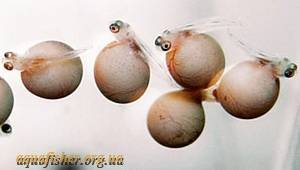 is characterized by the fact that the hatched fry hang motionless on plants, aquarium glass, or substrate and do not feed yet, but develop at the expense of nutrients contained in the yolk sac. Resorption of the sac is a signal to immediately feed the actively moving larval embryo. The larva becomes a fry only upon acquiring scaly cover and the structure of an adult fish. The eggs and larvae of some fish inhabiting water bodies under the canopy of tropical rain forests with soft, peaty, slightly acidified brownish water develop more successfully in the dark. Moreover, they often perish in the light. Apparently, they are killed by microflora, which, on the contrary, develops more successfully in illuminated conditions. This may happen as a result of changes occurring in water that constantly interacts with the environment, and this occurs more actively precisely in the light.
However, when the larval stage ends and the fry begin to feed independently, for some it is appropriate to illuminate the aquarium not entirely, but so that rays of light (preferably sunlight) penetrate through a small opening, creating a zone of high concentration of infusoria and rotifers. Here, fry that are still very weak find it easier to gather this microfeed. Such tricks have to be used when breeding many Characidae and some other species.
Mating mood and subsequent spawning are stimulated by a number of essential factors. First of all, this is the sexual maturation of fish that have reached the “age of love” under appropriate maintenance and feeding conditions. Speaking of maintenance conditions, attention should be paid to the sufficient capacity of the breeding aquarium, which can provide the necessary space for the fish to move. With a lack of space, many fish tend to become obese, and this negatively affects their reproductive abilities.
The stimulus for reproduction in many species is an increase in water temperature to the spawning norms of the given species. As a rule, the spawning ground temperature is 2–3 °C higher than the usual maintenance temperature. Raising and keeping fish during resting periods at spawning temperatures is undesirable, as this often negatively affects the development of young stock and provokes premature aging of the fish.
A lowered water level in the spawning ground also stimulates the mating mood for many fish. This primarily applies to fish from drying shallow tropical water bodies, for example, Fundulus and Anabantoidei fishes, which rush to leave offspring before the onset of drought fatal to adult fish. In addition, lowering the water level in the spawning ground provides better oxygen saturation of the water due to surface gas exchange. And young at early stages of development find it easier to find microfeed in the bottom layer of water when its level is low.
Many species inhabiting the rain forest zone spawn with the onset of the rainy season, which brings streams of water close in composition to distilled water into the water bodies. In aquarium conditions, spawning of these fish is stimulated by adding about a third of fresh, settled, soft water with a neutral reaction to the spawning ground.
And there are species that need a stimulus in the form of a special “furnishing” of the spawning ground with shelters for spawning or a suitable substrate: stones, certain plants, or their artificial substitutes made of foam rubber or plastic. Such tricks are necessary when breeding fish that show care for their offspring. And for fish that eat their eggs, a substrate of dense, fine-leaved plants serves to protect the eggs from gluttonous parents. Sometimes a separator net or plastic mesh, similar to that used on windows for protection against flies and mosquitoes, is used for this purpose.
Egg-binding (Cysting). This usually happens when the female is already mature for spawning but does not lay eggs because she has no partner or for some other reason — for example, due to an unsuitable environment. If she fails to reabsorb these eggs or expel them, the eggs will begin to decompose in her body, causing a bacterial infection of the reproductive tract, which usually ends in death. The optimal solution is to prevent this by providing the female with a partner and suitable environmental conditions. If egg-binding has nevertheless occurred, it might be possible to help the female strip the eggs. However, if the fish is small (say, less than 5 cm in length), this is practically impossible, even if you consult a veterinary specialist.
According to the substrate, fish are divided into:
• Lithophiles, spawning on stony substrates;
• Psammophiles, spawning on sand;
• Phytophiles, reproducing among plants;
• Ostracophiles — eggs are spawned into the mantle cavity of mollusks, under the shell of crabs, etc.;
• Pelagophiles — eggs and embryos develop floating in the water column;
• Pelophiles, preferring silt.
Often species are indifferent to the substrate; they scatter eggs with equal success in dense plants, on sand, etc. Demersal, non-adhesive eggs sink to the bottom.
In a number of fish, egg-laying is preceded by nest building:
• from plants in sticklebacks, Amblydoras, true gourami, Gymnarchus, etc.;
• from air bubbles “cemented” with saliva in Anabantoidei, Hoplosternum, etc.;
• in the substrate in Pyrrhulina guttata, Pseudobagrus, false gudgeon, etc.
Copella arnoldi places eggs on the inner side of plant leaves hanging over the water, and periodically sprinkles the clutch with tail strokes to prevent it from drying out.
 Methods of reproduction of egg-scattering fishes. Substrate-spawning fish.


