



Methods of reproduction of egg-scattering fishes.
The methods of reproduction in fishes are very diverse and can vary both depending on the genus and belonging to different families, and within the same genus. Based on this characteristic, they can be divided into three main groups.
Fishes of the first group spawn and leave their eggs unattended:

1) eggs stick to plants or other objects or fall to the bottom. This is typical for most barbs (Barbus) and tetras. In some fishes, eggs float to the surface, for example in Helostoma temminckii;
2) eggs hang individually or in clusters on plant leaves, as in many panchax killifishes (Aplocheilus);
3) the fish spawns in various depressions or buries its eggs, which is typical for Cynolebias and Pterolebias;
4) eggs are laid inside an animal that acts as a temporary host until the larvae hatch. Among freshwater fishes with this type of spawning, the most famous is the bitterling Rhodeus sericeus, the female of which lays eggs into the mantle cavity of freshwater bivalve mollusks, and the larvae swim out without harming their host.
The second group of fishes guards their eggs, and the role of guardians is played either by the male, the female, or sometimes both parents:

1) the female spawns on some object — a stone, leaf, or plant stem, and one or both parents alternately guard it. This is done by many cichlids (Cichlidae) and Nandidae;
2) the female lays eggs on the underside of leaves hanging over the water, and then the parents begin splashing water onto the eggs to protect them from drying out, continuing this until the larvae hatch and fall directly into the water. According to our data, this original method is characteristic of only one species — Copella arnoldi (Copella arnoldi);
3) the female lays eggs in some shelter that is carefully guarded. This method differs from the first one only in that the eggs are not on an open surface; it is preferred by some African cichlids (Cichlidae) and Nandidae (Nandidae);
4) the female spawns in a depression, and the parents guard it. This is how Tilapia species, some American sunfishes, and other cichlids behave, for example Geophagus;
5) the female spawns in a nest, usually built in advance by the male. These nests are very diverse — from underwater structures in Gasterosteus species to floating bubble nests in Colisa, Betta, and Trichogaster species.
And finally, representatives of the third group are characterized by the fact that the eggs remain in close contact with one of the parents for some time:

1) fertilized eggs hang in a cluster from the female’s belly and drop off, for example, when the female brushes her belly against a plant stem, usually before the larvae hatch. This is typical for Cubanichthys and Oryzias species;
2) incubation of the eggs takes place in the oral cavity of one of the parents, and the hatched larvae subsequently find protection with the parents, hiding in their mouths when danger appears. Such fishes include Geophagus, Haplochromis, and some Tilapia;
3) the development of eggs and hatching of larvae occur inside the mother’s body, and the fry emerge free-swimming and fully formed. These are, of course, the famous livebearing fishes — Poeciliidae and Hemirhamphidae.
Now it remains only to “sort” the many species known to aquarists worldwide and, having studied their life cycles, take on the responsibility of creating the conditions necessary for their full life, in order to observe their diverse reproduction methods.
Fishes that spawn in substrate depressions and care for their eggs and offspring.

This method of reproduction is characteristic of the following genera: Jordanella (Jordanella floridae), Lepomis (Lepomis), Enneacanthus. Such fish require a spawning aquarium with a fine sand substrate at least 5 cm thick, planted with aquatic plant clumps, and for Lepomis — a place where the female can hide. The male digs a pit in the sand, into which the pair of breeding fish deposits their eggs. This process is very simple: the male chooses a suitable place and prepares a depression by swimming in circles over the substrate, thereby creating a whirlpool. Sand particles and small pebbles that cannot be removed this way are gathered by the male in his mouth and carried to the side. The breeding male alone guards the clutch until the larvae hatch. In Mikrogeophagus ramirezi, care is provided by the pair; in other fish species, one of the parents can be removed from the spawning aquarium after spawning.
Fishes that spawn in the substrate and do not care for their eggs.
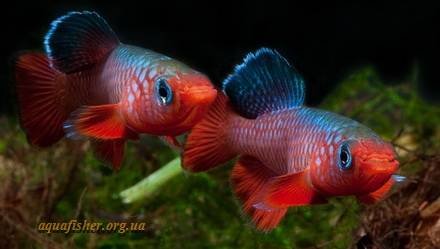
This type of reproduction is characteristic of the genera: Austrofundulus, Aphyosemion (Aphyosemion), Nothobranchius, Pterolebias, Cynolebias. These are the so-called “seasonal” fishes that live from the rainy season to the dry season. During this time, they manage to hatch from the eggs, reach sexual maturity, and spawn eggs that wait out the unfavorable period in the substrate of the dried-up body of water.
When starting to breed such fish, you will face the problem of creating conditions that at least somewhat match natural ones, which is very difficult to reproduce in an aquarium. The incubation period for such species is quite long. A layer of peat is placed at the bottom of the spawning aquarium, and several plant clumps are planted so the female can hide from the male. Lighting is dim, or at least there should be shaded areas. The water level should not exceed 25 cm. The feeding area of the bottom is left clear. The peat in which the fish lay their eggs is periodically (at least once every 3 weeks) removed and replaced with new peat. It is convenient to place it on a tray that is easily removed from the aquarium. The removed peat is placed in a net and water is drained until it drips, then it is laid in a 2-3 cm layer and slightly dried, but it must retain enough moisture to still absorb water drops and remain crumbly.
The peat with eggs is stored in a closed glass or plastic container or in a plastic bag (preferably labeled with the date the peat was placed) at a temperature of 21-23 °C for several months. During the first 2 weeks, the peat is inspected daily, and whitened, dead eggs are removed; they must not be allowed to stay on the surface of the peat. Then, the condition of the embryo in the eggs is checked weekly using a magnifying glass, while simultaneously checking the peat to prevent mold formation. When the development of the embryos is complete (eyes are visible as dark spots), the peat is transferred to a vessel and filled with soft water at a temperature 2-4 °C lower than during storage. The water level should not exceed 5 cm. Then the temperature is slowly raised to 25 °C.
The hatched fry are transferred to a grow-out aquarium with the same water level and parameters. As the fry grow, the water level is raised and the water parameters are gradually changed to optimal ones for keeping the given fish species. It happens that despite proper embryonic development, hatching does not occur. In this case, you need to shake the water with the eggs. If this does not help, replace the water with fresh and cold (10 °C) water. You can sprinkle dry food (daphnia or cyclops, for example) on the water surface, which will lead to strong bacterial growth and reduced oxygen content. The fry will strive to break the egg membrane to escape the unfavorable environment. They must be immediately transferred to clean water with the same parameters as in the spawning aquarium. Eggs usually remain in the peat. It is dried, and the process is repeated.

 Fishes that spawn on plants or other underwater objects.
Reproduction of egg-scattering fishes. 


