Order Cyprinodontiformes
Superfamily Cyprinodontoidae
Family Rivulidae
Genus Aphyolebias. Aphyol.
Inhabit South America. Aphyolebias were split from the genus Pterolebias. Species of this genus have a more slender body with elongated caudal fins in males. They live in virgin forests in shallow stagnant waters, often colored like dark tea, with a low pH and low hardness, and frequently over a muddy bottom. Various species are widely distributed across a large range along the Andean foothills in the lowlands of Peru and Bolivia, as well as northwestern Brazil and neighboring Colombia.
Aphyolebias species sometimes, but not always, dive deep into the soft substrate to spawn. They often bury their eggs deep into the soil with a powerful tail movement. The eggs are relatively large, measuring 2 mm in diameter. Fecundity is high, but a long incubation period is required, making breeding not always very easy. It may take 3 to 7 months for the eggs to incubate. The fishes are seasonal, yet they can live longer than most other annual fishes in the aquarium.

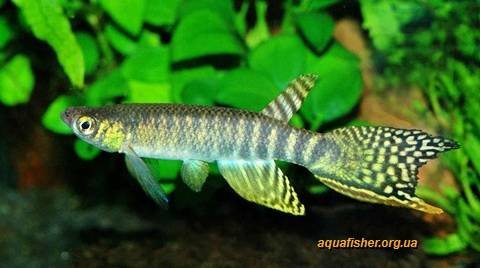
— Aphyolebias peruensis [Myers, 1954] — Peruvian Longfin. Code: PRU. Synonym: Pterolebias peruensis. Eastern Peru, upper Amazon basin. Male 10 cm, females 8 cm. In recent decades, this has been a very common fish. It belongs to highly variable color morphs. Main coloration ranges from light yellowish-brown to grayish-brown with green-blue sparkles.
Depending on the fish’s mood, more or less noticeable vertical stripes appear on its sides, increasing in intensity towards the caudal region; furthermore, they are more pronounced in males than in females. The caudal fin of males is unique in its bright coloration, especially in adult dominant specimens. The upper and lower tips of the fin are unevenly elongated and lyrate. The fin coloration is dark with a scatter of bright yellow-green and turquoise spots, the lower margin of the caudal fin is decorated with orange stripes, sometimes separated from the network of green spots by a dark stripe.

The pattern and coloration of the caudal fins in these fishes are so diverse that finding two similar fish is almost impossible. The pectoral and pelvic fins are transparent, pale, and flag-like. The dorsal and anal fins in males are elongated with stripes on a yellowish-green background, whereas in females they are more rounded and the stripes are less distinct. The caudal fin in juveniles is transparent and colorless, while in mature females it has a distinct reticulated pattern. The pattern and coloration of the caudal fin are so diverse that finding two similar fish is almost impossible.
Since these fishes love to hide, place rooted plants in the aquarium and floating plants on the surface where the fish can hide from each other; caves and pieces of peat are also needed for this purpose. The resulting twilight environment suits the character of these fishes much better than a brightly lit aquarium, making them less timid.
They feel best under subdued overhead lighting, staying mostly near the water surface among floating plants. Fishes can jump out of the aquarium, so it must be covered with a glass lid. The ideal combination is one male and three females. Never keep two males together! The weaker one will certainly be killed. Due to their aggressiveness, it is best to keep males singly, introducing them to 2–3 females every few days.
They accept live, frozen, and dry foods. Spawning substrate can be Java moss placed on the bottom, and they can also spawn in sand. Undoubtedly, a thick layer of peat corresponds more closely to natural spawning conditions. Fishes can be sexed after one month, at a length of more than 2 centimeters. At 3–4 months of age, they become sexually mature and can spawn. Lifespan is 10–12 months. T 20–24°C; dH 4–12°; pH 6–6.8.

— Aphyolebias rubrocaudatus [Seegers, 1984]. Code: RBC. Synonym: Pterolebias rubrocaudatus. (Eng. Redfin Longfin). 5–7 cm, female 4–5 cm. Southern Peru. Has a cigar-shaped body. The smallest of the Aphyolebias species. Planted aquarium with open swimming space and driftwood shelters. Non-aggressive when there is enough space and hiding spots. Water soft and neutral. Substrate of peat crumbs and fine dark sand. They also adapt to frozen food, but it should be fed in small portions only, regularly removing decaying residues. T 24–27°C.
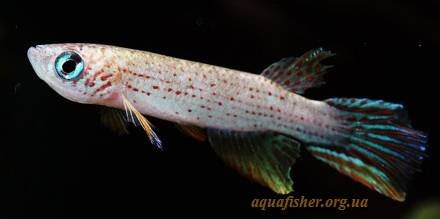
— Aphyolebias schleseri [Costa, 2003]. Code: SCL. Peru. Slow swimmers, easily outcompeted by active fish. They prefer diffused lighting in the aquarium, achieved using floating plants. Intraspecific aggression is moderate; two males can be kept in tanks of 60 liters or more with hiding places. Temperature 23°C; pH 7.5.
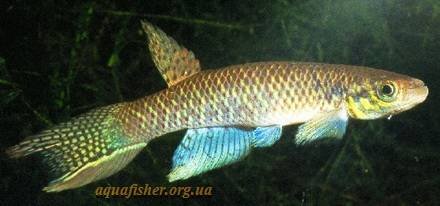
— Aphyolebias wischmanni [Seegers, 1983]. Code: WIS. Synonym: Pterolebias wischmanni. (Eng. Wischmann’s Longfin). Peru. Male up to 14 cm, female up to 13 cm, in aquarium up to 10 cm. Has a cigar-shaped body. Non-aggressive when sufficient space is provided. Lifespan up to 1.5 years. T 24–26°C.
 Austrofundulus leohoignei, Austrofundulus limnaeus, Austrofundulus transilis.
Terranatos dolichopterus, Trigonectes aplocheiloides, Trigonectes strigabundus.