



Order Characiformes ( Characiformes )
Family Characidae ( Characidae )
Subfamily Serrasalminae ( Serrasalminae )
Fish of the genus Pygocentrus can be recognized by their convex head shape and massive, bulldog-like lower jaw (more powerful and muscular than in most Serrasalmus). This indicates their diet: besides being scavengers, when necessary, all Pygocentrus species are full-scale predators that actively pursue their prey. There will be one dominant fish in the school. Despite the fact that the fish will swim peacefully together, at the crucial moment the dominant fish will show its power. In most cases, the alpha fish will be the largest, most aggressive, and boldest, occupying and defending the best spots in the aquarium in the water current and being the first near the feeder.
Genus Pygocentrus — Pygocentrus.
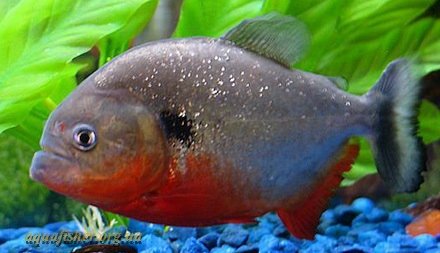
— Cariba Piranha, Orinoco Piranha — Pygocentrus cariba [Humboldt & Valenciennes, 1821]. Synonyms: Pygocentrus notatus, stigmaterythraeus, Serrasalmus albus, caribe, notatus. (English: Black Spot Piranha, Black Shoulder Piranha, Black Eared Piranha, Cariba Piranha, Orinoco Piranha, Venezuelan Red Belly Piranha). Guiana, Colombia, Venezuela, Amazon, Orinoco, Meta, Apure rivers. In the aquarium up to 30 cm. Snout is blunt, lower jaw is larger and darker than the upper. Mouth with sharp teeth.
Eyes are silvery, with black pigments above and below the diaphragm, like dark vertical stripes. Body is gray-silver with a blue, olive green, or gray tint, a black humeral spot behind the gill cover. Head is gray, orange or red at the back and bottom. Reddish-orange color extends from the jaw across the belly to the anal fin. Belly is red or red-orange.
Dorsal fin is gray-black. Adipose fin is black, transparent near the body. Anal, pectoral, and pelvic fins range from red to orange. Males and females look alike. Fish coloration varies greatly; individuals from different localities may have an orange, red, or pale yellow belly. Juveniles usually have a bright red belly and small black spots all over their upper body; the humeral spot appears at an early age.
A very aggressive fish, more active and more aggressive than Pygocentrus nattereri. In small volumes, the fish are aggressive toward each other and other large fish. Juveniles can be kept in a group, providing many visual barriers; they can establish and defend a territory. The aquarium is decorated with artificial plants and driftwood. Lighting is diffused, dim.
Undemanding regarding water parameters. Filtration, aeration, and weekly water changes are necessary. Gluttonous fish, will eat everything edible. Fish food in the form of sticks-frozen suspension, meat, small fish, earthworms, shrimp are acceptable. Juveniles should be fed frequently and in small portions. Parents care for their offspring. pH 6.0-7.0; dH 5-11°; T 25-29°C.


— Red-bellied Piranha — Pygocentrus nattereri [Kner, 1858]. Synonyms: Pygocentrus altus, stigmaterythraeus, ternetzi, Rooseveltiella nattereri, Serrasalmus nattereri, ternetzi. (English: Red Bellied Piranha, Red Belly Pacu, Piranha, Red Piranha, Red Breasted Piranha, Gold Dust Piranha, Yellow King Emperor Piranha). This is one of the dangerous piranhas whose schools live in the Amazon, Paraguay, Paraná, and Essequibo basins. In the aquarium up to 30 cm.
The piranha’s body is high, flat, covered with small shiny scales. On the impressive head of the fish is a mouth with large jaws. Their lower jaw is equipped with large sharp teeth that allow them to cut prey like a knife. The upper jaw is also armed with very sharp teeth, but they are smaller in size. Eyes are red. The fish have a long anal fin. Back ranges from silvery-gray to almost dark tones, bronze flanks with many black dots. Throat, bases of pectoral fins, and lower belly range from yellow and orange to bright red. The belly features a sawtooth keel formed by pointed scales.
A distinct black border runs along the edge of the caudal fin, and a cream one along the edge of the others. The large anal fin is carmine, slightly pointed and noticeably concave in males. Adult males have a red chest and belly. During the spawning period, the fish’s fins acquire dark tones, becoming almost black. In mature females, the belly rounds, the body becomes purple, and in males it is blue-black. Males are generally slightly smaller than females.
Young piranhas are silvery in coloration, with a slightly darker back, flanks covered with small black spots, and very large eyes. When the body length of piranhas reaches 8 cm or more, the black spots begin to fade and disappear, the entire body of the fish becomes gray-silver with a bluish or greenish tint, and the red color on the belly and fins begins to develop. Growth rates are high up to 12-14 months, after which growth slows down. The older the fish, the darker it becomes. Some specimens almost completely lose the red color on their belly. When young, the fish look very similar to juvenile Piaractus brachypomus.
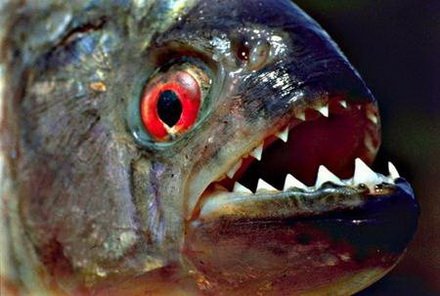
A very active fish with a schooling lifestyle. When keeping them in a school, fish of the same size should be selected, otherwise smaller specimens will eventually be eaten. Also, keeping these fish together with any other tank mates is not recommended. If a fish is injured, it becomes a target and will be eaten by other fish. The lower jaw is equipped with large sharp teeth, with which the fish can literally carve out large pieces of meat like a knife. The upper jaw is “armed” with equally sharp, but smaller teeth. Sharp teeth on powerful jaws are arranged in a single row and have cutting edges.
Schools of piranhas attack not only large fish, but also large mammals and humans. They instantly snap out chunks of meat like curved scissors from an animal that has fallen into the water, and the smell of blood attracts new hordes of insatiable predators. Young specimens gathered in a school are especially good—juveniles are very active and stay in sight most of the time. Adult piranhas are distinguished by solid behavior—most of the time they stay in a chosen spot, sometimes hiding in shelters, behind driftwood, or in thickets. Very often, when fish are introduced into a new aquarium, they hide in its corners, but after acclimatization they become less timid and swim all over the area.
The fish are large, and accordingly, they need a large aquarium. A pair of piranhas requires an aquarium with a volume of 250 liters or more. In small volumes, the fish are aggressive toward each other and other large fish. Coarse gravel is best used as a substrate. It is decorated with artificial plants and driftwood. Undemanding regarding water parameters. Filtration, aeration, and weekly water changes are necessary. Lighting is diffused, dim. Juveniles grow quickly and reach a length of 2.5 cm in a month. Having reached a size of 1.5 to 2 cm, young fish attack each other, inflicting and receiving injuries.
It should be remembered that the fish must be kept fed at all times. Hungry fish are aggressive; attacking each other, they disfigure themselves or one of the rivals may simply be killed. Live and fresh-frozen fish serve as the best food for them. Beef meat, beef heart, poultry meat, and large earthworms are also suitable as food. Fish need to be well-fed so they do not feel hungry, otherwise they may mutilate and even beat each other to death. They learn to take food from tweezers. Do not even think about holding food with your fingers!
Be careful when transferring them. Do not grab a jumped-out piranha with your hands. Its teeth are so sharp that it can slice off a piece of meat in an instant. Its jaw is designed like a sharp saw, and its strength is such that the fish can bite through a finger-thick stick. Bites resemble a razor cut and heal poorly. Sexual maturity is reached at 1.5 years of age. Lifespan in aquarium conditions is about 10 years. dH up to 20°; pH 5.5-7.0; T 24-28°C.

— Piraya Piranha — Pygocentrus piraya [Cuvier, 1819]. Synonyms: Pygocentrus bidorsalis, piranha, piraya, Serrasalmus piraya. (English: Blacktail Piranha, Piraya Piranha, San Francisco Piranha). Guyana, Paraguay, Peru, Venezuela, São Francisco River in eastern Brazil. In captivity up to 40 cm. They have a high and steep forehead, a powerful lower jaw with very sharp teeth. Large eyes are silvery, with a dark diagonal band. In youth (up to 7-8 months of age) they are colored silver, with a slightly darker back, and fairly large blackish round spots scattered across the body.
The lower part of the head, chest, belly area, and the bases of the pectoral and anal fins vary from light yellow to dark red, and the large anal fin is carmine. A distinctive feature is the fact that the belly has red coloration up to the lateral line and even higher. In males, it is slightly pointed and noticeably concave. The caudal fin is gray with a black stripe at the base. When the body length of piranhas reaches 8 cm or more, the spots fade and disappear, the entire body of the fish becomes gray-silver, the anal fin also lightens, but during spawning it becomes bright again.
A predator; when the jaws close, the teeth of the upper jaw precisely fit between the teeth of the lower jaw, allowing the fish to slice pieces of skin and meat from the victim’s body like a razor. The head structure of a young specimen with small sharp teeth does not give a full picture of the danger, predatory nature, and gluttony of these fish. It is best to keep piranhas in a small school of 5-8 fish of the same size and age: with normal feeding, they treat each other quite well, but with mandatory observance of the intra-school hierarchy.
They also put their teeth to use, but only in self-defense; during netting, they often instantly bite a neat hole of decent size in the net. Up to one year of age, such a school can be kept in an aquarium with a volume of 100 liters. Substrate and shelters (driftwood, large plant bushes, artificial ones are acceptable) are highly desirable in the aquarium. Filtration, aeration, and weekly water changes are necessary. Lighting is diffused, dim. The fish are fed small pieces of meat and fish; they cope with the problem of food “preparation” themselves.
Live foods include fry and large aquarium fish (including sick and injured ones), tadpoles, and frogs. It is advisable to add plant-based foods to the diet, even if in small quantities. They mature at the age of 15-18 months at a length of about 20 cm. Spawning is paired and can take place in the same aquarium where the fish lived. The substrate is the aquarium substrate, in which the male makes a regular round-shaped depression up to 20 cm in diameter and 1-1.5 cm deep.
The male guards the clutch, turning into a watchman, circling over the nest, attacking anyone who approaches the eggs and later the fry. To avoid making him nervous, other fish should be removed before spawning. After the fry grow up, the paternal instinct fades, and the male joins the general school. To avoid cannibalism, starting from three weeks of age, juveniles must be sorted weekly. They live up to 10-12 years. T 25-30°C; dH 12-16°; pH around 7.
 Metynnis argenteus, Metynnis altidorsalis, Metynnis hypsauchen.
Piaractus brachypomus, Pristobrycon striolatus, Pygopristis denticulata. 


