



Order Cypriniformes
Family Balitoridae
Subfamily Balitorinae
Genus Pseudogastromyzon

— Chinese Hillstream Loach — Pseudogastromyzon cheni [Liang, 1942]. China, streams and rivers with fast currents and rocky bottoms. 5 cm. The body is mostly brown. Numerous dark brown spots and stripes unevenly distributed on the back, and smaller ones on the head and lower part. In adult males, the dorsal fin is edged with a bright red margin. The tail is relatively long, with a small caudal fin. Males have small white tubercles on the snout, which become more prominent during the spawning season. Males are slenderer than females, which are more rounded.
An aquarium with plenty of hiding places, smooth pebbles and boulders, dense vegetation, and floating plants is required. Large, flat stones in the aquarium are needed, upon which algae will develop under strong lighting, necessary for their life. Keep in a school of 3 or more individuals, do not keep with aggressive species. Several males can be kept together. Water is soft; they love strong water circulation and aeration. High oxygen content is a must. They reach sexual maturity at 6 months. For spawning, they dig a hole under a stone with powerful strokes of their tail. pH 6.5-7.5; dH 5-9°; T 20-24°C.


— Fang’s Hillstream Loach — Pseudogastromyzon fangi [Nichols, 1931]. Synonym: Crossostoma fangi. China. 9 cm. Has a beautiful yellow coloration. Its spots are smaller and there is no red margin on the fin. An aquarium with plenty of hiding places, smooth pebbles and boulders, dense vegetation, and floating plants is required. Do not keep with aggressive species. Substrate of fine gravel or sand without sharp edges. They love strong water circulation, aeration, and regular water changes. They are almost constantly in water motion. High oxygen content and low temperature are required. pH 7.0-8.0; dH 2-12°; T 20-24°C.

— Chinese Zebra Loach — Pseudogastromyzon fasciatus [Sauvage, 1878]. Synonym: Psilorhynchus fasciatus. (Chinese Zebra Sucker, Zebra Hillstream Loach). China, living in cool, fast-flowing streams. 9 cm. Its body shape, mouth, and fins are designed to help it cling to rocks in fast-flowing waters. The body is naked, without scales.
Body coloration ranges from light golden to brownish tones, with small dark spots behind the head up to the pectoral fins, followed by dark, fairly evenly spaced stripes along the entire body, ending with spots on the tail. The yellowish dorsal fin is large and resembles a sail when raised, featuring a wide dark band. The caudal fin has 2-3 wide, oblique dark bands, giving it a checkered appearance.
They are peaceful and should be kept in a group of 3 or more individuals with non-aggressive species. An aquarium with strong lighting to promote algae growth, good water movement, and regular water changes. Moderate amount of plants, but leave a large open swimming area. Provide a sufficient number of hiding places and caves made of round stones and driftwood.
Substrate of fine gravel or sand without sharp edges. This species tends to dig in the substrate for food more than most species of the genus. Water should be clean, soft or moderately hard, and slightly acidic. High oxygen content is a must. They accept all types of live food, pellets, tablets, flakes, and algae. They live up to 7 years. dH 2-12°; pH 6.5-7.0; T 22-24°C.
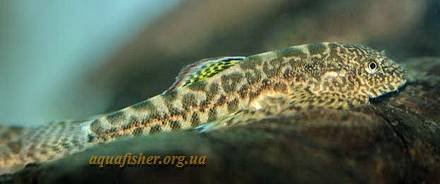
— Myer’s Hillstream Loach — Pseudogastromyzon myersi [Herre, 1932]. Synonym: Hemimyzon myersi. (Stone Sucker, Sucker Belly Loach). China, Hong Kong. 5 cm. The main body coloration ranges from brown to light brown, covered with tiny black spots. Some adult specimens have red rays in the dorsal fin. Males have a prominent tubercle on the snout. Very similar to P. cheni.
Active algae eater. Peaceful, unpretentious, constantly active, continuously grazing on algae and leftover food unclaimed by other aquarium inhabitants. Intraspecific territoriality can lead to minor disputes; to avoid this, provide enough hiding places. The challenge lies in replicating the conditions of its natural biotope. Its entire belly forms one large sucker. This means it lives in a very strong current where it must cling as tightly as possible.
Fresh water with a high redox potential and a very strong current created by powerful water pumps are needed. High oxygen content is a must. Prefers brightly lit bodies of water with plenty of driftwood and live vegetation. Moves around the aquarium almost constantly. For spawning, they dig a hole under a stone with powerful tail strikes. Fry reach a length of 2.5 cm by 4 months. pH 6.5-7.5; T 20-24°C.
 Sewellia breviventralis, Sewellia lineolata, Sewellia sp. Spotted.
Homaloptera confuzona, orthogoniata, tweediei, zollingeri. 


