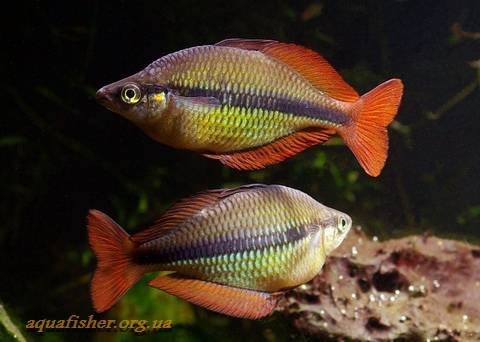
Order Atheriniformes ( Atheriniformes )
Family Melanotaeniidae ( Melanotaeniidae )
This family is restricted in distribution to the freshwaters of Australia, New Zealand, and New Guinea. A smaller portion of the family’s species inhabits the waters of Australia, while the majority reside in the rivers, streams, and lakes of New Guinea. Melanotaeniids are small, relatively high-bodied fishes with an elongated-oval, laterally compressed body, a long anal fin, and an oblique mouth. Small conical teeth are developed not only on their jaws but also on the outer surface of the lips.
There are two dorsal fins; the first is short and has spiny rays. The second dorsal and anal fins have a long base and border more than half of the body. The dorsal fins are separated by a narrow gap. The caudal fin is emarginate, and the anal fin is long. Sexual dimorphism in members of the family is clearly expressed in coloration, fin and body size. The body shape of melanotaeniids changes significantly as they grow.
Males are usually distinguished from females by brighter coloration and enlarged fins, and their bodies are deeper, especially in adult, mature males. In males, the folded anterior dorsal fin extends past the origin of the second dorsal fin. The rear edges of the dorsal and anal fins are usually more rounded in females, and may be slightly more elongated in males. All melanotaeniids are characterized by bright coloration. They mature at 8–12 months. They live 3–6 years.

Two populations are distinguished: the Australian — with a primarily silvery coloration, and the New Guinean — with an olive-brown coloration. Females are typically grayish-brown in tone. The coloration varies greatly among different members of the family, but most species are dominated by brownish and reddish tones with darker spots and stripes. A bright black stripe is almost always clearly visible along the side of the body (hence the name Melanotaeniidae — “black-banded”). When young, these fishes are quite nondescript, and the beauty inherent to the species reveals itself rather late — but lasts a long time.
The maximum size of melanotaeniids reaches 15 cm. All species of the family are schooling freshwater fishes living in lakes, ponds, and rivers, although a few are also found in brackish water. In Australia, members of this group, undoubtedly of marine origin, are known from water bodies located very far from sea coasts. The ranges of individual species are generally restricted to specific river systems and are quite small.
Peaceful, schooling, active fishes, they mostly stay in the upper water layer, look spectacular in schools of 6–8 specimens, are jumpy, like water movement, tolerate low oxygen poorly, and take food from the bottom reluctantly. Rainbowfishes are excellent jumpers, so the aquarium should be tightly covered. When keeping rainbowfishes, it is advisable to use external filters, as the water must be very clean, free of suspended particles, with a low content of nitrogen compounds. They prefer hard or medium-hard water with a slightly alkaline active reaction. Replace 25–30% of the volume with fresh water weekly. Rainbowfishes appreciate clean, oxygen-rich water, and a salinity of 2–5% if necessary.
They are kept in a school in spacious aquariums, moderately planted with vegetation and brightly lit; they do not disturb plants. They are great for a community aquarium with not very aggressive tank mates. Ideally suited for co-habitation in the company of medium-sized Malawian and Tanganyika cichlids, calming them down with their schooling behavior. In a community aquarium, it is best to keep *Melanotaenia* with related medium-sized species, barbs, large danios, *Epalzeorhynchos*, *Aplocheilus*, and livebearers. Great for a community aquarium with not very aggressive neighbors.
Ideally suited for co-habitation with medium-sized Malawian and Tanganyika cichlids, calming them with their schooling behavior, as well as with livebearing toothcarps. Since the fish spend most of their time in the upper half of the aquarium volume, bottom-dwelling species should be considered. Any bottom fish can get along here — catfishes, gobies, loaches, *Pangio*, spiny eels, small non-aggressive *Lamprologus*, *Julidochromis*, and *Telmatochromis*. Bottom fish are also useful because they eat food that has fallen to the bottom. After all, rainbowfishes feed mainly in the water column or from the surface and are reluctant to go down to the bottom.

Rainbowfishes will eat any fish food you give them, but this does not mean that every food is good for them. A key element of this fish species’ health is that they must receive the food they eat in their natural habitat. The jaws of *Melanotaenia* are so densely covered with teeth in the front that there is no doubt about their diet — these fish consume a lot of filamentous algae. In the wild, rainbowfishes feed mainly on algae and small plants, and may also eat aquatic and terrestrial insects, tadpoles, crustaceans, and very small fish. Still, algae make up the bulk of their diet.
Even high-quality dry fish food is not quite the right choice for feeding these small fish because the composition of most dry foods is designed for omnivorous fish that eat more “meat-based” food rather than plant-based. Such a diet, rich in protein and lacking (or having a very low percentage of) plant fiber, puts rainbowfishes at risk of various health problems. A fish deprived of plant food, especially with a monotonous diet, will receive food unbalanced in amino acids, and this ends in health disorders, poor coloration, and exhaustion.
Many aquarists feed rainbowfishes a protein-rich diet because it increases their growth rate. However, it is worth noting that an accelerated growth rate does not indicate fish health. Most importantly, your fish should look healthy and happy, but this type of food actually creates a risk of health problems. In nature, rainbowfishes also feed on various insects, crustaceans, and even small fish. This means that a certain percentage of “meat” food is simply necessary for them. The portion of “meat” food in your rainbowfishes’ diet should be 35–40%. Fatty foods should be avoided. Monotonous, heavy feeding with bloodworms or tubifex causes toxicosis and dropsy. It is best to feed tubifex and bloodworms using a floating feeder.
Fish diseases are generally caused by stress and/or water pollution. This can lead to ulcers, the most common disease in rainbowfishes. Some fish die within a short time, others live for several months, but the disease usually ends fatally. They tolerate Ichthyophthiriasis (white spot disease) infestations very poorly, especially if treatment is not started immediately.

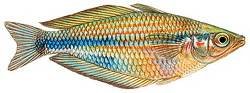
Genus Melanotaenia — Melanotaenia.
Synonym of the genus: *Nematocentrus*. Because of their iridescent coloration, they received another name — rainbowfishes. When calm, the fins of *Melanotaenia* are usually pressed against the body. The fish spread them out when hunting, during rapid changes in direction, during mating games, and when attacking competitors. Since they live in schools in their natural habitat, they should be kept in spacious aquariums with 6–8 individuals together. They treat each other peacefully. In a community aquarium, it is best to keep *Melanotaenia* with related medium-sized species, barbs, danios, *Lamprichthys*, and *Aplocheilus*.
Since the fish spend most of their time in the upper half of the aquarium volume, bottom stocking should be considered. Any bottom-dwelling fish can get along here — catfishes, gobies, spiny eels, small non-aggressive *Lamprologus* and *Telmatochromis*. Bottom fish are also useful because they eat food that has fallen to the bottom. After all, rainbowfishes feed mainly in the water column or from the surface and are reluctant to go down to the bottom. Unfortunately, “jet-propelled” *Melanotaenia* do not watch where they are going and often crash against the aquarium walls, cover glass, and rocks. In large aquariums, the fish grow larger than their wild counterparts, becoming very high-bodied and bright.
When keeping growing and adult rainbowfishes, it is advisable to use external filters, as the water must be very clean, free of suspended particles, with a low content of nitrogen compounds. The water must have one quality — contain as little protein breakdown products as possible, which poison *Melanotaenia*. Therefore, do not keep voracious livebearers with rainbowfishes, and replace 25% of the volume with fresh water weekly. *Melanotaenia* are unpretentious regarding chemical water parameters; any tap water with an active reaction close to neutral will do. The water should be moderately hard or, preferably, soft.
Rainbowfishes love dense vegetation in aquariums; there should be plant shelters at the ends and back wall, and swimming space in the front. Depending on the type of lamps used, the coloration of the same specimen will vary significantly. Rainbowfishes reach sexual maturity by the end of the year. Temperature 23–25°C. Adding table salt or sea salt to the water has a positive effect on the fish’s health. Ectoparasites brought into the aquarium with food often settle on the body of the fish. Sometimes ulcers and even tumors appear. You can increase the salinity of the water in the aquarium by adding sodium chloride (3-5 g/l) without harming the fish.

Also kept in aquariums: — Melanotaenia eachamensis [Allen & Cross, 1982] — Eacham Rainbowfish. 6–8 cm. The body of males is bronze-colored, the first dorsal fin is black, and the second dorsal and anal fins are dark maroon. Males differ from females in color saturation and the shape of the dorsal, anal, and pelvic fins. Males are brighter, with a higher body. The ends of the dorsal and anal fins are pointed and colored, whereas in females they are rounded and transparent; — Melanotaenia exquisita [Allen, 1978] — Exquisite Rainbowfish. 7 cm, female is smaller. Adult males are olive on the sides and silvery below. There is a pair of dark stripes running along the middle of the side with a red stripe below. A pair of dark zigzag stripes is located between the red stripe and the base of the anal fin. The dorsal, anal, and caudal fins are edged in red, often with small black spots. Geographic color variations: M. exquisita “Bindoola Creek”; M. exquisita “Edith River”; M. exquisita “Waterfall Creek”; — Melanotaenia iris [Allen, 1987] — Strickland Rainbowfish. 10 cm. Adult males are bluish in the upper half, with a bright blue middle stripe, as well as orange stripes between each row of scales. Pelvic fins are white, pectoral fins semi-transparent. Males are brighter, with a higher body, and the upper half of the body is bluish;
— Melanotaenia ogilbyi [Weber, 1910] — Ogilby’s Rainbowfish. New Guinea. 7 cm. Bluish on the sides and back, becoming whitish below. Each row of scales on the blue part of the body is separated by a narrow dark stripe. Fins are bluish; the front edge of the first dorsal fin, the outer part of the second dorsal fin, and the anal fin are dark in males. Geographic color variations: — M. ogilbyi “Timika” — Background color is bright yellow with red stripes, blue shimmering scales; — Melanotaenia pimaensis [Allen, 1981] — Pima River Rainbowfish. 6–9 cm. Olive to brown in the upper part, silvery-blue on the sides with narrow orange lines between each row of scales. Adults have a blackish spotted midline; — Melanotaenia pygmaea [Allen, 1978] — Pygmy Rainbowfish. Eastern Australia. 7 cm, females 5 cm. Males have a brilliant metallic azure shine, a blackish lateral stripe, and pale yellow fins. During the spawning period, males have a yellowish body color below the lateral line and bright red stripes from the dorsal fin to the upper lip, expanding toward the lower chest. Likes current;
— Melanotaenia rubripinnis [Allen & Renyaan, 1998]. — Red Finned Rainbowfish. 10 cm. Red body on the back and whitish on the lower half of the body, except for a blue spot above the anal fin. A black spotted stripe from the edge of the eye to the base of the tail, with a narrow blue stripe above and a wider yellow stripe below. Depending on habitat, they may have a brownish upper part with a black lateral stripe bordered above and below by narrow blue stripes. From mountain streams, they are of a uniform bluish color, with a white chest area and a black stripe between the eyes and pectoral fins. Dorsal, anal, and caudal fins are red-orange, the rest are colorless; — Melanotaenia utcheensis [McGuigan, 2001]. — Utchee Rainbowfish. Northern Australia. 6 cm. Has a distinctive color feature — bluish-black lateral band lines and orange edges on the scale rows. Geographic color variations: — M. utcheensis “Short Creek”;
 Melanotaenia affinis, angfa, arfakensis, australis.
Cairnsichthys rhombosomoides, Rhadinocentrus ornatus.