



CICHLIDS OF LAKE MALAWI.
Order Perciformes
Family Cichlidae
Subfamily Pseudocrenilabrinae
Genus Cheilochromis.

— Cheilochromis euchilus [Boulenger, 1908]. English: Malawi Thick Lip. Synonyms: Haplochromis, Chilochromis, Chilotilapia, Pseudohaplochromis euchilus. Lake Malawi. 22 cm, females up to 17 cm. Utaka group cichlids. A rather high body, slightly compressed laterally. A very spectacular cichlid with turned-out, seemingly swollen lips. It has unique thick lips.
Males have a dark blue, sometimes greenish coloration with a yellowish tint on the sides. The blue color extends to the head, the throat is iridescent green. Females are silvery-yellow or light beige with two black or brown horizontal stripes in the upper half of the body. Fins are usually light with faint spots. Adult and dominant males are distinguished by magnificent coloration.
An aquarium with a large number of stable hiding places. Keeps in the middle and lower water layers. Keep one male and 2-3 females. Plant sturdy hard-leaved plants. Aggressive and territorial. When kept in an aquarium, males behave quite actively and sometimes suppress even larger neighbors. Only due to aggressiveness, it is recommended to keep this species in aquariums of at least 600 liters.
It has a specific tooth structure, which it uses to crush snail shells. First, they study potential prey for a long and thorough time, then lightning-fast “shoot” their thick lips, sealing the opening of the rock substrate, and suck out the prey by creating a vacuum (negative pressure) inside the oral cavity. Thick, fleshy lips at this moment act as a “pneumohydraulic lock”. In aquarium maintenance, turned-out and fleshy lips lose their shapes and sizes, although they do not disappear completely, which is due to the absence of food specialization inherent in natural specimens and adaptability to new living conditions. The female incubates eggs in her mouth. pH 7.5-8.8; dH 10-25°; T 24-28°C.

Genus Chilotilapia.

— Chilotilapia rhoadesii [Boulenger, 1908]. English: Bream. Lake Malawi – sandy areas. Utaka group cichlids. 20-24 cm. Large, relatively high-bodied cichlids with a steep forehead and a wide, straight mouth. The melanin pattern consists of a dark horizontal stripe, and another stripe runs along the base of the dorsal fin. Males are colored in blue and green tones with yellow splashes, with 1-2 longitudinal blue stripes along the body and red-orange dots on the fins. In some males, the yellow color even turns out to be predominant at times.
The head and gills are metallic blue. Only dominant males have such coloration. Females are silvery-gray, sometimes with a yellow tint, with two horizontal black stripes and 8-10 transverse dashes. The same stripes also appear in dominant males or under stress conditions.
Intraspecific aggression is moderate. Males are territorial during the spawning period, and conflicts happen with any intruders, including cichlids of other species. It feeds mainly on mollusks; the structure of the teeth and jaws allows it to easily crack and open the shells of its victims. Any granulated and flake foods, seafood mince, and live snails can be used as food. Reproduces in captivity without any special problems. T 23-28°C; pH 7.5-8.6.
Genus Ctenopharynx.

— Ctenopharynx nitidus [Trewavas, 1935]. Synonym: Haplochromis nitidus. Lake Malawi. Male 16 cm, female 12 cm. Male is blue-yellow with a radiant yellow chest. Females and juveniles are beige with three large black spots on the body. During preparation for spawning and during the spawning period, the male is quite territorial and actively defends his spawning territory. Keep 1 male and 2 females. T 23-28°C; pH 7.8-8.5.

— Ctenopharynx pictus [Trewavas, 1935]. Synonyms: Cyrtocara picta, Haplochromis, Otopharynx pictus. Lake Malawi. 13 cm. Distinctive features of this cichlid species are: three fairly large spots on the sides and a far protruding mouth opening downwards. The oral cavity is enlarged, with the gill covers positioned relatively far from the mouth. Such a distance between the mouth and gill covers allows this cichlid to suck in only small and free-swimming invertebrates along with water, leaving actual sediment deposits lying on the bottom.
Cleans algae growth literally like a vacuum cleaner. Male is blue in the upper body and yellow in the lower. During spawning, the male puts on a light blue breeding outfit. Outside of spawning, they have three large dark spots on the sides. Females and juveniles are beige with three black dots. Territoriality is weak and directed only against males of its own species.
Genus Cyathochromis.
This species was placed in a separate genus because it differs from all other members of the Mbuna group by a special tooth structure, which are very long and take the shape of a spoon at the end.
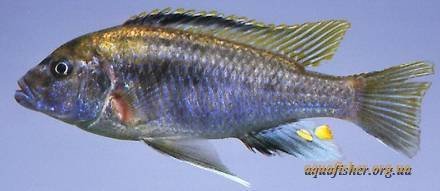
— Cyathochromis obliquidens [Trewavas, 1935]. Lake Malawi – southern part, transitional zone between rocky and sandy areas. 13-15 cm. Gray-green with a yellow throat. The coloration of obliquidens is very similar to the coloration of some species of the genus Tropheops, but the shape of their body, especially the head, as well as the shape and structure of the teeth contrast sufficiently. Males, depending on the population, can have different colorations containing blue and yellow colors. There is a bright black stripe on the dorsal fin, and the front edge of the anal fin is dark.
Juveniles and females are yellowish-gray, with a bright dark horizontal stripe extending onto the gill covers. Sometimes some individuals show a second horizontal stripe on the upper half of the body. Males are weakly territorial. Herbivorous, they feed on algal fouling and all kinds of creatures that can be found in it. Rather difficult to breed, the aquarium population is maintained only through wild specimens. pH 7.0-8.5; T 23-28°C.
 Champsochromis caeruleus, Champsochromis spilorhynchus.
Buccochromis lepturus, nototaenia, rhoadesii. 


