



Order Cyprinodontiformes
Suborder Cyprinodontoidei
Family Poeciliidae
Subfamily Poeciliinae
Genus Poecilia.
Guppy — Poecilia reticulata.
Continued…

There are 13 forms that differ from each other in the size and shape of the caudal fin. In addition, there are 8 types of basic coloration: gray, light, blue, golden, albino, silver, cream, white. Combining 13 forms and 8 types yields over a hundred combinations. But this is not the limit either. The dorsal fins of males have various forms. Taking into account all possible combinations of sizes, colors, dorsal and caudal fin shapes, a huge number of guppy types can eventually be obtained. Currently, classifying guppies is very difficult, as new breeds are continuously bred every year as a result of numerous crossings. The basis for classifying guppies is body coloration (mainly in males), sizes, shape, and color of the fins.
Scarlet; Albinos; White-head, Berlin; Sunrise; Dragon Head; Canadian; Red-head; Carnation; Wild types; Zebra; Snake Skin (Snakeskin); Snake Scale; Snake; Gold (Golden Tuxedo); Spanish; Spanish Snake; Canadian; Cobra; Carpet; Royal Cobra; Red-tailed, Yellow-tailed, etc.; Leopard; Metallic; Milky Way; Mosaic (Mosaik); Moscow Blue-Green; Moscow Blue; Moscow Malachite; Neon; Panda; Variegated (Variegated Gold); Platinum; Half-black Red, Half-black Yellow, etc.; Half-black, Half-red, etc.; Russian (Russian Red Cobra); Lace; Singapore; Tuxedo; Steel Skin; Glass; Dark-bodied; Tiger; Grass; Tuxedo; Veiltail; Filigree; Flamingo; Gypsy Skirt; Black Monk; Black Prince; Japanese Glass.

There are special international rules according to which individual varieties must be bred. They regulate fin shapes and coloration. Such selective forms include: roundtail, top sword, bottom sword, double sword, scissors-tail, pin-tail, spear-tail, spade-tail, lyretail, triangle, and flagtail. Various types of body coloration are also added to them. The most attractive traits of coloration and fin shape differ among various breed groups, and therefore the conditions under which they look most effective also differ. Gray (by background coloration) guppies are less demanding on maintenance conditions than light ones, and light ones are less demanding compared to albinos. Large-finned varieties are more demanding than short-finned and fork-tailed ones.
Evaluation criteria: •— An essential criterion of this standard and evaluation rules is the precise assessment of details, since guppy exhibits are primarily distinguished on the basis of the smallest details. •— The goal should be compliance with standard shapes in all aspects. •— Based on established body and fin shapes, as well as their size ratios, optimal proportions are sufficiently identified. •— First of all, evaluation begins with the corresponding description of the standard shape; in case of doubt, a drawing is used. •— The evaluation set consists of 3 males and 1 female of the breed group. •— Points are deducted for deviations from the standard.
Body: •— The body is the main and starting point for evaluating various other criteria. •— All other lengths and sizes are evaluated solely taking into account their ratio to the length and height of the body. •— Body length L is measured from the tip of the head to the base of the caudal fin. •— The shape must be strong and flexible according to the type. •— Body height H is measured at the highest point of the body and should be ¼ of the length L. •— If the body shape does not meet the standard requirements, marks are lowered. •— The maximum deduction for non-compliance of the body shape with standard requirements should not exceed 8 points. •— In the presence of pathological changes such as a curved back, humpback, tumors, emaciation, spinal curvature – the fish is disqualified. •— Coloration is of immense importance. Coloration refers to the color and pattern of the guppy’s surface cover. Up to 36 points are awarded for body and fin color. Color and pattern are evaluated as a whole. •— Paint/pattern quality – a harmonious combination of all colors, in which intense (bright) and pastel colors must be sufficiently saturated and clearly demarcated, or, accordingly, the pattern must be integral and harmonize with the color.
Score deductions for tail coloration assessment: — Color covers 100% of the surface – no points deducted. — Color covers 75% of the surface – 6 points deducted. — Color covers 50% of the surface – 9 points deducted. — Color covers 25% of the surface – 12 points deducted. — Color covers 0% of the surface – 14 points deducted. — Insufficient color/pattern quality – up to 6 points deducted. — The total number of deducted points must not exceed 14.
Body shape defects: •— Coarseness (clunkiness), the fish does not look graceful, appears clumsy. •— Caudal peduncle too thin. •— Back round. •— Body too thin. •— Severe bend. •— Bump behind the eyes. •— Flat head.
Large-tailed breeds: Body length L of large-tailed breeds is evaluated as follows: — 26 mm – 8 points. — 24 mm – 6 points. — 22 mm – 3 points. — 20 mm – 1 point. — For a size less than 20 mm, no points are added. — For a size greater than 26 mm, up to 3 points are deducted.
Medium-tailed breeds: Body length L of medium-tailed breeds is evaluated as follows: — 25 mm – 8 points. — 23 mm – 6 points. — 21 mm – 3 points. — 19 mm – 1 point. — For a size less than 19 mm, no points are added. — For a size greater than 25 mm, up to 3 points are deducted.
Short-tailed breeds: Body length L of short-tailed breeds is evaluated as follows: — 24 mm – 8 points. — 22 mm – 6 points. — 20 mm – 3 points. — 18 mm – 1 point. — For a size less than 18 mm, no points are added. — For a size greater than 24 mm, up to 3 points are deducted.
As a result of domestication, its heredity, appearance, and living condition requirements have changed to one degree or another. The most attractive traits of coloration and fin shape differ among various breed groups, and therefore the conditions under which they look most effective also differ. The variety of fish coloration is unusually high. Even the fin shape in individual local breeds varies. Males from Venezuela are dominated by green coloration. Individuals from Barbados exhibit various shades of red up to violet. Fish from Trinidad have sharply demarcated yellow, green, and blue coloration. Guppies living in the wild in Florida are characterized by copper coloration, while African breeds feature a smooth rainbow-like transition between colors.
The line from the snout tip to the dorsal fin origin should be straight or very softly rounded, smoothly transitioning to the belly, and then following straight from this curvature to the end of the caudal peduncle. The caudal peduncle should have upper and lower edges as parallel as possible. The fish must have a straight body and control its body movements relative to the bottom and water column of the aquarium. Pectoral fins must be identical in shape and at least reach the origin of the dorsal fin. Ventral and anal fins (gonopodium) must have thick thread-like extensions of arched or straight shape, undamaged, unbroken, or crooked. The ventral fin must reach the caudal fin, and the anal fin (gonopodium) must reach the rear edge of the caudal fin.

Veiltail guppies. Veiltail guppies include all breeds with a pronounced large caudal finnage. By tail shape, they are divided into train, skirt, fork-tailed (pointed and blunt-ended), flagtail, and ribbon-tailed. Veiltail guppies with caudal finnage shaped like an open fan are called fantails. The caudal finnage of veiltail guppies must be delicate and flexible. Its length in all breeds must equal the body length, while its width should resemble a wide flared trumpet in fork-tailed and skirt varieties, and a wide paddle (shield) in train varieties. The tail contour and rear line should preferably be trimmed, meaning without notches or fingers. The dorsal fin in veiltail guppies can be either short, with its tip reaching the beginning of the caudal fin, or long and pointed (Robson type). The caudal fin of ribbon-tailed guppies is round, carrying a long, wide, blunt ribbon attached to the lower part of the fin and directed downwards. Males with two or three ribbons are occasionally found.

The coloration of veiltail guppies, except for ribbon-tailed ones, is very diverse. Delicate pastel body colors from dark green and light blue to carmine red, crimson, orange, and bright yellow are frequent here. Fins and tail shield are saturated with black, blue, and light blue pigment. Silver or blood-red spots are often sprinkled. Carpet coloration with ornamentation occurs. Ribbon-tailed guppies are colored differently. Their tail shield is colorless, transverse stripes are located on the pre-tail area, and the main stroke of the pre-tail area is pink. Pink pigment in the form of spots is also present on the ribbon. Overpopulation and fighting lead to tears and damage of the caudal finnage in veiltail guppies. Veiltail guppies should be fed two or three times a day in small portions and only with live foods.
Variegated Tail Patterns.

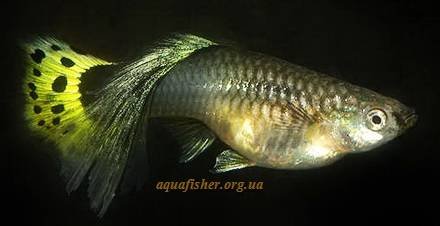
The color pattern on the caudal fin of domesticated guppy breeds can have various appearances: solid bright coloration, a reticulated pattern resembling snake skin (“cobra”), as well as multicolored mosaic patterns of two or more colors. The term “variegated” is usually used for guppies with a variegated mosaic pattern of black speckles and ovals of various shapes and sizes on light fins. Naturally, several males or females from a brood, and sometimes fish from different breeders, share similar patterns. The gene responsible for variegated coloration (Var gene) is absent in wild guppy breeds.
 Classification of selective guppies.
Rules for keeping purebred guppies. 


