



Order Cyprinodontiformes
Family Anablepidae
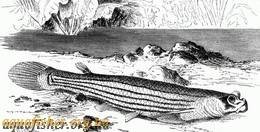
The typical habitat of foureyes is in the mouths of Mexican rivers, the lagoons of Central America, as well as in the coastal waters of the South American mainland, in shallow water, in areas of tides. Their name is taken from the Spanish language, from Central American countries where these fish live (Cuatro ojos). All foureyes are large (25 cm) fish living near the water surface. Only large tanks are suitable for them, which is why we see them so often in public aquariums. Of course, they do not have four eyes.
They got their name due to the special structure of the eyes, divided by an epithelial septum into two parts — upper and lower, with one part able to be seen above the water surface and the other below it. Both parts of the fish’s eye have their own focal length. This means these fish are able to monitor processes in both environments. The fish swims near the water surface in such a position that only the upper “halves” of the eyes protrude outward, while the lower ones remain in the water.

When a foureyes stays in one place, it constantly moves its head up and down so that the upper part of the eye is constantly moistened, since the “upper” eye has no eyelid and is not protected from dust and drying out. This very advantageous ability allows them to look for food and notice danger in time.
When schools of these fish head to the shore during low tide, dozens and hundreds of convex eyes stick out on the water surface, inspecting the surroundings like periscopes. Foureyes are livebearing fish. They are low-fecundity and carry only a few fry — from one to five. The female gives birth a maximum of twice a year. The fry, however, are born large — from 3 to 6 cm.

Keeping them is relatively simple. They need warm (25-28°C), brackish water, and the air around the aquarium must be very humid. Foureyes need aquariums that are not very deep, but with a large surface area, and arranged so that they can be viewed from above. Since these fish are excellent jumpers (when frightened or hunting flies, they jump up to a meter high), the aquarium must be securely covered.
They like a sandy or pebble “beach”, as the fish like to partially crawl out of the water and rest on it. A good filtration system is required. Foureyes eat high-protein food, and the filtration system is designed to effectively remove their waste. It is advisable to have a powerful external filter, the pipes of which could become part of the aquarium interior — for example, you can arrange a waterfall on the stones of the “beach” from them.

Remove all sharp objects from the aquarium so the fish do not injure their eyes. If you decorate the aquarium with stones, use rounded boulders, and if you want to put pieces of wood on the bottom, check their edges for sharp protrusions and knots. Salt-tolerant plants can be used for aquascaping, but make sure there is plenty of open space on the water surface.
Although foureyes are insectivores in nature, feeding them in captivity is easy as they take frozen bloodworms, as well as chopped mussels, shrimp, meat, and fish. If the fish refuse one type of food, try something else, but be sure to diversify their diet, and if you can feed them live food, nothing could be better. Some specimens also take flake and sometimes tablet food.

 Identification: Identification: Genus Anableps — Anableps.
Subfamily ( Anablepinae )
Genus Anableps — Anableps
This species has five horizontal stripes on its body, which are more or less visible depending on the fish’s condition. Keeping them in a terrarium with a low water level and free space above the surface is preferable. They should be kept in a group of at least 5-6 conspecifics. Species allow distinguishing the scale count from the center of the lateral line — Anableps anableps (11), Anableps dovii (14-15), and Anableps microlepis (17-18).

— Four-eyes fish, Largescale Foureyes Fish, Striped Foureyed Fish — Anableps anableps [Linnaeus, 1758]. Synonyms: Anableps gronovii, lineatus, surinamensis, tetrophthalmus, Cobitis anableps. Rivers and lagoons from southern Mexico to northern South America, Venezuela, Brazil. Inhabits mainly brackish water and very rarely visits marine or fresh waters. Males up to 17 cm, females up to 25 cm. The body is long and cylindrical, resembling a pike’s body, with flatly protruding eyes above the head.
The color of the outer integument is light, almost white or grayish tones. Usually, five dark brown or black-green long stripes are clearly visible along the body, the first and last are less distinct and may have breaks along their entire length. A narrow light stripe runs along the back, branching at the nape and ending near the eyes. Large eyes protrude above the head. The iris of the eyes is slightly golden. Young males and females look identical. Adult females are about twice as large as males.

They usually swim near the water surface in such a way that the water line coincides with the stripe dividing the eye, with the upper half of the eyes protruding from it. It can see simultaneously what is happening above water and what is happening underwater. In natural conditions, they make quite large jumps above the water surface. Best kept in groups of 6 or more. Peaceful fish, but consider small fish as dinner. The top of the aquarium must be covered with a 6 mm thick glass cover, as the fish can easily jump out of the aquarium.
In natural conditions, during hunting, the foureyes jumps out of the water up to 1 meter high. Water layer 25-30 cm, moderate lighting. The water should be alkaline and moderately hard, salted with 2.5-3% salt. The main food is insects flying near the water surface, but it does not refuse traditional aquarium foods and small fish.
If you throw tubifex or bloodworms into the aquarium, the foureyes rush down with strong undulating body movements and then rush back to the surface. But even with abundant feeding on tubifex, they prefer to pick midges from the surface, despite their small size. They do not eat house flies floating on the surface. But if flies fly above the water, the fish watch them closely and sometimes even jump out of the water.
They take frozen bloodworms, as well as chopped mussels, shrimp, meat, and fish. They are constantly hungry, and if we do not provide them with a large amount of protein-rich foods, spinal deformation usually develops and they grow slowly. Sexual maturity in fish occurs at two years. Foureyes are livebearing fish with internal fertilization. But they carry only a few fry — from 1 to 5, and the length of the born fry is inversely proportional to their number, ranging from 2 to 5 cm respectively. Pregnancy lasts about 3 months. Darkening of coloration indicates poor health. They are also susceptible to bacterial skin infections that are difficult to treat. dH 8-20°; pH 7.5-8.5; T 24-28°C.


— Pacific foureyed fish — Anableps dowei [Gill 1861]. Synonym: Anableps dowi. From Mexico to Nicaragua. Usually this species is found in brackish water. Males 22 cm, females up to 34 cm. Has an elongated body. The broad, seemingly truncated head of the fish ends with a transversely positioned mouth with thick lips. The fish is greenish-brown in color, the back is slightly darker, the belly is lighter. A white, yellow, or golden stripe runs along the body.

Keeping them is quite difficult. A large horizontal-type aquarium is required. They can live in seawater, therefore adding salt is recommended. They swim almost always near the surface, so the upper part of the eyes constantly sticks out of the water. If you observe the fish for some time, you can notice that it dips its eyes into the water for a moment every now and then. This happens because it does not have a lacrimal gland like terrestrial animals. The structure of the eyes in this fish is very peculiar. They are divided in the middle by a dark strip of skin into two halves, each of which has a pupil.
The fish swims so that the water surface falls right in the middle of the eye, in the area of the dark leathery strip. Using the upper part of the eye, it surveys the entire above-water world, while the lower part of the eye examines the underwater environment. Not only the cornea of the eye is divided lengthwise, but also the fundus formed by the retina. The image of the above-water space is transmitted to the lower retina, and the image of objects underwater to the upper retina. But light refraction in air and water is different, so the lens of the upper part of the eye is thinner, and the lower one is thicker. Thus, it is achieved that the image in both parts of the eye is projected onto the retina with equal sharpness.
Food — earthworms, grasshoppers, plant food is mandatory. Fry are born large — up to 5 cm, but more often around 2.5 cm; the probability of survival is higher in larger ones than in smaller ones. Right from birth, fry can eat insect larvae and grow quickly if fed well and part of the water is changed regularly. T 23-27°C.

— Anableps microlepis — Anableps microlepis [Muller & Troschel 1844]. Synonym: Anableps coarctatus, elongatus. Central and South America: from Trinidad and Venezuela to the Amazon delta in Brazil. This fish prefers marine biotopes and very rarely appears in brackish waters. The species feeds on insects. Males 24 cm, females 32 cm. Unlike A. anableps, 2-3 often poorly noticeable brown stripes run along the body. Between the inner stripes, the integument is colored with a clearly noticeable yellow pigment.
A large, low, brackish-water aquarium is required. Food — of plant and animal origin, algae, and insects. They mature at 8 months. The female’s pregnancy lasts 8 weeks. Fry up to 6 cm long, grow quickly. T 24-28°C; pH 7.0-8.5; dH 10-20°.
 Jenynsia lineate, Jenynsia onca, Oxyzygonectes dovii.
Xenotoca eiseni, Xenotoca melanosoma, Xenotoca variata. 


