Order Cyprinodontiformes
Superfamily Egg-laying toothcarps ( Cyprinodontoidae )
Family Nothobranchiidae
Continued…
Genus Fundulopanchax. Fp.

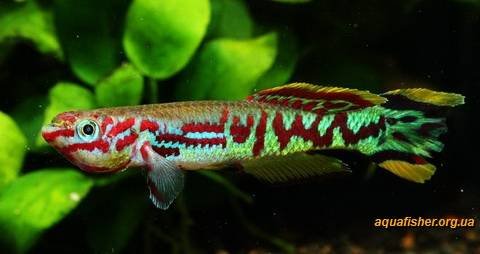
— Fundulopanchax scheeli [Radda, 1970] — Fundulopanchax scheeli. Code: SCE. Synonym: Aphyosemion scheeli. (Eng. Scheel’s Lyretail). Southeastern Nigeria in small streams of tropical humid coastal forests and small savanna water bodies. 5 cm, female is smaller. A characteristic feature of the coloration is a yellow border along the edges of all lower parts of the fins, including the pectoral fins. The male’s body color is pale green, the back is darker with a turquoise sheen. Red spots are scattered all over the body.
The dorsal fin is yellowish-green with red spots at the base. The caudal fin is decorated with blue and green patterns with red inclusions; the upper and lower rays, often elongated in adult males, are bordered with yellow stripes. The anal fin is lemon-colored with red spots at the base. Individuals with red stripes on the anal fin are found. Females are pale brown with red dots on the front part of the body. Subspecies — F. scheeli akamkpaense differs by a greenish body coloration.
Belongs to one of the easiest-to-care-for killifish species, and therefore is recommended for keeping by beginner aquarists as well. Older males can become somewhat quarrelsome. The main condition for keeping is the presence of shelters made of driftwood, pieces of peat, and plants, where dominant males usually stay. Keep 2-4 females per 1 male. The water temperature during keeping should not be higher than 23°C; at higher temperatures, the lifespan and fertility of the fish decrease. It is better to soften the water to a hardness of 6-10° and acidify to pH 6.5.
The fish most eagerly eat insects and their larvae, daphnia, and take tubifex much worse. Having seen prey, A. scheeli approaches it in a few jerks, waits for some time until the victim shows signs of life, then grabs it. Spawns on a layer of peat or on plants. Fry grow fast and reach sexual maturity by 4-5 months. They live up to 2 years in the aquarium, but stop breeding at 11-12 months. pH 6-7.5; dH 4-12°; T 20-23°C.

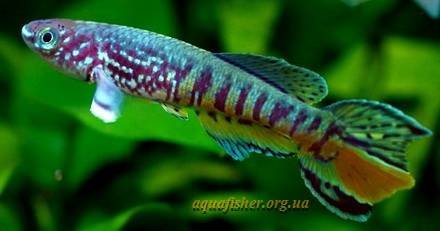
— Fundulopanchax sjoestedti [Lonnberg, 1895] — Blue Gularis, Golden Pheasant, Dwarf Red. Code: SJO. Synonym: Aphyosemion sjoestedti, zimmeri; Aphyosemion, Fundulopanchax coeruleum; Fundulus sjoestedti, gularis, zimmeri. (Eng. Blue Gularis, Golden Pheasant, Dwarf Red). The largest representative of the genus Fundulopanchax. Inhabits temporarily drying and permanent water bodies of the coastal part of western Nigeria, the Niger River delta, and water bodies located west of Cameroon (Western Africa). The length of an adult male can reach 12 cm, females 5-8 cm. Semi-annual species.
The fish are highly variable in both coloration and body shape. Even among the most colorful relatives, they stand out with unusually lush fins and exceptional richness of coloration. The body is chunky, elongated, mouth superior. The caudal fin is trident-shaped, with veil-like extensions. The dorsal fin is located strictly above the anal fin. Currently, there is a great variety of color morphs. The back in males is reddish-brown, the belly is pinkish.
The bluish-green sheen of the flanks is especially effective under front-top lighting or direct sunlight. The eyes and lower lip glow blue, the gill covers are bordered with a dark blue stripe. Apparently, this is why the fish is often called the blue pheasant. Contrasting red dots are scattered across the head and body, and white dots on the front part. Starting from the middle of the body to the base of the caudal fin, distinct vertical reddish-brick stripes are visible, forming an intricate pattern on the front part of the trunk and head.

The caudal fin in an adult male resembles a trident; its upper part is blue with red strokes and dots, the lower part is orange. Some varieties have a bluish-blue edging of the outer edges of the caudal fin, which is narrower at the top. The anal fin is yellow with bluish spots, about half the length of the border is also bluish-blue, the front rays are elongated. The dorsal fin is blue with many small dark red dots.
Pectoral fins are transparent, with orange tips. Ventral fins are yellow-green with a blue tint at the base and with a red or blue border along the edge. Females are brownish with barely noticeable brown stripes, smaller and paler than males, and have rounded fins. Her fins have a bluish tint. Small reddish-brown dots are scattered over her body and fins. There is a variety with orange coloration.
After some time of keeping in captivity, a certain hierarchy is established, mainly among males. The fish swim up to each other while spreading their fins to the maximum and circling around one another. In addition, they flare their gill covers and push out the branchiostegal membranes, mouth open. Such behavior is aimed at demonstrating the maximum body size.
Males, if there are few of them (2-3 individuals), often compete with each other for females, so it is better to keep a group of one male and two to three females in a small aquarium. In large reservoirs, keeping three or more males is possible. Fortunately, aggression is directed only against their own kind: males get along quite well with neighbors of other species, even smaller ones. Fish swim at all levels.
A distinctive feature of males is their extraordinary mobility and temperament. Males court females all the time. Therefore, harassed females urgently need shelters between plants, driftwood, or stones. Aquarium with thickets of fine-leaved plants, including floating ones, creating shade. Lighting is diffused, moderately bright. Shaded areas need to be created.
Fine dark sand mixed with boiled peat chips is used as substrate. The water should be old, peated, slightly acidic, temperature (optimal) 20-24°C. When kept at a higher temperature, they feel worse, and the lifespan of the fish is shortened. In alkaline and hard water, the fish weakens. 1 teaspoon of rock salt is added to the water for every 10-15 liters. Changing 20% of the water volume twice a month has a positive effect on the condition of the fish.
They prefer live and frozen food; dry food is eaten very rarely and with great reluctance. Sexual maturity at 3-6 months. Eggs are laid mainly on the substrate, so lay peat on the bottom in places. These fish bury eggs in the substrate with a sharp blow of the caudal fin. By three weeks, the fry grow up to 2 cm, coloring closer to the second month of life. Lifespan up to 2 years. pH 7, dH 4-7°.

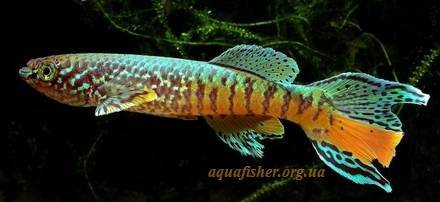
— Fundulopanchax walkeri [Boulenger, 1911] — Fundulopanchax walkeri. Code: WAL. Synonym: Aphyosemion rubrostriatum, spurelli, fallax, walkeri; Fundulus walkeri, rubrostriatus; Fundulopanchax spurrelli. (Eng. Walker’s Killi). Africa, Ghana, Western Togo. Inhabits open biotopes. The body is elongated, up to 7 cm. A species with many different color variations.
Along the cigar-shaped yellowish-green body with a blue sheen run 4-6 stripes of red-brown or brownish-purple dots; on the head and gill cover, the stripes are longitudinal. The length of the stripes increases from bottom to top. Brown color predominates in the dorsal part, the belly is almost white. Pectoral fins are fan-shaped, ventral fins are very small.
The coloration of all fins, except the ventral ones, is very saturated and represents a contrast alternation of burgundy, yellow-orange, and turquoise stripes. The caudal fin is lyre-shaped, its upper and lower edges are yellow with a red border, in the center are red-brown spots; the dorsal and anal fins are yellow with red-brown spots and borders. The outer rays of the caudal fin in the male are somewhat elongated.
The main body color of females is gray-brown. Fins are gray with barely noticeable reddish dots. Males are larger than females, brightly colored. The coloration of males is most intense at two months of age. At this time, the fins are fiery in color, later they turn yellow. The overall intensity of coloration depends on the conditions in which the fish are kept. In cool water, they become sluggish and pale. The female is paler, gray-brown. Fins are rounded, gray with faint reddish specks. The same specks are present on the body. Subspecies: — F. walkeri spurelli (Code: SPU).

Predatory schooling fish. If several pairs are kept in the aquarium, males strive to capture territory and defend it from opponents. After some time of keeping in captivity, a certain hierarchy is established, mainly among males. The fish swim up to each other while spreading their fins to the maximum and circling around one another. In addition, they flare their gill covers and push out the branchiostegal membranes, mouth open. Such behavior is aimed at demonstrating maximum body size. True, internal warfare is not conducted so aggressively, and the fish do not inflict serious damage on each other.
A large capacity of the aquarium and an abundance of planted plants, including floating ones, help to smooth out the situation somewhat. Do not house with overly small fish, as they are often devoured. Keep in species and general aquariums with good vegetation and plenty of swimming space. They stay at the upper level; place floating plants on the water surface – a natural twilight is created in the reservoir, in which the fish feel better. They like to hide in thick thickets.
Their males are aggressive towards females, so shelters are necessary for the latter. The water is soft, slightly acidic, peated, light amber in color; adding a small amount of table or sea salt for prophylactic purposes is permissible. This species loses the multicoloring of its coloration in overly warm water, which leads to a shortened lifespan of the fish. In the aquarium, they can be given tubifex, cyclops, live daphnia. Fine dark sand mixed with boiled peat chips is used as substrate. In captivity, fish accept all types of live food, including quality dried foods. They mature at 2 months. Reproduction is not difficult. Spawns in peat. Keeping at a temperature of 22-25°C, pH 7, dH 4-7°.

 Identification: Genus Fundulopanchax — Fundulopanchax scheeli, sjoestedti, walkeri.
 Nothobranchius albimarginatus, Nothobranchius annectens.
Fundulopanchax gardneri, Fundulopanchax gularis, Fundulopanchax robertsoni.