


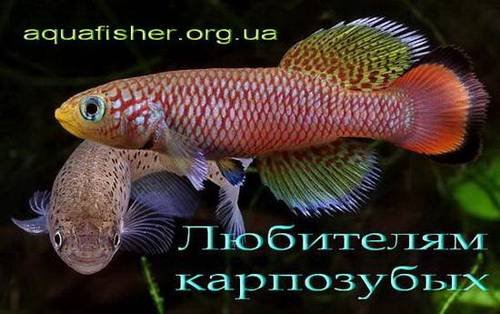
Order Cyprinodontiformes
Superfamily Cyprinodontoidae
Family Nothobranchiidae
Genus Epiplatys. African Pikes — Epiplatys. Epi.
Distributed in stagnant and slow-flowing waters of the western and central parts of the African continent. They inhabit streams and small bodies of water in tropical rainforests and savannas of the river basins of the Atlantic coast of Africa, up to the upper reaches of the Nile River. In nature, they inhabit the surface layers of water, and descend downwards extremely rarely, usually in moments of danger. Their body shape and predatory habits make them resemble a small pike, which is why aquarists call them African pikes.
The body is strongly elongated in length. One of the most striking differences of fish of this genus, in addition to closely related genera, is the flat back. The head, like all fish swimming under the water surface, is strongly flattened and forms a single line with the front part of the back. Also characteristic of them are the dorsal and anal fins strongly shifted towards the tail, while the dorsal fin is greatly shortened.
The large mouth is directed upwards. Natural food sources include insects flying over the water surface, which the fish skillfully jump for to a considerable height. In their homeland, fish stalk prey, hiding among thickets of floating plants. To attract insects, Epiplatys have a large shiny scale on their head.
Mostly, Epiplatys are colored inconspicuously, but very elegantly. The coloration among representatives of the genus is very diverse, but there are frequently recurring motifs, such as transverse or longitudinal stripes. It must be admitted that the fish look most ornate under side lighting, while under top lighting most of their beauty is not visible. Males are smaller, but brighter than females.
Maintenance in an aquarium for most species is not difficult. In nature, they inhabit water bodies with fairly soft, slightly acidic water containing dissolved organic matter, but in captivity they easily adapt to ordinary tap water. Hardness is of little importance, and pH is desirable to maintain at 6.7-7.0. Fish tolerate water with an alkaline reaction poorly. They also do not like fresh water, in which their immunity weakens.
It is advisable to keep them in water that has stood for a long time in an aquarium with live plants, but not very rich in organic matter. Strong current has a depressing effect. The aquarium should be low with a large water surface and tightly closed with glass, as the fish can jump out even into a very small gap. In any case, it is necessary to have plenty of floating plants on the water surface in the aquarium.
Suitable for keeping in a general aquarium with the correct selection of neighbors, which should be of the same size. They can be kept together with small characins and cyprinids. If kept with active fish species, such as many barbs, they hide in plants or a corner of the aquarium and often do not come out even at feeding time.
Spawning can occur in a general aquarium, but is preferable in a spawning tank with floating plants and thickets in which the female hides from the male’s pursuit. Most Epiplatys species are best bred in soft, acidic water. Females spawn eggs on plants floating near the water surface. Under suitable conditions, they easily reproduce in the general aquarium. Fry grow well and escape from adult fish in floating plants (Riccia).
There should be more females than males, as the latter chase them zealously. Undemanding regarding food, they readily eat any live foods, especially small insects. In aquarium conditions, they can also be trained to frozen foods. They get used to dry foods with difficulty, only after a few days of starvation, and eat them reluctantly. Epiplatys are resistant to diseases and, under good maintenance conditions, get sick extremely rarely. Treatment is easy, as the fish tolerate temperature increases up to 30°C well, as well as standard therapeutic doses of medications. They live for 2-4 years.
Epiplatys are divided into several related groups, named after the most characteristic species:
— Bifasciatus group: E. bartoiensis, E. biafranus, E. bifasciatus, E. lokoensis, and E. matlocki;
— Chaperi group: E. chaperi, E. ch. schreiberi, E. ch. sheljuzhkoi, E. ch. spilImanni, E. dageti, E. d. monroviae, and E. etzeli;
— Chevalieri group: E. chevalieri and E. ch. nigricans;
— Multifasciatus group: E. berkenkampi, E. boulengeri, E. huberi, E. mesogramma, E. multifasciatus, and E. phoeniceps;
— Sexfasciatus group: E. esekanus, E. longiventralis, E. sexfasciatus, E. s. baroi, E. s. rathkei, and E. s. togolensis;
— Singa group: E. grahami, E. sangmelinensis, and E. singa;
— Spilargyreius-Fasciolatus group: E. azureus, E. coccinatus, E. fasciolatus, E. f. tototaensis, E. hildegardae, E. josianae, E. lamottei, E. njalaensis, E. olbrechtsi, E. o. kassiapleuensis, E. roloffi, E. ruhkopfi, E. spilargyreius, and E. zimiensis.

— Epiplatys barmoiensis [Scheel, 1968] — Barmoi Epiplatys. Code: BAR. Synonym: Epiplatys bifasciatus, matlocki; Aplocheilus barmoiensis. Sierra Leone, Guinea. 7 cm. Rather modest, somewhat timid species. Compatible and peaceful with calm fish of equal size. Likes large, well-planted aquariums with free swimming areas. Stays under the water surface. Extremely jumpy. In case of danger, it can make a jump of a meter distance. A tight cover glass is important. Mature at the age of about 8-9 months. Water: temperature 23-25°C; pH 6.0-7.5; dH 4-12°.

— Epiplatys bifasciatus bifasciatus [Steindachner, 1881] — Twoband Killi. Code: BIF. Synonyms: Aplocheilus, Haplochilus, Panchax bifasciatus; Aplocheilus, Epiplatys ndelensis; Aplocheilus, Epiplatys, Panchax steindachneri; Aplocheilus, Epiplatys, Panchax taeniatus. From Senegal to Sudan, areas around the Senegal, Niger, Volta, Nile rivers and Lake Chad, mostly savanna and partly rainforest water bodies. 5 cm. Variable species.
Male is greenish, almost yellowish with bluish metallic sparkles, back is dark. Two black stripes run along the body. Scales have a red border. Female is colored somewhat paler, her fins are rounded. Mature at 7-8 months. Water changes and parameter adjustments should be carried out slowly, as this species is sensitive to sudden water changes.

— Epiplatys lamottei [Daget, 1954] — Redspotted Panchax. Code: LAM. Synonyms: Epiplatys fasciolatus, Aplocheilus lamottei. Guinea, Liberia. Body elongated, up to 7 cm. Lower jaw and eyes blue. Bluish-violet, with 5-7 longitudinal rows of red spots. Under side lighting, the body of males is an intense violet-blue color with several rows of red dots. Anal and caudal fins with a bright red border, ventral fins also have an intense red color. Female is brownish with a weak violet-blue sheen and longitudinal rows of small red dots.
Upon entering a general aquarium, they do not swim out of shelters for a long time, even when hungry, if large fish of other species, even if not predators, are in the feeding area. They defend their territory from other species and conspecifics. Especially males attack opponents often without prior threat. Especially in a small group, this can lead to torn fins. In large groups, subdominants and females temporarily swim in a small school near the surface. Dominant males occupy territories located in the upper half of the aquarium, but rarely among floating plants.
Fish remain relatively motionless under floating plants or other shelter. As soon as they notice food, they sharply grab the prey and return to their original position. Food is eaten there. Surface-oriented fish take food from the bottom reluctantly. Pellets or dry food are also eaten after acclimation, but it should not serve as the main diet. During maintenance and breeding, pH should not be below 7. At 5 months they acquire adult coloration, reaching sexual maturity at 8 months. T 20-24°C.
 Epiplatys chaperi, Epiplatys chevalieri, Epiplatys dageti.
Callopanchax occidentalis, Callopanchax toddi. 


