Phylum — Arthropoda.
Subphylum — Crustacea.
Class — Malacostraca.
Order — Decapoda.
Superfamily — Atyoidea
Family — Atyidae.
Genus Caridina.

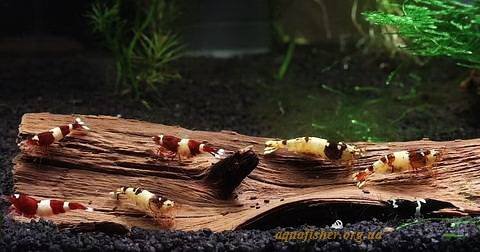
— Caridina cantonensis “Bee Shrimp” [Yu, 1938] — Bee Shrimp, Bumblebee Shrimp. “Bee Shrimp”, “Biene shrimp”. Southern China, Hong Kong. Size: up to 2.5-3 cm. The body is transparent, dominated by brown colors, although there are specimens with black stripes and spots, and sometimes even bluish with a reddish-brown dotted pattern. Females are somewhat larger, more intensely colored, and more active. Why are small shrimps so striped, and why are the stripes so contrasty? Very simple — it is disruptive coloration. Visually, this completely defenseless creature is not perceived as an integral object. And it is not hunted.
This is a fairly peaceful species that behaves shyly in a small group, while with an increase in the group they become more active and less timid. Aquarium with a large number of plants and mosses. At night they are more active, although throughout the day they do not stop moving and eating. Difficult to keep, as they are quite sensitive to any change in aquarium parameters. Prefer soft, acidic, necessarily clean water. Partial water changes are mandatory. Optimum temperature is 24°C, although they can live at 20-28°C, without sudden fluctuations. Good biological filtration is very important.
Reach sexual maturity by 4 months. Reproduces in freshwater. Reproduce only under good, stable conditions. Currently, the Bee Shrimp is quite rare in hobbyist aquariums, as they reproduce very reluctantly. The fry are extremely sensitive to water quality during the first two weeks. Average lifespan is one year or more, depending on the quality of conditions in the aquarium. pH 6.2-7.0; T 18-26°C.


— Caridina cantonensis “Blue Bee” — Blue Bee Shrimp. “Blue Bee Shrimp”. China. Size 2.0-2.5 cm. Shrimps of this species can be colored in various shades. Despite the name, the Blue Bee can be blue, purple, or brown. It is assumed that the brown coloration is “wild”. At present, almost all representatives of this species available for sale are wild-caught. But breeding and maintaining the “purity” of this species are already actively underway.
At a young age, it is quite difficult to distinguish a male from a female. Finding differences becomes possible when they reach sexual maturity; at least it is easier to determine the female, as she is larger in size, her abdominal carapace is much wider, and she has a curved lower abdomen. Males, in turn, are smaller in size and have a straight lower abdomen. — “Royal Blue”;
Not aggressive, the shrimp can be kept in mixed aquariums. Somewhat shy, may hide in shelters. For the shrimp to successfully live and reproduce in the aquarium, the pH level in the water should be from 6.5 to 6.8, and the temperature 23-26°C. These parameters are similar to those in which Crystal Red or Bee Shrimp prefers to live.
Since the Blue Bee species is closely related to the two mentioned species, its care should be about the same as for its distant relatives. They will eat both specialized foods and other treats. Under optimal growing conditions, females produce young every two months from 15 to 30 individuals. At birth, they are almost blue, resembling Blue Pearl.

— Caridina cantonensis “Orange Bee” — Orange Bee Shrimp. “Orange Bee Shrimp”. A very rare species of shrimp. Thin white and black stripes on an orange body. The orange color is not superficial, but seems to emerge from within. The color intensity in fry appears with age. Females are larger than males and have a much more pronounced orange coloration, as well as a curved under-abdomen. Females carry amber-colored eggs. Maintenance and breeding conditions are the same as for Crystal Red Shrimp.
 Caridina cantonensis “Tiger”, “Black Tiger”, “Blue Tiger”, “Red Tiger”.
Caridina babaulti, “Dark Green Shrimp”, “Green Shrimp”, “Malaya”, “Indian Stripes”.