



Subclass Bryidae, true mosses ( Bryidae )
Order Hypnales ( Hypnales )
Family Hypnaceae ( Hypnaceae )
Genus Taxiphyllum — Taxiphyllum.
Flame moss — Taxiphyllum sp. “Flame Moss”.

Underwater, the moss has sparsely branched shoots that grow straight and spirally twisted, making them resemble flames. As the vertical shoots grow, they twist, creating the impression of a small dark-green campfire, 5-15 cm high. Unlike most other mosses, it grows upwards faster and spreads outwards very slowly. Used for decorating stones and driftwood located in the middle or background. It attaches very weakly to the substrate, so it must be tied to stones or driftwood with fishing line or secured with a net. It is easily attached to wood or stone with fishing line and placed anywhere in the aquarium.
The composition decorated with this moss retains its attractive appearance for a long time without requiring frequent maintenance. The moss fixed to decorations can later be easily rearranged in the aquarium as desired. To decorate the back wall of the aquarium, the moss is attached to it using a net. The net can also be used if it is necessary to cover some horizontal area of the substrate surface with moss. Gradually, it grows, rises upwards, and eventually hides the net.
It prefers cold water around 20°C, but also grows well in warmer water (up to 28°C) and bright light. The addition of CO2 will accelerate the growth of this moss, although it can be grown without these conditions. Lighting from low to bright 0.25-0.5 W/liter, depending on the distance to the light source. Soft or medium-hard water is preferred for the moss, and the degree of “twist” of the branches also directly depends on the water hardness. Water acidity within pH 5.5-7.5. Prefers to be in a weak water current. No additional feeding required. Grows slowly. Temperature 15-28°C; dH 5.0-9.0.


 Identification: Flame moss — Taxiphyllum sp. “Flame Moss”.
Spiky Moss — Taxiphyllum sp. “Spiky Moss”.

Southeast Asia. It belongs to the same genus as Taiwan Moss, but has larger leaves with bright green foliage. Very similar to its younger brother, Christmas Moss. However, unlike the latter, it is coarser, stiffer, and has larger branches. The leaves are thick and very rigid compared to other mosses. Height 2-10 cm. Can be easily attached with fishing line to driftwood or stone and placed anywhere in the aquarium, looks best on vertical surfaces.
Very fluffy, well suited for the background. Can serve as a good refuge for fry and small fish. Not demanding on keeping conditions, however, it grows well in cool water and with the addition of CO2, although it can be grown without these conditions. Other water parameters are of no great importance. Prefers bright lighting, at least 0.25 W/l. Temperature 15-28°C; pH 6.0-8.5.
Identification: Spiky Moss — Taxiphyllum sp. “Spiky Moss”.
Peacock Moss — Taxiphyllum sp. “Peacock Moss”.
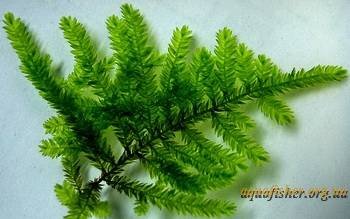
Unpretentious and beautiful moss with dark green leaves and bright green shoots, with a medium growth rate. Height up to 10 cm. Differs from Christmas Moss in that it has a softer and more velvety texture. The overall appearance is more “delicate” in a sense. The moss is used to decorate aquarium walls and is attached to driftwood and stones. The moss does not float, so if it is trimmed or a piece is torn off, it can be found at the other end of the aquarium, where it will start growing.
The plant is unpretentious. It responds well to light, CO2, and fertilizers in the water column, but will grow just as well without these conditions. With a sufficient level of light, it grows better. Water of medium hardness. It grows much better at a cool temperature up to 25°C. At a higher temperature (about 30°C), the moss begins to lose the shape of its leaves. For a good condition of the plant, it is necessary to periodically clean the moss from dirt. Propagated by division of the adult plant.
Identification: Peacock Moss — Taxiphyllum sp. “Peacock Moss”.

Taxiphyllum alternans Taiwan Moss, Taxiphyllum barbieri Java Moss. 


