



Order Cypriniformes ( Cypriniformes )
Family Cyprinidae ( Cyprinidae )
Genus Barbonymus — Barbonymus.

— Red Tailed Tinfoil Barb — Barbonymus altus [Gunther, 1868]. Synonym: Barbodes altus, foxi, Barbus altus, Puntius altus, bocourti. (Eng- Red Tailed Tinfoil Barb). Thailand, Laos, Cambodia, Vietnam, Mekong, Chao Phraya, Mae Klong rivers. In aquarium 15-20 cm. Large fish with a high back, flanks with silvery-iridescent scales, all fins red.
Differs from B. schwanenfeldii by smaller size and coloration of the caudal fin. In B. schwanenfeldii there are black stripes along the outer rays, while in B. altus the coloration of the caudal, anal, and ventral fins is red. In addition, it has an overall golden-bronze body tint, and the dorsal fin has a black spot. Selectively bred forms “Golden” and “Blushing”, with golden and reddish coloration.
This species is the most widespread and easiest to keep among the genus Barbonymus. This species is very active and requires plenty of swimming space, so it is only suitable for large tanks. Secure decorations firmly so they do not knock them over in a panic. Non-aggressive species, but will eat small fish and can annoy other fish with its activity and size. Can be kept in schools (from 5 pcs) with many cichlids, catfish, and other large cyprinids. Individual fish or a pair can become temperamental and even aggressive. Gravel or pebbles are used for the substrate, on top of which a few smooth rocks and driftwood can be placed.
Water movement from a powerful biological filter should be directed along the aquarium to create a current. They need a high level of oxygen saturation in the water. Soft, finely-leaved plants will be eaten by the fish. Omnivorous, live and frozen foods such as bloodworms, daphnia, artemia are used for feeding, along with quality flakes, pellets, and plenty of vegetable matter. Adult fish are also fed chopped earthworms, shrimp, mussels. Live up to 10 years. pH 6.0-8.0; dH 5-15°; T 23-27°C.


— Silver Barb, Java Barb — Barbonymus gonionotus [Bleeker, 1849]. Synonym: Barbodes, Barbus, Puntius gonionotus, Puntius javanicus, Barbodes jolamarki. (Eng- Java Barb, Silver Barb). Thailand, Malacca Peninsula, Sumatra and Java, Mekong and Chao Phraya river basins. 45 cm, in aquarium 25 cm. Body strongly compressed, back high, often concave above the nape. Head small, barbels very small.
Body color is silvery, sometimes with a golden sheen. Dorsal and caudal fins are grayish-yellow, anal and ventral fins are light orange to reddish, pectoral fins are pale to light yellow. B. gonionotus can be distinguished from relatives by the presence of gray caudal and dorsal fins, and pale yellow anal fins.
The main requirement is a spacious aquarium with sufficient swimming space, with a minimum size of 210 x 60 cm. They grow very quickly, and this size is considered a temporary measure. Non-aggressive species, but small fish will be eaten, and due to its constant energetic activity, it can frighten aquarium neighbors. If only one or two specimens are kept, only one fish aggressive to everyone will survive; a group of six or more is considered the minimum. This species likes to dig in the substrate, so use large washed gravel and omit plants.
Water for maintenance can be of medium hardness. Given the large size of the fish, the aquarium must be equipped with a powerful filter and strong aeration. Soft-leaved plants will undoubtedly be eaten by the fish. Feeds on plant matter and invertebrates. Can be fed with any live foods, as well as artificial foods for herbivorous fish. Try not to overfeed, as these are especially greedy fish. Reproduction starts from 9 months of age. pH 6.0-8.0; dH 5-15°; T 22-25°C.
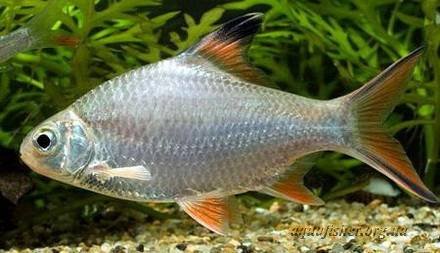
— Tinfoil Barb, Goldfoil Barb — Barbonymus schwanenfeldii [Bleeker, 1854]. Synonym: Barbodes, Barbus, Puntius schwanenfeldii. (Eng- Goldfoil Barb, Tinfoil Barb). Inhabit rivers and lakes of Cambodia, Laos, Thailand, Vietnam, Malaysia, Borneo, Sumatra. 30 cm, smaller in the aquarium. Very large, strong, and fast fish. This is one of the largest barb species.
Body is silvery, patternless, with bluish iridescence. Grayish-brown back turns into shiny silvery flanks with clearly defined scales. The triangular dorsal fin in adult fish is black with a red base and a notched rear edge. Ventral and anal fins of a mature fish are bright red-orange, the less brightly colored caudal fin is bordered top and bottom with black.
Juveniles have a “metallic” coloration, which is why they are also called tinfoil barbs. But with age, the red coloration of the anal, caudal, and ventral fins appears. The dorsal fin acquires a coloration from red to black with a white tip. Along the outer side of the deeply notched caudal fin runs a black band bordered by a thin orange stripe. Sex is not determined until the first spawning; the male is generally smaller, slimmer, and more brightly colored.
Differs from Barbonymus altus by the presence of stripes on the caudal fin. Now an albino-xanthistic form with golden coloration is often found — B. schwanenfeldii “Gold”. Has a golden or yellow body color. Fins are usually translucent with a golden or reddish tint. This species often falls victim to various forms of artificial dyeing – blue, pink, purple, and orange.
Due to the fact that the fish are quite large and active, they need an aquarium with a minimum length of 1 meter, with lush vegetation. The background in the aquarium should be dark, then the fish will look most spectacular. Driftwood and stones can be used as decorative elements. Very active and need enough space for swimming. Grow very quickly even in small aquariums, gaining more than 12 cm of length in a year.
Active, relatively peaceful fish that can be kept with cichlids in a large aquarium. Prefer a community of similar size and temperament. Schooling, but when kept alone do not die, instead turning into rude individualists. If you want to see their natural behavior, you should keep at least six specimens. Fish usually swim in the lower part of the aquarium. Fish like to dig in the substrate, constantly searching for food by rooting in the substrate with their heads, so use large washed gravel and omit plants. Plant hard-leaved plants with a powerful root system in the aquarium, as they use them as hiding places.
Water for maintenance can be of medium hardness. Given the large size of the fish, the aquarium must be equipped with a powerful filter. A predator, and although the fish is considered peaceful, it can eat smaller neighbors. These barbs are always hungry. Live, frozen, and dry foods can be used as food, vegetable supplementation is mandatory, greedily eats duckweed. Sexual maturity occurs at 8-11 months. In home conditions, breeding this barb species is hardly feasible. pH 6.0-7.0; dH 6-15°; T 22-25°C.

 Identification: Genus Barbonymus — Barbonymus.
 Barilius barna, Barilius dogarsinghi, Barilius shacra.
Barbus janssensi, leonensis, pobeguini, walkeri. 


