



Subclass Alismatidae ( Alismatidae )
Order Alismatales ( Alismatales )
Family Aponogetonaceae ( Aponogetonaceae )
Continued…
Genus Aponogeton — Aponogeton.
Madagascar and African Aponogetons.
Aponogeton boivinianus, Boivin’s Aponogeton — Aponogeton boivinianus.
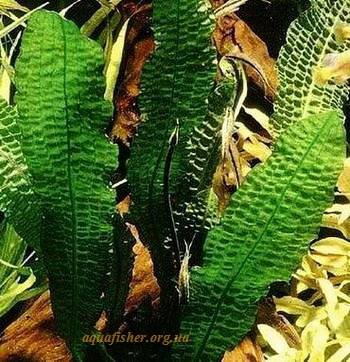 “1” Island of Madagascar. A large and powerful plant with long, wavy, corrugated, leathery leaves, suitable only for large aquariums. Under favorable conditions, it can form many very large leaves (up to 60 cm long and 8 cm wide). Its leaves are massive, spear-shaped, and transparent-green, making this species easy to identify. The leaf blade is ribbon-like, with a rounded base and a sharp apex, strongly curved and wavy, dark green. Venation is parallel, the main vein is thick, protruding from below, in addition to it, up to 7, less often up to 9 veins are visible. Light green or brownish young leaves eventually acquire a rich dark green color and become a winning background for bright, active decorative fish. Height 40-60 cm. Width 20-30 cm. There are variations: — Aponogeton boivianus bulb and Aponogeton bovianus medium.
“2” Temperature 22-26°C. Plants can be easily kept in soft or medium hardness water, as well as at pH ranging from slightly acidic to slightly alkaline. pH 6.5-7.5, dH 4-18°. Does not like old water; periodic water changes are required in the aquarium where it is kept. CO2 supplementation is necessary. Requires moderate lighting with an intensity of 0.4 W/l. The plant can tolerate shading, but with a lack of light it stretches in length, and the leaf color becomes pale.
“4” The rhizome is tuberous, globose up to 3 cm thick, leaves grow from the upper end. Loose and nutrient-rich substrate consisting of rounded particles 3-5 mm in size with a layer thickness of not more than 5 cm has a positive effect on plant growth. It is advisable to put a few lumps of clay under the plant tubers. To prevent depletion of the plant’s root system, it is necessary to occasionally pull out the plant along with the roots and keep them for some time until they dry out, and then replant them in the substrate.
“5” In nature, it grows in places with a strong current, so it prefers flowing aquariums, but a strong current should not be created immediately after transplantation, until the plant begins to produce new leaves. Solitary plant. Planted singly or in loose groups on the sides of a large aquarium or along its back wall. A healthy plant grows quite quickly and needs space for growth, so a young representative of this species should not be planted in a densely planted aquarium. Does not like close proximity to other aquarium flora. With a pronounced lack of free space, the plant slows down growth and may wither. Grows slowly.
During the growth period, an adult plant produces 1–2 leaves per week. Grown specimens can reach impressive sizes, which is why spacious aquariums are necessary, as a large number of leaves up to 60 cm long and 8 cm wide will easily shade a small body of water. For long-term maintenance, as soon as the plant signals the onset of the resting period by dropping leaves, it is recommended either to reduce lighting and, if possible, lower the water temperature by 2-3 degrees, or to store the tubers only in a slightly moist state at room temperature. Maintenance conditions are difficult. Often dies after flowering.
“6” The plant propagates by division of daughter tubers. It can also be propagated by dividing the old tuber into several parts. Care should be taken that each cut part has several growth buds, because a new plant will eventually start growing from them. It is advisable to propagate the plant in this way in early spring, during the resting period.

Aponogeton longiplumulosus — Aponogeton longiplumulosus.
 “1” Northwestern part of the island of Madagascar. Height up to 55 cm, forms up to 20-30 leaves. A strong plant with wide, transparent brownish-green leaves, which can be slightly wavy depending on maintenance conditions. Very decorative due to wavy edges. Submerged, petiolate leaves. The leaf blade is fragile, somewhat transparent, up to 35 cm long, up to 3 cm wide, linear in shape with a cuneate or cordate base and a sharp apex, edges even or wavy, neutral green to dark green in color. There are 1-2 longitudinal veins on both sides of the wide midrib.
Petiole is short – up to 12 cm. At first, the leaves grow upwards, but over time they begin to bend to the sides. Has a pronounced resting period lasting 2-3 months. A. longiplumulosus is very similar to the long-known species – A. ulvaceus. But these plants also have significant differences. The tuber of A. ulvaceus is prickly around the growth point. In addition, its leaves are spiral, whereas in A. longiplumulosus they are wavy.
“2” Suitable for keeping in normal aquarium conditions, grows best in running water. In the aquarium, plants become most luxuriant when grown in soft to medium hard water, acidic to neutral. Prefers a temperature in winter of 18-20°C, the rest of the time – above 25°C, pH 5.8-7.2, dH 2-12°. Likes strong, diffused, combined lighting.
“4” Has an elongated or spherical tuber up to 2 centimeters in diameter. Unwashed coarse sand as substrate. It should be planted deep in the substrate, as it is eagerly eaten by mollusks and algae-eating fish (livebearers, Ancistrus). Tubers are immersed in the substrate by 4-5 centimeters. Do not press the tuber into the substrate; it is enough to secure it in a predetermined place. Later developed roots will pull the tuber into the sand themselves. If you press it into the substrate, an unnoticed damaged area will begin to rot and the plant may die. The substrate should not be too poor in nutrients.
“5” A very beautiful plant, most suitable for a large aquarium. Solitary, it is recommended to plant singly or in groups in the middle ground or along the back wall of the aquarium. It is better to plant it no closer than 10-13 cm to other plants as it begins to “push” neighbors apart as it grows. Releases 2-3 leaves per month. The species regularly has a resting period, but produces shoots again after a few months. The resting period can occur either with leaf shedding or with their preservation.
In most cases, at a certain time, a noticeable stop in plant growth occurs. This may mean that the plant needs a resting period. But there is another reason – the rotting of the tuber begins. In this case, you need to take it out of the substrate and wash it well with oxygen-rich water. If the tuber is still healthy – firm, without an unpleasant odor, then, obviously, it needs a resting period. You need to put it on the substrate, and later the roots will pull it inside.
“6” Propagated by division of the tuber. Growing young plants is associated with normal difficulties. If the development of the sprout stops, it must be replanted.
 Pistia stratiotes, Spirodela polyrhiza.
Aponogeton madagascariensis, Aponogeton ulvaceus. 


