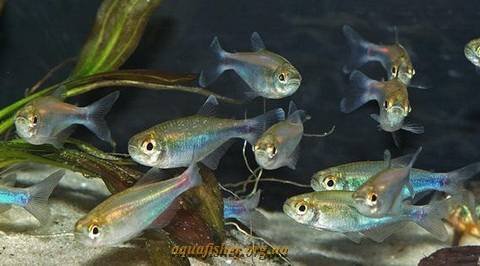
Order Characiformes
Family Characidae (Characins or American tetras)
Subfamily Stevardiinae
Genus Mimagoniates (Coelurichthys)
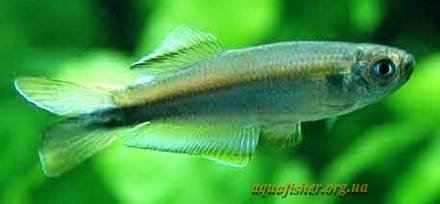
— Barber’s tetra — Mimagoniates barberi [Regan, 1907]. Paraguay. 6 cm, females 4 cm. A peaceful, active, schooling fish. They prefer dense vegetation and driftwood. A dark substrate and diffused light filtered by floating plants enhance the fish’s coloration. The water must be very soft; they fall ill in hard water. A sensitive species when it comes to water parameters: they do not tolerate hard water and require soft, slightly acidic water; using peat in filtration is recommended. They require regular water changes in the aquarium. Omnivorous, preferring live foods, although they adapt to dry food as well. pH 5.5-7; dH 2-5°; T 20-27°C.

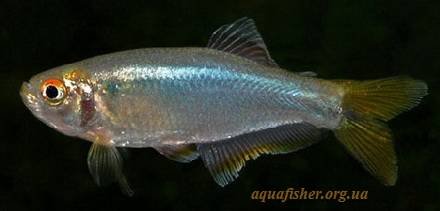
— Croaking tetra — Mimagoniates inequalis [Eigenmann, 1911]. Synonym: Glandulocauda inequalis. Brazil, Uruguay. Males up to 5 cm, females up to 3.5 cm. The body is silvery with a blue metallic sheen. Males have brighter colors and better-developed fins. Males attract females by releasing a distinct scent from specialized caudal glands located near the tail. Its common name, the croaking tetra, originates from their ability to produce quiet clicking sounds when releasing an air bubble underwater that was swallowed from the surface. Peaceful, quite hardy in the aquarium, and very active. They mature in 3–4 months. Internal fertilization. Water temperature during maintenance should be 19–23°C (no higher).
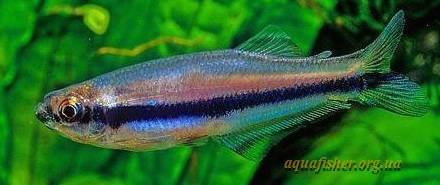
— Blue-banded tetra / Tenuis tetra — Mimagoniates lateralis [Nichols, 1913]. Synonym: Mimagoniates tenuis, Coelurichthys lateralis, tenuis. Southeastern Brazil, Paraguay, Argentina. 5 cm, females smaller. Coloration is very attractive, especially in males. The back is olive-brownish, below which runs a broad, soft-edged bluish stripe stretching across the entire body from the gill covers to the base of the caudal fin. Beneath this blue zone runs a dark brown or dark blue band that broadens at the caudal peduncle into a diamond-shaped, nearly black spot, which then tapers into a thin ray, splitting the fish’s tail into two equal yellowish lobes.
The belly is yellowish-brown with bluish flecks near the anal fin. The dorsal fin is elongated and decorated with longitudinal stripes of various colors (yellow, brown, bluish). The anal fin almost joins the caudal fin and is mostly yellowish with a dark margin. Females are colored much more modestly, dominated by olive-yellowish-gray tones. In males, the dorsal and anal fins are pointed.
Peaceful and schooling. The school is in constant motion, with males displaying flared fins and shimmering colors as they pursue females. They thrive in large community aquariums with soft, peat-filtered water. They school in the upper and middle water layers. They appreciate dense vegetation and driftwood. A dark substrate and diffused light from floating plants enhance the fishes’ colors. They require regular water changes. Fish kept in water that is too hard are not capable of breeding.
These fish tolerate prolonged exposure to temperatures above 28°C poorly — they become sluggish, inactive, their colors fade, atypical pigmentation appears on the body, and some fish may die. Neither intense aeration, nor filtration, nor frequent water changes will help. Omnivorous. The core of their diet consists of bloodworms, glassworms, small crustaceans, and balanced dry flake foods. Feeding *Tubifex* leads to negative consequences for the fish, including death. Internal fertilization. T 20-24°C; pH 5.5-7.0; dH 2-5°.
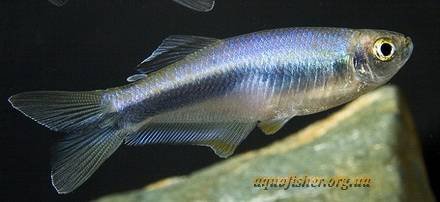
— Blue croaking tetra, small-scaled croaking tetra — Mimagoniates microlepis [Steindachner, 1877]. Synonym: Mimagoniates iporangae, Coelurichthys microlepis, iporangae, Paragoniates microlepis. Brazil, found in clear water streams and small rivers. 6 cm. The back is olive, flanks light green with a dark stripe, and fins are yellowish. The male is larger and more colorful; his dorsal fin is longer and pointed, while the anal fin merges toward the tail. Due to the body structure, fin shapes, and distinctive swimming style in the upper water layers, this species is often mistaken at first glance for a small rainbowfish or danio.
These are exceptionally peaceful, schooling, small tetras compatible with any other suitably sized characids, as well as other gentle tropical tankmates. When setting up the aquarium, their dynamic swimming behavior should be taken into account by leaving plenty of open swimming space, while planting the peripheral areas with dense thickets of stem plants. Soft water with a neutral reaction, filtration, and regular water changes are preferred. T 18-23°C; dH 2-20°; pH 6-7.
 Acnodon normani, Catoprion mento, Colossoma macropomum.
Pseudocorynopoma doriae, Pterobrycon myrnae, Tyttocharax cochui, tambopatensis.