



Light reflectors.
An important part of the lighting fixture is the reflector. For example, a good reflector can almost double directional illumination. An ideal reflector significantly increases the proportion of light penetrating under water because it collects all light rays going upwards and sideways, reflecting them in parallel beams into the aquarium. A reflector allows you to get more light without increasing the number of lamps. Therefore, it is better to use fewer lamps, but with a reflector.

The “best” reflector is not much (10-20%) better than the worst one. Any “good” reflector will produce approximately the same amount of light. However, it should be remembered that reflector surfaces quickly lose their properties, and they must either be cleaned or replaced, as cleaning does not always restore their original brilliance. Even if the aquarium has two lamps, the problem of heat dissipation from the lamps and water overheating arises. This problem is especially acute in summer. From warm water, CO2 quickly evaporates, and plants begin to starve. One has to keep aquarium lids open or purchase (equip) lids with a built-in fan.

In the absence of a reflector, the amount of light falling on the surface is determined by the angle between the directions to the edges of the illuminated area with the apex at the lamp. The amount of light is (depending on the lamp height and area size) 25-30%. T8 fluorescent lamps without reflectors produce light that gives an unnatural appearance to the underwater world (T5 lamps are much better in this regard). The reason is that such lamps produce diffused light that spreads equally in all directions. Light thus spreads across surfaces and casts shadows quite differently.
Efficiency does not depend on the number and diameter of lamps, provided that the lamps are placed approximately in the middle. If the lamps are placed close to the edge, part of the luminous flux will be lost. It makes no sense to use many lamps, especially of large diameter. When placed close to each other, a lot of light is lost, and they heat up, leading to even greater losses, and light output drops sharply.
If you use a fluorescent lamp without a reflector, you reduce the useful light several times. As is easy to understand, only the light directed downwards reaches the plants. The light directed upwards is useless. The light that blinds your eyes when you look at an open lamp is also useless. A good reflector directs the blinding light downwards onto the plants.
Simulation results of a fluorescent lamp show that illumination in the center when using a reflector increases almost threefold, and the light spot on the surface becomes more concentrated — the fixture illuminates the plants, not everything around. Most fixtures sold in appliance stores have no reflector or have something that is shameful to call a reflector. Special systems for lighting plants or aquariums with reflectors are very expensive.

By using mirrored parabolic reflectors, you can get much more natural light in the aquarium — with parallel rays. Installing parabolic reflectors for fluorescent lamps not only improves the aesthetics of light, but also increases the luminous efficacy of lamps by two or more times by directing the light flux in the right direction. About 80% of the light emitted by the lamp will be directed into the aquarium, and at the correct angle — no more than 53 degrees to the water surface.
Only a reflector curved in the shape of a parabola gives directional light with parallel rays. Without a parabolic reflector, a significant number of rays reach the water surface at a large angle and are reflected from the surface without ever penetrating the water! A parabolic reflector provides directional light with parallel rays that attenuates much less with distance and penetrates much deeper into the water column.
The lamp in such reflectors must be positioned exactly in the center of the parabola, otherwise the effect will be no greater than from a regular “trapezoid”. If the aquarium is illuminated by a lamp with a parabolic reflector, the smallest ripples on the water surface will focus/defocus the directed parallel light rays and cast moving light glares onto the underwater landscape, and the shadow falling on the plants and substrate will be much more natural.
The shadow falls on the surface of objects rather than dissolving in the air as with diffused light, much better revealing their shape and volume, and therefore spatial depth. A parabolic reflector significantly enhances the illumination of small foreground plants. Diffused light makes fish and plants look “flat” and grey. Conventional reflectors (trapezoidal shape) reflect light well, even making it partially directional, but not at all like a true parabola.
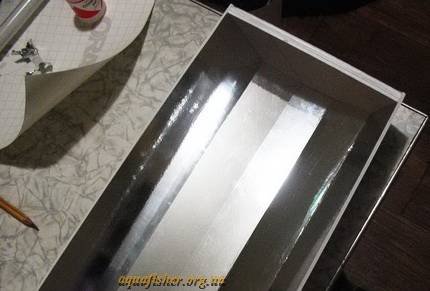
Making a homemade reflector for a fluorescent lamp is simple. The shape of the reflector, especially for one or two lamps, is not fundamentally important — any “good” shape where the number of reflections is no more than one and the return of light to the lamp is minimal will have approximately the same efficiency within 10-15%. Its height should be such that all rays above the limit ray are intercepted by the reflector — in this case, the fixture will not blind your eyes.
By setting the direction of the reflected limit ray (for example, downwards or at an angle), you can construct a perpendicular to the reflector surface at the point of reflection that bisects the angle between the incoming and reflected ray — the law of reflection. In the same way, the perpendicular is determined at other points. After that, you can either make a polygonal frame or construct a smooth curve and bend the reflector according to a template. Do not place the top point of the reflector close to the lamp, as the rays will bounce back into the lamp. In this case, the lamp will heat up. Be sure to make holes at the top of the reflector for ventilation.
Reflectors are made of metal foil, aluminized materials, kitchen aluminum foil, lacquer coatings, galvanized iron, mirrors, self-adhesive “mirror” film. You can also paint the reflector surface with white paint or silver paint. When coating metal surfaces, the corrosion resistance of the used coating is of great importance.
To avoid potential trouble, airtight caps should be put on the ends of the lamps, protecting the lamp contacts from contact with moisture. For some lamps, various dust covers, cuffs, and other automotive rubber small parts that you can find in abundance in any auto parts store will do quite well. They can be made from cable glands (cable entries for electrical wiring). For T8, PG-29 is suitable. The socket is placed inside the cable gland body.
 Aquarium keeping and electrical safety.
Aquarium hoods with lighting equipment. Increasing illumination. 


