



Goldfish Aquarium.
The oldest aquarium inhabitants, tracing their ancestry back to the crucian carp, have changed beyond recognition over centuries of selective breeding and have become a familiar aquarium pet. Goldfish are extraordinarily hardy creatures; they are capable of living for years in 2-3 liter bowl aquariums, however, this does not mean at all that they feel good in these mini-aquariums. A voluminous aquarium is necessary (due to lack of movement, all elite selection forms become inert, and motor and metabolic disorders arise). For short-bodied fish, 1.5 sq. dm of surface area is needed for every 10 cm of body length of all fish, and 2 sq. dm for long-bodied ones.
An aquarium for goldfish must be quite spacious, with a good oxygen regime, based on at least 20 liters per young fish. The shape of the aquarium should preferably be as close to “classic” as possible, meaning its length is about twice its width. Short-bodied goldfish (veiltails, telescopes) require a larger volume of water than long-bodied ones (common goldfish, comet, shubunkin) with the same body length. If air aeration is not carried out in the aquarium, these values must be doubled, and a portion of the water (30%) must be replaced daily with fresh water. The temperature difference should not exceed 2 degrees.

Water temperature can range from 15 to 25°C for long-bodied species and from 22 to 26°C for short-bodied ones. In addition, fish such as telescopes, ranchu, and lionheads are considered more thermophilic. Goldfish (long-bodied ones kept in basins and ponds) tolerate a temperature drop down to 0 degrees Celsius. When keeping goldfish, it is worth remembering that they are cold-water fish, so it is better not to torture them and keep them with their own kind; in a general aquarium with tropical fish, they might be a bit too warm. But keep in mind that elevated temperatures cause accelerated aging of the fish.
It should be taken into account that a volume of 50 liters and above is recommended for a single goldfish. Furthermore, a minimum volume of 100 liters is desirable for a pair at least 5-7 cm in size, excluding the length of the caudal fin (three are possible, but in this case, powerful filtration and more frequent water changes must be organized). Why are the requirements so strict? There are probably two main reasons. Firstly, fish imported from Southeast Asia are grown in ponds and have difficulty adapting to small aquariums compared to ponds. And secondly, due to their natural gluttony and the peculiarities of their digestive system structure, goldfish place an increased biological load on the aquarium.
This is expressed in a large amount of waste produced. As soon as this amount exceeds a certain threshold, a biological balance failure occurs in the aquarium with all negative consequences, up to the death of the fish. In addition, a high stocking density of fish that have not reached their maximum size is quite capable of causing a phenomenon known in aquarium hobby as “stunting”: fish stop growing, certain structural defects begin to appear, and they become more susceptible to diseases.

The chemical composition of the water is of no great importance. Water hardness 8-25°, acidity 6-8. If the fish feel unwell, salt can be added to the water at 5-7 g/l. The fish tolerate a salinity of 12-15% quite well. It is advisable to regularly replace a portion of the water volume.

Goldfish are extremely poorly compatible with any other aquarium fish. Goldfish will gladly feast on anything that can fit into their mouths. Those fish that are not eaten by your goldfish may well nibble on them (long tails and fins of goldfish are particularly attractive in this regard). An exception can be peaceful, unpretentious catfish. In a general aquarium, goldfish can be kept together with calm fish. Veiltail forms are kept with peaceful neighbors that are not prone to fin-nipping.
Strange as it may seem, not all breeds of goldfish are compatible with each other. There are fish that are recommended or necessary to keep separately, including from their own kind. In addition, representatives of different breeds may not match each other in temperament; in particular, this applies to the cohabitation of long-bodied and short-bodied goldfish.
Long-bodied ones are significantly more active than their short-bodied relatives; most often these fish are schooling and, furthermore, are capable of growing very large, up to 30 cm and even more (excluding the length of the caudal fin). Therefore, long-bodied goldfish feel most comfortable in ponds. When keeping them in an aquarium, it is desirable that its capacity is at least 200 liters. In general, these fish (the “ordinary” goldfish, comet, shubunkin, wakin) are quite unpretentious, hardy, and not so sensitive to changes in housing conditions.
Among short-bodied fish, there are those which, as mentioned above, are recommended to be kept separately for various reasons. The telescope is clumsy and somewhat blind, so neighbors can leave it on starvation rations; moreover, its eyes are very vulnerable. The same applies to the celestial eye. Neighbors may accidentally or intentionally injure the “sacs” of bubble-eyes. In this group of fish, riukin and fantail are considered the most unpretentious. Orandas, telescopes, celestial eyes, ranchu, and lionheads are more difficult to keep. Pearlscales and bubble-eyes are clearly not suitable for beginners.

Decoration is possible with any materials (stones, driftwood, ornaments, ceramics). When decorating the aquarium, one important circumstance must be taken into account: what kind of goldfish will live there. If you plan to keep telescopes, celestial eyes, or bubble-eyes, you will have to abandon not only stones, decorative “castles”, and substrate particles with sharp edges, but also plants with leaves having sharp edges or serrations. Otherwise, the fish may get injured.
Choose decorations for your aquarium to your taste, but they must be smooth, without sharp corners where they could tear their luxurious fins or injure their eyes. The main thing is to have plenty of open space where the fish love to swim. Otherwise, there is a very high risk of fish injury. In an aquarium with goldfish, lighting is needed not only for plants; without good lighting, the bright coloration of the fish fades.
To plant or not to plant live plants in a goldfish aquarium? Definitely plant! The beauty of goldfish is also fully revealed only against the background of lush greenery. The presence of plants has a favorable effect on the ecological environment, helps cope with algae, pleases the eye, and serves as an excellent supplementary food for the fish. Goldfish gladly eat almost any aquarium plants and can quickly turn your “blooming garden” into a nibbled wasteland. Many aquarists believe that in this case, there is no point in bothering with plants at all.

There are a large number of large-leaved, tough, or simply “unpalatable” plants that the fish will not touch. These are, for example, Anubias, Lemonis (Hygrophila), Cryptocorynes, Echinodorus, Vallisneria, Nuphar, Sagittaria, Elodea. Java moss can be used. Such plants will not be eaten and will serve as additional ecological stabilizers in the aquarium.
So that the fish do not uproot the plants every time while rummaging in the substrate, when planting them, the bottom around the roots can be covered on top of the substrate with larger rounded pebbles. Plants are best planted in pots. Goldfish often damage their lush fins on tough leaves of plants that should not be planted. An area with floating plants (Riccia, duckweed) is desirable on the surface of the aquarium, which the fish feed on.
Due to their natural gluttony and the peculiarities of their digestive system structure, goldfish place an increased biological load on the aquarium. This is expressed in a large amount of waste produced. As soon as this amount exceeds a certain threshold, a biological balance failure occurs in the aquarium with all negative consequences, up to the death of the fish. The presence of a filter in aquariums with goldfish is also a prerequisite, since active and gluttonous fish, taking food from the bottom and constantly rummaging in it, pollute the water.
Therefore, a good internal filter for mechanical cleaning in the aquarium seems necessary. An external filter helps organize biological filtration in the aquarium, especially when using special filter media — a rather useful, although not absolutely necessary device. It is indispensable when there is a desire to save space in the aquarium for a larger number of fish.
It is definitely worth reminding that filters must work around the clock. The sponges of internal and external filters must be rinsed weekly. It is necessary to organize fairly frequent water changes; in this regard, goldfish are quite problem-free and, once accustomed, easily tolerate a 25-30% water change twice a week.
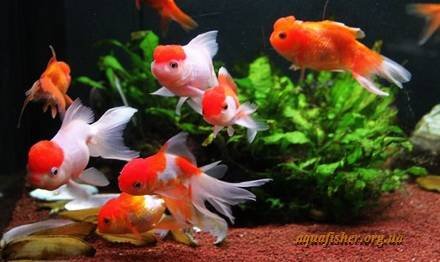
As a substrate in goldfish aquariums, coarse river sand from 3 mm or rounded pebbles 5 mm in size are used. Do not use substrates with sharp edges, especially when keeping breeds with bulging eyes and pregnant females. Rounded large pebbles at the bottom will be ideal, just make sure they are not too small in fraction, since goldfish grab everything from the bottom with their mouths and can swallow it.
Some authors advise using coarse gravel and scattering fine sand over only a small area of the bottom, where the fish adore digging. Regular substrate siphon cleaning is necessary (as it gets dirty, at least once every two weeks; it can be combined with water changes).
Water aeration is mandatory for goldfish, during which water is enriched with oxygen both from the surface of air bubbles formed by the air stone and from the water surface; they need a sufficiently high oxygen content in the water. As a result of water circulation caused by the stream of bubbles, oxygen-rich upper layers mix with oxygen-depleted lower layers.
In addition, circulation is useful because it mixes the relatively warm upper layers with the colder bottom layers, thereby creating uniform temperature conditions inside the aquarium. If the fish swim with their mouths raised to the surface, trying to catch air, it means the water is not sufficiently saturated with oxygen. Then you should increase aeration or replace part of the water with fresh water.
 Goldfish Aquarium. Part 2. Goldfish and Koi Carp in a Pond.
Mini-aquarium for Betta. Small aquarium with labyrinth fish. 


