AFRICAN CICHLIDS.
Order Perciformes
Family Cichlidae
Subfamily Pseudocrenilabrinae
Genus Divandu

— Divandu albimarginatus [Lamboj & Snoeks, 2000]. Gabon, Congo. 12 cm. The main body color is light brown, cheeks and lower part somewhat paler. Usually 6-7 vertical bars on the flanks. Scales on the chest are significantly smaller than on the flanks. The first ray of the pelvic fin in adults of both sexes is long, usually extending beyond the anus. Reddish-black spots on the caudal, dorsal, and anal fins forming stripes. The upper margin of the caudal fin has a narrow red edge. Sexual dimorphism is negligible. Timid in the aquarium, but conspecific aggression is quite high. May attack smaller fish. Does not touch plants. Very clean water with low nitrogen levels is required. pH 7.0-7.8; T 24-26°C.
Genus Etia
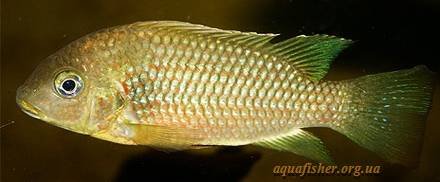
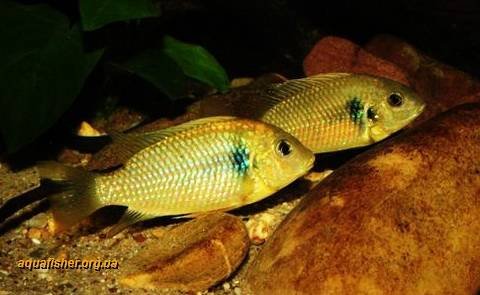
— Etia nguti [Schliewen & Stiassny, 2003]. Cameroon, in small rivers and streams feeding into the Cross River system. 20 cm. They have a light golden body color; in reflected light, numerous shiny spots can be observed, and scales are surrounded by iridescent turquoise. A dark brown spot is located behind the gill cover. The belly has a lighter soft yellow shade. Small turquoise spots are present on the dorsal and anal fins. Pelvic fins are bright yellow.
Males have a slimmer body, a sharper snout, and a greater number and intensity of blue dots on the caudal and dorsal fins. Can live in groups, but quarrel with conspecifics during spawning. Aquarium with plenty of rocks at both ends and plants in the center. Sandy substrate, which they sift through their gills. Readily accepts dry and frozen foods. Eggs are laid on a smooth surface, where both parents guard them.

Genus Enigmatochromis
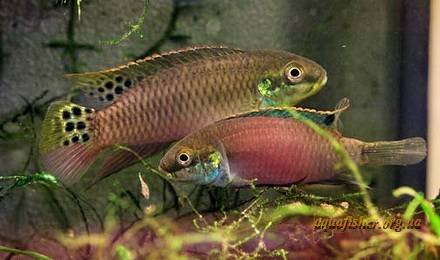
— Enigmatochromis lucanusi [Lamboj, 2009] (English: Pelvica Blue Fine). Africa, Guinea, in small rivers and streams. 10 cm. Similar to Pelvicachromis roloffi. A black stripe runs from the lips through the eyes to the caudal fin. Round black spots are present at the end of the dorsal fin and on the caudal fin. A red stripe runs along the top of the dorsal fin. In the female, the rear part of the anal fin is elongated and turquoise in color.
Prefer an aquarium with dense vegetation (including floating plants) and plenty of hiding places such as stones, driftwood, and caves like coconut shells. Peaceful fish best kept in pairs. During the breeding season, they can be aggressive. Additionally, females may constantly chase males if the pair is not well-matched.
Inhabit the lower water layers. Require very soft and slightly acidic water; poorly tolerate abrupt parameter changes. Omnivorous; accepts frozen or live daphnia, and dry food. Eggs are laid in a cave and guarded by both parents. The parents care for the fry for 5-6 weeks.
Genus Gobiocichla
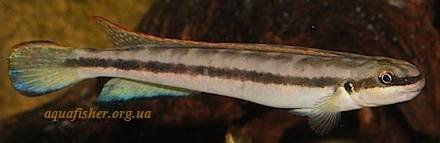
— Gobiocichla ethelwynnae [Roberts, 1982]. Niger River, Cameroon. 10 cm, females are smaller. Body is long and slender, greenish or dark olive, lower side light gray, black vertical bars on the back. Dorsal fin grayish or olive, sometimes yellowish-red at the rear. Anal fin yellowish-brown or olive. Pectoral fins yellowish or light green. During incubation, partners take turns: the female cares for the offspring first, followed by the male. Since the swim bladder in these fish is practically atrophied, they live exclusively on the bottom and only with great effort rise into the water column. Algae eaters.
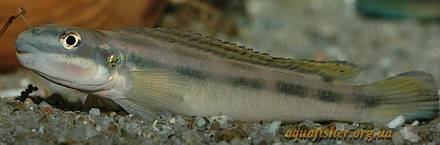
— Gobiocichla wonderi [Kanazawa, 1951]. Synonym: Labrochromis polli. Niger River, Cameroon. 10 cm. Body color is greenish, lighter on the belly. Dark longitudinal stripes along the middle of the body. Dorsal and anal fins in males are slightly pointed. Grow very slowly. Aquarium with piled rocks and artificial plants. Highly aggressive; the dominant male keeps all others in fear. The dominant male may kill a weaker specimen. Prefer a strong current reflected from the walls and corresponding water oxygenation.
Since the swim bladder in these fish is practically atrophied, they live exclusively on the bottom and only with great effort rise into the water column. Substrate of fine sand. Feel uncomfortable in water that is too hard. Omnivorous, algae eaters. Scrape algae from rock surfaces. Diet consists of plant flakes and pellets, as well as frozen live food. During incubation, partners take turns: the female cares for the offspring first, followed by the male for 5 weeks. The fry have vertical bars on their bodies.
 Haplochromis nuchisquamulatus, obliquidens, perrieri, plagiodon, sauvagei.
Congochromis dimidiatus, sabinae, squamiceps.