



SOUTH AMERICAN CICHLIDS.
Order Perciformes
Family Cichlidae
Subfamily ( Geophaginae )
Genus Crenicara.

— Crenicara latruncularium [Kullander & Staeck, 1990] — Crenicara latruncularium. Brazil, Bolivia, Rio Guapore, Rio Mamore rivers. 9 cm. Males are larger, more brightly colored, with elongated dorsal and anal fins. Aquarium with plenty of wood shelters, stones, and floating plants. Spawning takes place in a cave. Females guard the clutch and will fearlessly rush at any fish that encroaches on their territory, including males. T 24-28°C; dH up to 10°; pH 6.0-7.0.
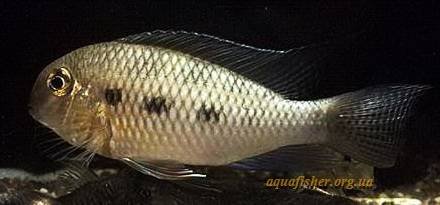
— Crenicara punctulatum [Gunther, 1863] — Checkerboard cichlid. Synonym: Acara, Crenicara punctulata, Crenicara elegans; Aequidens madeirae, hercules. (Eng. Checkerboard cichlid). From Guiana to Peru and Ecuador, Amazon. 8-12 cm, females are smaller. These fish have a wide distribution range and therefore occur in various color variations depending on their origin. Body compressed laterally, high in the middle, tapering towards the head and tail, males are more massive and rounded.
Basic coloration is silvery with a yellow to orange tint in males. Along the midline, it has a series of several oval-shaped spots, located at an equal distance from each other. Scales with dark edges. In males, the dorsal fin is elongated. Pectoral fins range from orange to red. The female is easily distinguished by reddish rounded ventral fins; the male’s ventral fins are bluish and sharper.
Very peaceful fish, showing no aggression, can be kept in a general aquarium with large characins. Can be extremely timid, so keep in a group; when alone, they constantly hide among plants. Aquarium with stem plants and driftwood at the bottom, as they need hiding places. Slightly acidic and soft water.
It has been established that in captivity, all individuals in a growing brood start life as females. At the age of 8 months, reaching a length of about 6 cm, one individual begins to develop into a male, the so-called alpha male, dominating the rest of the group members, who either remain females or become underdeveloped males ready to take over the role of alpha male and take possession of the harem in case of his death. Difficult to get used to dry food. The smaller female cares for the eggs and offspring. T 23-27°С; pH 5.0-6.0; dH 1-10°.
Genus Taeniacara.
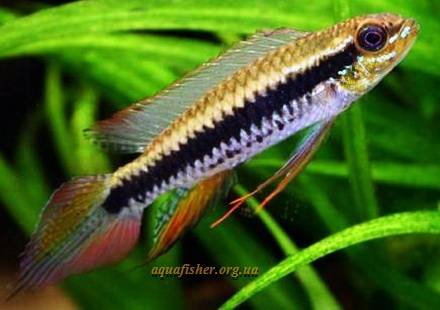
— Taeniacara candidi [Myers, 1935] — Black Stripe Dwarf Cichlid, Torpedo Cichlid, Weise’s Dwarf Cichlid. Synonym: Apistogramma weisei. (Eng. Black Stripe Dwarf Cichlid, Torpedo Cichlid, Weise’s Dwarf Cichlid). Middle Amazon, Rio Negro, Preto, Tapajos, Branco, Arua river basin, Brazil, in small rivers, usually with black and acidic water. Males 7 cm, females 5 cm.
A cichlid with an unusually thin, slender, elongated graceful body with an elongated caudal fin. They have a thinner body than most species of the genus Apistogramma. A small mouth with a protruding lower jaw allows them to feed from the water surface. The upper lip shimmers with a bright green color. The movements of the fish are extremely graceful and plastic. They have very large red eyes compared to body size.
Basic coloration is silvery, a horizontal black stripe runs along the body from the eye to the base of the caudal fin, slightly serrated in front, belly silvery-white in front of the anal fin. The lower part of the body has rows of vertical stripes and spots from the base of the ventral fins to the base of the anal fin. The body may also have blue, red, and brown shades depending on the fish’s mood. Lower part of the head greenish-golden, gill cover with a greenish-blue sheen.
Male is yellow with a wide black stripe starting from the mouth and ending at the base of the caudal fin, and blue strokes on the gill covers. Fins are blue with red-burgundy lines and dots (ventrals make up 40% of body length). The ends of the long blue ventral fins are reddish-orange, and can reach the caudal fin. Dorsal fin bluish with a red rim, which is absent in females. Anal fin with blue and orange stripes. Caudal fin is long (about one-third of the body), lanceolate, rays in the middle part taper to a single point at the end, forming a long tail.
Tips of the dorsal and anal fins are elongated, ventral fins reach the middle of the anal fin. In both sexes, the upper part of the caudal fin is red to orange with blue elongated spots, the lower part is blue. Female is smaller, paler colored. Females have a rounded caudal fin, unpaired fins with the same coloration as males. Ventral fins are short, typically orange with black tips. During spawning, females change color to yellow or orange with a wide black stripe extending onto the caudal fin.
The aquarium should be densely planted with vegetation, with plenty of shelters made of driftwood, stones, wood, coconut shells, ceramic products with small entrance holes. Place oak leaves on the bottom with a sand substrate. Extremely intolerant of conspecifics, males are pugnacious. The dominant male will kill all other males, so there should be no more than one male with two to four females in the aquarium. The only possible solution for keeping several pairs is to provide them with a large aquarium with dense vegetation and sufficient shelters.
It should be considered that each female defends her small territory and can be more aggressive than males towards other females of this species and Apistogramma. Territorial fights with a display of strength stop when the male appears, but only until the next skirmishes. Other peaceful cichlids of the same size, as well as species occupying middle and upper water layers, can be added to the community. Dark river sand with a grain size of 3-5 mm should be used as a substrate. When using substrate, stones, and decorations, make sure they do not affect hardness and acidity.
The water must be very soft and acidic, with low nitrate levels, and stable, specific water parameters are mandatory. Excess nitrogen compounds can weaken the fish and lead to bacterial infections, so regular water changes (about 20% per week) are necessary. Added water must have the same parameters and temperature as in the aquarium. Good filtration with a gentle current and low lighting create conditions for the well-being of the fish. Very sensitive to changes in water parameters.
Adult fish do not like being moved and are very sensitive to changes in water parameters. It is best to buy young fish, which acclimate better to new conditions. Fish have a small mouth, they need a varied diet of small live and frozen foods, refusing dry foods. A small mouth with a protruding lower jaw allows fish to take food from the water surface.
Mature at the age of over 6 months. Males are somewhat aggressive towards females. Narrow tubes are preferred for reproduction, which should not be too long—4-5 cm is enough. Their diameter is important, which should be about 1 cm. Caves are chosen by females, who also care for the eggs and offspring. Also, mounds of moss are placed in the aquarium, which will be especially useful for fry. Fry grow quickly, reaching 3-4 cm in 4 months. They live up to 5 years. pH 5.5-6.8; dH 1-10°; T 24-28°С.

 Description of the genus Apistogramma, Apistogramma agassizii.
Biotoecus opercularis, Apistogrammoides pucallpaensis, Mazarunia mazarunii. 


