



Order Polypteriformes
Family Polypteridae
Genus Polypterus.
Polypterids are lungfishes – their swim bladder is double, cellular, opens from the ventral side and acts as a “lung”, which is why bichirs regularly surface in the aquarium to take a large gulp of air, regardless of whether the water is well-oxygenated or not. If prevented from surfacing, the fish will die.
Polypterids are characterized by an elongated, cylindrical body, a flattened head with two short tactile barbels on the nose, rhombic ganoid scales (the fish appear armored), 15-18 dorsal spines, muscular pectoral fin lobes, and a number of primitive features shared with lungfishes (pulmonary respiration, spiral valve, conus arteriosus).
The fish are crepuscular in the wild, but active constantly in the aquarium. All polypterids are predatory, specializing in small fish, tadpoles, and invertebrates. Adult fish readily eat any meaty food, but for successful breeding, they need to be fed worms, mollusks, dragonfly larvae, fry, or shrimp. They are prone to overeating.
They get along well with sluggish fish – various catfish, labyrinth fish, fast barbs, atherinids, and characins often leave them hungry. Lifespan in captivity is 8 years or more. Maintenance conditions: dH 2-15°; pH 6.5-7.5; T 22-28°C, aeration, filtration, water changes, aquarium volume at least 200 liters.

 — Nile bichir — Polypterus bichir bichir [Lacepede, 1803]. (Eng- Katangae Nile Bichir, Lapradei Nile Bichir). Africa, upper Nile, Lake Chad and Lake Turkana basins. 70 cm. Adult fish are olive-green on the back, with grey flanks and a yellowish belly. Subspecies: — Polypterus bichir lapradei. In captivity, they are noted for a vicious and uncompanionable temperament. Highly territorial, very aggressive toward each other, can be kept with large fish; smaller ones will be eaten. Eat only live food. pH 6.8-7.2; dH 9-12°; T 24-29°C.
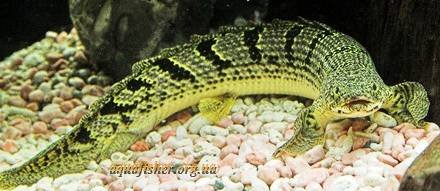 — Armoured bichir — Polypterus delhezi [Boulenger, 1899]. Synonyms: Polypterus ansorgei delhezi. (Eng- Armoured Bichir, Banded Bichir, Barred Bichir). Congo River basin. 35 cm. Differs from other species by obliquely directed dark stripes on the posterior part of the body. Slender, elongated, eel-like body ranging from light olive to brownish-orange (belly lighter) with a greenish sheen, a black spot at the base of the pectoral fins.
There are numerous black dots, sometimes forming a reticulated pattern on the back and flanks. It has 7-8 almost vertical black stripes, which are more or less distinctly visible depending on the individual. The male has 9-12 rays in the dorsal fin, and they begin slightly closer to the head than in other species. Tubular nostrils are clearly visible. Males differ from females by an elongated anal fin.
A predatory species that can eat anything that fits into its mouth. They do not tolerate fish of their own kind, and are much calmer toward larger fish of other species. Compatible with large, active fish capable of defending themselves, which spend most of their time in the upper water layers. Young polypterids can be kept in a small group, but they grow quickly.
For tank decoration, it is advisable to use dark, fine, loose substrate and synthetic flora. They are noted for their attachment to dense plant thickets; some species prefer driftwood and hiding places. The fish are nocturnal, spending daylight hours in shelters and coming out to feed at dusk. Diet: predominantly live food (mainly feeder fish, tadpoles, earthworms). dH up to 12°; pH around 7; T 24-28°C.

 Identification: Genus Polypterus — Polypterus bichir, delhezi.
 — Saddled bichir — Polypterus endlicheri endlicheri [Heckel, 1847]. (Eng- Congicus Saddled Bichir, Saddled Bichir). Africa: Nile, Niger, Volta, Bandama rivers, upper Comoé. 55 cm. The lower jaw is longer than the upper jaw. There are 11-15 dorsal finlets on the back. Sandy-grey in the upper part and paler in the lower, with several indistinct horizontal stripes on the back and flanks.
These stripes can be forked or broken into spots. Irregular vertical stripes are present on the flanks of the fish, which do not extend to the belly, which is uniformly whitish-yellow in color. Black spots are present on the head, body, and caudal fin.
Predatory, piscivorous. Suitable for keeping in a large freshwater display aquarium. Compatible with active, large fish capable of defending themselves, which spend most of their time in the upper water layers. For tank decoration, it is advisable to use dark, fine, loose substrate and live or synthetic flora.
It is advisable to place various rock structures and driftwood in the aquarium with polypterids. Young polypterids can be kept in a small group. Adults often conflict with each other, especially when living space is scarce. Nocturnal fish with very poor eyesight, but an excellent sense of smell to locate prey.
Identification: Saddled bichir — Polypterus endlicheri.
 — Ornate bichir — Polypterus ornatipinnis [Boulenger, 1902]. (Eng- Ornate Bichir). Rivers and standing waters of Nigeria and Cameroon, Lake Tanganyika. 50 cm. Body coloration is extremely variable and unique to each individual. The body ranges from light brown to brownish-grey, with irregular dark brown to black spots and stripes scattered all over the body creating a pattern, and a dark reticulated pattern on the head. Dorsal fin with 9-11 spines. Fins have the same coloration. The male’s anal fin is larger and thicker. They use their pectoral fins to move across the substrate.
They feel comfortable in spacious aquariums with soft, fine-grained substrate, hiding places in the form of caves, rock piles, stones, and driftwood large enough to conceal them completely. The footprint area of the aquarium is more important than its height. They can be aggressive toward conspecifics, especially when there is not enough space to hide. Compatible with large, peaceful tankmates in a large setup with plenty of hiding places, but prefer the company of their own kind. Do not combine with small fish, as they will be eaten. They occupy the lower water layers.
Active at night. Having poor eyesight, they have developed an excellent sense of smell, which they use to find food in low-light conditions. Small fish, even very agile ones, are expertly caught by polypterids, especially at night. Plants are destroyed. Carnivorous, fed with small fish, earthworms, tubifex, bloodworms, frogs, and chopped meat. Undemanding in care. Grow very quickly. Live for 10 years. pH 7.0-8.2; dH 9-18°; T 25-29°C.
 Polypterus palmas, senegalus, weeksii.
Description of the family Polypteridae, Erpetoichthys calabaricus. 


