LAKE MALAWI CICHLIDS.
Order Perciformes
Family Cichlidae
Subfamily Pseudocrenilabrinae
Continued…
Genus Maylandia.

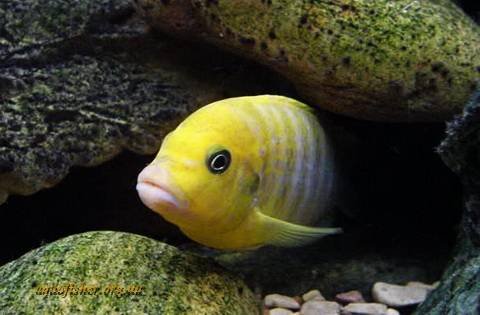
— Maylandia chrysomallos [Stauffer, Bowers, Kellogg, & McKaye, 1997]. Synonym: Metriaclima chrysomallos. 9 cm. Characterized by either an entirely blue body or a blue body with yellow coloration on the lower part of the head, throat, anterior belly, and pectoral fins. Males have light blue flanks with a yellow lower part and 6 grey vertical stripes.
The dorsal fin is pale blue with vertical stripes. Females of certain populations of this species have a beige-brown or beige-blue body and fin coloration. In geovariants with entirely blue males, females generally also have a blue or grey-blue coloration. They feed on loose algae from rocky periphyton. Females and immature males group into large schools in open water.


— Maylandia crabro [Ribbink & Lewis, 1982] — Bumblebee Cichlid, Hornet Cichlid. Synonym: Pseudotropheus, Melanochromis crabro, chameleo. (Common names: Bumblebee Mouthbrooder, Hornet Cichlid). These varieties were originally described as Melanochromis. Lake Malawi. Males up to 15 cm, females up to 11 cm. Adult males are black-brown or velvety black. The dorsal fin is long.
The adult dominant male is almost black with blue vertical stripes, some show bright blue specks, and during spawning becomes almost entirely black. Their fins are dark blue. Males have two to four distinct egg-spots on the anal fin, while females have only one or two.
Fry and females are egg-yellow with 8-10 zigzag black-brown vertical stripes, five of which extend onto the dorsal fin. They are crossed along the entire body length to the tail by a single brown horizontal stripe. Bright blue sparkles are clearly visible on the first rays of the pelvic fins and the spines of the dorsal fin.
Populations inhabiting the northwestern coast of the lake lack yellow coloration in the lower half of the body. Other populations have a base yellow color with wide brown stripes. Still others have a pattern made of yellow-brown spots instead of brown stripes, which does not reach the base of the belly.
The fish got their name from their ability to rapidly change color depending on external conditions and mood. They are able to quickly change their characteristic color pattern from yellow with brown stripes to matte brown. The transverse stripes in females can disappear (making the fish yellowish-brown) or turn into a single solid longitudinal stripe down the middle of the body. In males, rows of bluish-purple transverse stripes appear and disappear.
In nature, they use chameleon coloration when picking parasites from the skin of large cave-dwelling catfishes, while simultaneously stealing their eggs. Color morphs: — M. crabro “Bumblebee Ornatus” and “Chameleo” — a delicate blue and yellow mottling is visible over the brown stripes.
Aggressive, have a pugnacious reputation. Fish stay in the middle and lower water layers. Can be kept in pairs in a community aquarium, but preferably in a group of 1 male to 4-6 females, ideally with aggressive fish that stay in the middle and upper water layers. The aquarium should have thickets, and plenty of caves for females to hide from males, as well as driftwood.
It is not uncommon for males to pursue females to death. A dominant male will kill any rival, including subdominant males. This species may occasionally eat the scales of other fish in the aquarium. Regular water changes are necessary.
Plant and animal food in equal proportions. Fish are prone to overeating. They mature at 9-13 months, with males maturing slightly later than females. Pairs form a territory, which is usually defended by the male. Eggs are laid on a flat stone. The female incubates the eggs in her mouth. Fry grow very quickly. When the juveniles grow up, sexed males must be removed, otherwise the dominant male will kill them. They live up to 8 years. pH 7.5-9.0; dH 12-25°; T 24-27°C.
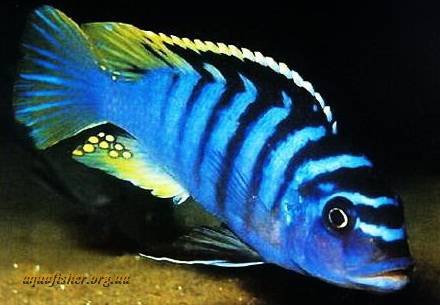
— Maylandia cyaneusmarginata [Stauffer, Bowers, Kellogg, & McKaye, 1997]. Synonym: Metriaclima cyneusmarginatus. 8 cm. Males of this magnificent large zebra are colored as follows: black vertical stripes are located on the blue body, partially extending onto the dorsal fin, along which runs a black submarginal stripe. The anal fin and the soft-rayed area of the dorsal fin are yellow, the caudal fin is adorned with blue rays and edged at the top and bottom with yellow rays.
Sexually active males guard their caves, driving away other fish. Sexually mature females are enticed into the caves, where spawning takes place. Juveniles have the same coloration as females. Black spots in OB morph juveniles appear no earlier than three months of age.

— Maylandia estherae [Konings, 1995] — Red Zebra. Synonym: Metriaclima, Pseudotropheus estherae. (Common names: Cherry Red Cichlid, Ice Blue Zebra, Pearl Zebra, Cobalt Blue Zebra, Orange Blotch Cichlid, Red Zebra Mbuna). Lake Malawi, rocky biotopes. 12-15 cm. They are polychromatic fish, color varies depending on geographical origin.
Various color forms exist in nature within populations, which can differ significantly. Alongside the dark normal color form, there are light blue males. There are also quite rare bright orange specimens. Particularly interesting are marble-colored fish, orange, and yellow with black spots. Albinos are also quite common in stores.
Males are larger, with a more massive head, and have either a different body color or, depending on location, a much more intense color than females. A large number of egg-spots on the anal fin is considered a male characteristic. Males of this species are usually blue. The normal coloration of females is beige-brown, dark orange (with or without spots). Morphs range from very pale orange to pale pink. O-morph females have a rich reddish-orange color. Orange females and blue males (RB zebra).
In M. estherae “Minos” males have a very bright white-pink coloration, which becomes almost white when excited. All females are either entirely red or orange-spotted. Such males combined with red O-morph females are known to us as the “double red” (RR) zebra. Fry from a normally colored blue male and an orange female can be distinguished by sex immediately after leaving the mother’s mouth — males are beige-brown and females are orange. M. estherae “Blueface” — males have the lower part of the head colored dark blue. Females are light brown, but both orange and spotted morphs occur. As for marmalade OB-morph males, they are extremely rare in nature.
Keep one male with multiple females. Fish aggressiveness is below average, occasional skirmishes occur, and even females unready for spawning get harassed. Males are territorial with pronounced intraspecific competition during spawning. The aquarium must have rocks where weaker fish can hide from aggression. Dominant males occupy spawning sites where they invite females. Can be kept in large groups in an aquarium with other Malawi cichlids, but in a larger volume. Neighbors can be other similarly sized and temperamented Malawi cichlids, as well as some catfishes and other large fish.
Gravel substrate, which cichlids will move around, so plants should not be planted. Plastic plants and floating plants can be used. Regular large water changes are mandatory. They are herbivores and in the wild feed on algae; in the aquarium, any food with a predominance of fiber is suitable. They reach sexual maturity at 10 months. Males establish territories. Females care for the fry only as long as they have yolk sacs, then the young move on to free swimming. pH 7.8-8.6; dH 10-15°; T 25-27°C.
 Maylandia fainzilberi, greshakei, hajomaylandi, lanisticola.
Maylandia aurora, Maylandia barlowi, Maylandia benetos, Maylandia callainos.