Order Cyprinodontiformes ( Cyprinodontiformes )
Suborder Cyprinodontoidei ( Cyprinodontoidei )
Family Poeciliidae ( Poeciliidae )
Subfamily Poeciliinae ( Poeciliinae )
Genus Heterandria — Heterandria.
Males are considered among the smallest vertebrates. The body is elongated, moderately flattened. An aquarium with floating plants with long roots is needed. Live food is required, with vegetable food as a supplement. Pregnancy lasts 4-8 weeks, the female drops several fry a day over a long period. Recommended keeping conditions: temperature 22-26 °C, hardness 10-20°, acidity 6.7-8.

— Two Spot Mosquitofish — Heterandria bimaculata [Heckel, 1848]. Synonym: Poeciloides bimaculatus, Pseudoxiphophorus bimaculatus, pauciradiatus, reticulatus, Xiphophorus bimaculatus. (English: Spotted Tail Mosquitofish, Two Spot Mosquitofish). Mexico, Yucatan Peninsula, Guatemala, Honduras. Male 7 cm, female 15 cm. They have an elongated and laterally compressed body with a high caudal peduncle. In fish inhabiting mountain waters, it is stockier. Body coloration varies depending on the habitat region.
The most common coloration is greenish-gray to beige-pink with a purple tint, with a reticulated pattern due to the dark edging of the scales. An orange-red spot is on the gill cover. A black spot is at the base of the caudal fin. The dorsal fin is long, yellowish-green with brown dots and dashes. In the male, the lower part of the caudal fin has a red border.
Fish originating from the Yucatan Peninsula are light gray-brown with a reticulated pattern. A black spot is at the tail root. The lower part of the caudal fin has a light blue border. In the male, the dorsal fin has a yellowish to orange-red border.
Predators, small fish serve as food. Can be kept only in a species aquarium. They stay in the upper and middle water layers. The aquarium should have dense thickets in places and floating plants with hanging long roots. Food: live, additionally vegetable, substitutes. They mature at 4 months. After 6-8 weeks, the female gives birth to up to 40-50 fry up to 1.5 cm in size. pH 6.5-7.0; dH 10-15°; T 22-28°C.

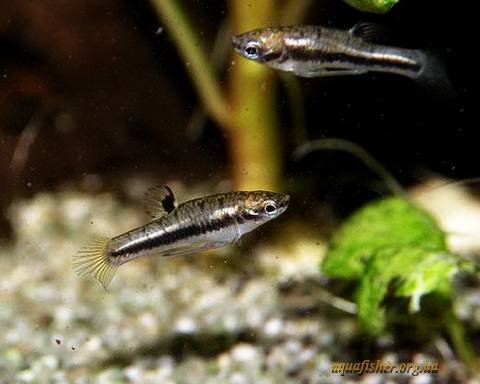
— Dwarf Livebearer, Formosa — Heterandria formosa [Girard, 1859]. (English: Dwarf Livebearer, Dwarf Top Minnow, Formosa Livebearer, Least Killifish, Mosquito Fish). Water bodies of the southeastern USA. Male 1.5 cm, female 4 cm. A very small livebearing fish, males are considered among the smallest vertebrates. Adult males are so small that they are exhausted or eaten by all aquarium inhabitants except the smallest ones. The body is only slightly laterally compressed. The main body coloration is yellowish to olive-brown, with a pearlescent sheen in reflected light.
The upper part of the body is dark olive with small black specks. An uneven, wide, dark brown to black stripe extends from the end of the head to the base of the caudal fin, with 8-12 slightly noticeable transverse wedge-shaped dashes of the same color, clearly expressed under good keeping conditions. The belly is whitish. The dorsal and anal fins are reddish with triangular black spots at their very base. On the dorsal fin, the spot has a reddish-orange edging. The caudal fin is pink.
Peaceful, active. This heterandria is best kept in a large school in a species aquarium with plenty of plants, including floating ones. Fish stay in the upper and middle water layers. Males constantly instigate small skirmishes among themselves, trying to assert their superiority. In winter, it is advisable to lower the water temperature. Against the background of dense fine-leaved plants, it looks better and uses them for shelter. They are very fond of vegetable food, eating biofilms on plants and leftover food.
Fish lift food from the bottom reluctantly, so it is recommended to feed them cyclops, daphnia, and brine shrimp, and they also need vegetable food. Sorted small bloodworms and tubifex are best placed in a floating feeder, from which the fish will gradually eat them. Require a water salinity of 3-5%. Mature in 6-8 months. Reproduce in a general aquarium. Over a very long reproduction period, the female “gives birth” to 1-5 fry every 2-5 days (larger females more), the fry development period is 6-10 days. Lifespan is 3-3.5 years. T 20-23°C; dH 5-20°; pH 6.5-7.5.

 Limia dominicensis, Limia heterandria, Limia melanogaster, Limia nigrofasciata.
Girardinus falcatus, Girardinus metallicus.