



CICHLIDS OF LAKE TANGANYIKA.
Order Perciformes ( Perciformes )
Family Cichlidae ( Cichlidae )
Subfamily ( Pseudocrenilabrinae )
Continued…
Genus Tropheus — Tropheus.

— Tropheus moorii [Boulenger, 1898] — Blunt Head Cichlid. (English: Blunt Head Cichlid). They are found in all rocky parts of Lake Tanganyika. Up to 12 cm, females are smaller. There are over 40 variants of different geographic races, each with its own distinctive coloration. Sexual dichromatism is not developed. The upper lip of males is noticeably larger than that of females. Sometimes stripes are brighter in females. Since subdominant males also have vertical stripes, it is difficult to determine the sex of the fish based on coloration. Males grow at a faster rate and display adult coloration earlier.
The head has a brown or reddish-brown main coloration, sometimes with a blue-green or turquoise pigment. The coloration of the outer part of the upper eye ring is bright. Fish from the southwestern regions of the lake have more or less noticeable stripes between the eyes and bright patterns on the cheeks. Variations found in the type locality have bright light-blue dots on the head. The coloration of the dorsal, anal, and pelvic fins in almost all geographic variants is exceptionally attractive.
The basis of the fish’s diet is the vegetation covering the rocks. Because of this, they very jealously guard algae grounds and exhibit territorial claims to any neighbors encroaching on their feeding zone. Feeding consists of high-quality vegetable foods; a frequent cause of mass mortality in fish is improper feeding, especially when using foods with high protein content. The key to successful maintenance and breeding of Tropheus is the use of spirulina-based foods. Proof of a healthy diet is thick, dark-colored excrement. Animal-derived food is contraindicated; they are very sensitive to improper feeding and can get sick.
They are very demanding regarding water quality. The aquarium must have a powerful, continuously operating filtration system. For the well-being of the fish, it is necessary to change the water regularly and provide a diet that promotes metabolism. It is precisely after a water change that the colors of these magnificent fish flare up.

You need to purchase at least 6-15 young fish and grow them up, then the fish will take their place in the aquarium and skirmishes will be reduced to a minimum. In the aquarium, construct rock formations forming caves, crevices, and similar shelters, the number of which should be greater than the number of fish, as well as separate standalone rocks. In this regard, the minimum volume of the aquarium should be at least 300 liters, as they are often even more aggressive than starred Tropheus.
To minimize intraspecific aggressiveness, it is preferable to keep adult individuals of the same species in a school (10-20 or more individuals), in which the number of females should exceed the number of males by 3 times, and in an aquarium of sufficiently large volume without decorative elements (rocks, caves, artificial plants, etc.) so as not to create demarcated territories. Dominant males only control the spawning site; they practically do not enter rock caves. Only under such conditions can lethal “territorial showdowns” be avoided. When keeping a dozen or more T. moorii in a single aquarium, relative equilibrium is maintained within the school. Skirmishes periodically flare up between males, but they are bloodless.
Dominant males guard their territory and let no one in. Any border violator is immediately attacked, but as soon as they return to the school, the chase stops. Females are the exception. Upon seeing a female, the male begins to display his qualities. Shaking his entire body, the male heads toward a rock. If the female does not swim after him, a light blow or bite immediately follows, and she returns to the school. If ready to spawn, the female descends to the rock. They mature at 14-16 months. Only the female cares for the offspring. The female incubates eggs in her mouth. They live up to 12 years. pH 7.3-9.2; dH 8-22°; 25-28°C.

Various morphs of this species are found throughout the lake. A polymorphic species, it has over 25 color varieties, of which the most interesting is the royal black-brown form with a wide vertical red-lemon stripe down the middle of the body. The variety of color forms is primarily related to the relative isolation of individual islets separated by significant expanses of water. Thus, in the northwestern part of the lake, black, orange, and yellow forms are common; in the northeast, yellow-red, yellow-green, striped, and golden forms; in the southwest, olive-green and black-red; in the south, rainbow and citrin-1; in the southeast, citrin-2. Orange-2, blue-black, green-red, and other forms are also known. — T. moorii “Bulu Point” — Several color variations are known: with 2 red spots on the body, with 2 white spots, with 2 white-yellow spots and red specks on them, with one large red spot; — T. moorii “Chaitika” — One of the most beautiful varieties of the genus. Particularly impressive are the magnificent dark blue dorsal and anal fins; — T. moorii “Fulwe Rocks” — This race is distinguished by the presence of narrow, slightly bluish stripes on the body; — T. moorii “Hinde B” — Somewhat similar to the variety from the Fulwe Rocks area, but the narrow stripes are yellower. The stripes remain in adulthood;

— T. moorii “Ilangi” — Completely yellow body with a dark brown head and dark red dorsal and pelvic fins. Red pigmentation on the back. Yellow-toned females. This beautiful coloration can only occur in aquariums where good maintenance conditions and proper lighting are established; — T. moorii “Kabeyeye” — Body green-blue in the dorsal area, yellowish on the flanks, and greenish in the belly area. Red sparkles near the head. And a yellow dorsal fin. This race is quite close to the Chaitika race; — T. moorii “Kala” — The feature of this morph is its magnificent yellow fins; — T. moorii “Kalambo Golden” — has a rare coloration that appears due to a recessive xanthic (yellow) gene — giving the fish a golden tint. The fish’s other coloration can take on strange color combinations such as orange, yellow, white, and even green and red. This fish has iridescent dark spots on its body and yellow or orange fins. The fish does not assume adult coloration until it is almost fully grown (8-9 cm); — T. moorii “Kalambo” — Bright green body with a wide yellow spot on the flank and small dots on the head; — T. moorii “Kapampa” — On a chestnut body, there is a wide yellow spot in the upper middle part of the trunk (below the dorsal fin);

— T. moorii “Kasanga” — Green-chestnut body with vertical stripes. Wide orange stripe on the flanks. Dorsal and anal fins are red with blue dots; — T. moorii “Kasakalawe” — several color variations are known: with an orange spot on the flanks, with a yellow spot on the flanks and a blue body, with a yellow spot in the lower part of the body and yellow stripes extending upwards from it to the back; — T. moorii “Katili” — This race is colored in green-brown tones, the dorsal fin is transparent with abundant red pigmentation. The head and chest are red. The race does not look bright and attractive; — T. moorii “Katoto” — Representatives of this population have a brown body with a wide pale yellow spot on the flank and small yellow dots on the head. The dorsal fin is lilac; — T. moorii “Kiku” — The coloration of representatives of this race is similar to the coloration of the Kapampa race, but without a bright spot on the body, vertical stripes are barely noticeable; — T. moorii “Kiriza golden” — black (melanin) coloration is practically absent, and yellow coloration spreads over almost the entire body and fins;

— T. moorii “Kiriza OB” — dark (black, dark brown) spots are randomly scattered across the body and head, partially concealing the yellow coloration of the vertical stripe or the entire body; — T. moorii “Lufubu River” — Representatives of this population have a lilac-yellow body. All fins and the head are pinkish, with yellow dots on the head; — T. moorii “Lusingu” — Tropheus of this population are very similar to the morph from the Moba area; — T. moorii “Lyamembe” — Representatives of this population have dorsal and anal fins with a green sheen, and there is also some greenish pigment on the body and on the brownish-toned head. At the moment of excitement, a green spot appears on the flank. Two stripes on the snout; — T. moorii “M’tosi” — This race is very similar to the Fulwe Rocks race; — T. moorii “Mamalesa” — This race is distinguished by a small number of yellow dots aligned vertically on the flanks. The dorsal fin is yellowish-gray; — T. moorii “Moba” — This race is distinguished by the presence of large dots on the head and practically absent stripes on the body; — T. moorii “Moliro” — The head and tail are black, and the body is dark red, the intensity of which changes depending on mood, the back area behind the head is light green; — T. moorii “Mpulungu” — This race is distinguished by blue pigment on the head and the presence of small yellow dots and a wide orange stripe on the body. Pectoral fins range from yellow to green or yellow-orange, dorsal fin with dominant blue, red, or yellow-green color depending on the individual;
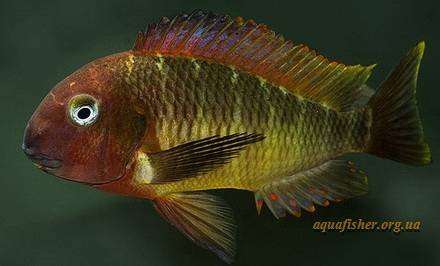
— T. moorii “Murago gelb” — body and dorsal fin are colored yellowish-brown, there is a large number of yellow specks on the head; — T. moorii “Mutondwe” — This race is distinguished by a wide yellow irregular spot on a dark brown body. The dorsal fin is colored blue in the spiny-rayed zone. There are no spots or dots on the head; — T. moorii “Muzi” — This race is distinguished by the presence of blue dots on the dorsal fin. There is no bright yellow spot on the body, but there are more blue dots on the dorsal fin than even in the “Red Rainbow” race; — T. moorii “Mwerazi” — This race is distinguished by smaller dots on the head compared to the Moba and Lusingu races, the presence of stripes between the eyes, and a yellowish stripe on the flanks; — T. moorii “Namansi” — This race is characterized by a yellowish-brown fish, sometimes an orange tint appears on the body;
— T. moorii “Nangu” — This race is distinguished by a green-yellow body with quite bright stripes. The head has a lilac sheen, while the dorsal fin is of yellowish shades. There are no yellow dots on the head; — T. moorii “Nkonde” — This race is distinguished by almost yellow body and head, the head sometimes has a lilac tint in reflected light (similar to Tropheus moorii “Ilangi”); — T. sp. “Red” — Velvet-red color is present in the body coloration of all races of this variety; — T. moorii “Samazi” — Body brownish, stripes thin white-yellow. Red and blue pigment on the dorsal fin is barely noticeable; — T. moorii “Siyeswe Bay” — red spots on a dark brown background in fish are bright, larger, and have clear light borders at the edges; — T. moorii “Zongwe” — This race is distinguished by a green-chestnut body with many yellow dots on the head. These dots are the same size as those of the Moba and Lusingu races.
— Two-spotted form. Body black, with 2 large vertically elongated spots on the flank.
— Yellow form. Body black with wide lemon-yellow cross stripes.
— Yellow-green form. Main body coloration dark brown, part of the back copper-colored, with a lemon-yellow spot on the flank.
— Yellow-red form. Black body with varying widths of cross stripes that are yellow on the upper body and turn red towards the belly.
— Yellow-gray form. Body gray to gray-green. Belly whitish. Head with small light dots. Dorsal fin yellowish-white.

— Green form. Body green to olive-green. A narrow shiny yellow cross stripe at the front of the body.

— Royal form. Main body coloration dark coffee, fins black. 2/3 of the body, depending on the fish’s mood, glimmers with a shiny golden-yellow color. With a wide vertical red-lemon stripe down the middle of the body. Fry is unremarkable — grayish-brown with a dingy yellow, barely perceptible center.
— Red-green form. Body dark green, belly yellow or red. Dorsal fin ranging from copper to red.
— Lemon form 1. Body, caudal, and pelvic fins olive-green. A lemon-yellow spot on the lower half of the body between the gill cover and the base of the anal fin. The area between the gill cover and the base of the pelvic fins is red-purple. The front part of the anal and dorsal fins is red-purple, the rear is yellow.
— Lemon form 2. Body dark olive-green to black. A shiny yellow spot on the lower half of the flank. Anal and dorsal fins gray-green.
— Olive-green form. Body olive-green. Cross stripes and lemon-yellow spots on the flank, three orange stripes near the mouth. Belly yellow.
— Orange form. Body olive-green to black-gray. Light dots on the head. Orange spot in the middle of the body. Throat, anal, and dorsal fins of a shiny, pale blue color.
— Orange form 1. Body black to black-brown, with a wide orange stripe divided into two parts by a dark stripe, which extends onto the dorsal fin where it becomes almost yellow.
— Orange form 2. Black body with wide cross stripes of varying lengths of orange-red color.

— Striped form. Body and fins brown to olive-green. 5-6 yellow cross stripes on the flank. Belly lemon-yellow.
— “Cherry Head” form. Main body and fin coloration black, trunk between the gill cover and the start of the anal fin silvery-white, head cherry-red.
— “Yellow Throat” form. Body dark brown, throat shiny golden-yellow. 5-6 faint yellow cross stripes in the upper half of the body. Dorsal fin dirty yellow in the spiny-rayed part.
— “Blood Throat” form. Body brown-black. In active fish, depending on mood, the throat and body up to the base of the pectoral fins can become blood-red. Dorsal fin sometimes red.
— “Murago” form. Main body and fin coloration gray-green to gray-brown. Head red-brown with greenish-white dots. 8 yellowish-white cross stripes on the flank. The spiny-rayed part of the dorsal fin can turn lemon-yellow.
— “Striped Tail” form. Body and caudal fin brown-black, cherry-red cross stripes or large spots on the rear 1/3 of the body. Bases of the anal and pelvic fins bluish. Anal and dorsal fins cherry-red at the front.
— “Choco” form. Body black-brown, with a yellow spot near the back and belly. Sometimes a yellow cross stripe appears.
— Striped forehead form. Body dark green to black, yellow stripes near the mouth. Anal and dorsal fins golden-yellow.
— Black form. Body black-brown. Dorsal fin orange-red with a pattern of black dots.
— Black-blue form. Body black-blue in color.
— Black-red form. Body black. Depending on the fish’s mood, it can become blood-red with a black sheen along with the fins. Anal, dorsal, and pelvic fins are red.
— Black-orange form. Body dark brown to black, with orange-yellow spots or rarely cross stripes on the flank.
 Xenotilapia bathyphila, boulengeri, caudofasciata.
Tropheus duboisi, Tropheus polli. 


