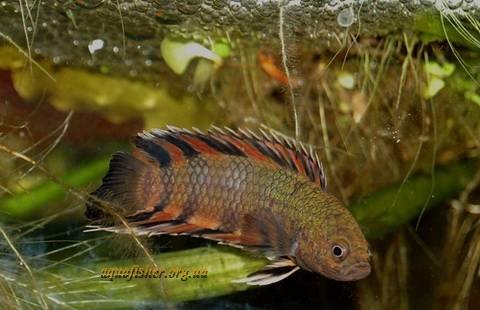
Order Perciformes
Suborder Anabantoidei
Family Anabantidae
Genus Microctenopoma

— Microctenopoma ansorgii [Boulenger, 1912]. Synonyms: Anabas davidae, ansorgii, Ctenopoma ansorgii, davidae, Microctenopoma ansorgei. (English: Climbing Perch, Pretty Ctenopoma, Rainbow, Ornate, Orange Ctenopoma). Central and Western Africa, Angola and Cameroon, middle Congo River. They stay near the banks of slow-flowing waters under the protection of plants and among tree roots.
Males grow up to 8 cm, females are smaller. The body is elongated with straight profiles of the back and belly, slightly flattened laterally. In both sexes, the dorsal and anal fins are long, extending evenly from the head to the tail.

This ctenopoma is the most brightly colored of the entire genus. The coloration is brown, orange to yellowish-brown with a greenish, blue, or violet sheen, and the lower part of the body is often yellowish. The dorsal and anal fins are long. There are 6-7 vaguely defined reddish-brown wide vertical bars on the flanks, extending onto the reddish-brown dorsal and anal fins. In the male, the last rays of the dorsal and anal fins are elongated and white.
Sometimes it is called the “orange fish” because the elongated dorsal and anal fins (especially in males) seem to continue the lateral vertical lines, and the space between them shimmers with an orange-red color during spawning games. The caudal fin is translucent with a brown tint. In this state, the male’s body coloration acquires a golden hue, the caudal fin turns black, and a white margin appears on the dark background of the ventral fins.

It is best to keep them with similarly sized and tempered tankmates. Keeping them in a community aquarium is not excluded (then they lead a solitary lifestyle), but a species aquarium still has advantages. They maintain a hierarchical relationship among themselves, meaning constant duels occur, while they remain peaceful towards other fish of equal size. Males are especially aggressive towards each other during spawning. A tight-fitting cover glass is mandatory; without it, they will jump out. They breathe atmospheric air using a labyrinth organ.
They inhabit the middle and lower water layers. Ctenopomas do not swim aimlessly; after each feeding, they retreat to a shaded area to digest their food and reappear in about an hour. These beautiful fish like to live in dense plant thickets. Floating plants with large leaves should be present at the surface, under which the male builds a bubble nest. Filtration, aeration, and weekly water changes are required. The water is usually slightly acidic and very soft, peat-filtered. Successful breeding occurs only in very soft water.
The diet consists mainly of small frozen or live foods, and they rarely accept dried products. These are rather slow fish, and more agile species can leave them hungry. Sexual maturity is reached at the age of 1.5-2 years. In a large aquarium, fish often spawn on their own. Males build a small nest of large bubbles among floating vegetation or under a broad leaf in a shaded spot. The female spawns transparent, oil-containing eggs that float to the water surface and are placed into the nest by the male. They live up to 5 years. T 24-26°C; dH up to 8°; pH 6.0-7.5.


— Microctenopoma congicum [Boulenger, 1887]. Synonyms: Anabas congicus, congica, Ctenopoma congicum. (English: Congo Ctenopoma). Gabon, Congo: Ogooué, lower Congo, Ubangi. 6-8 cm. Reddish-brown coloration with 3 dark rays extending from the eyes, speckles on the dorsal fin, and streaks on the anal fin. Older males have long anal and dorsal fins.
The Congo ctenopoma and the eight-banded ctenopoma are very similar and are often confused even by dealers: both are striped, adorned with greenish-blue dots, and feature unpaired fins. However, the second species has a noticeably larger caudal fin, and its dorsal and anal fins are more elongated. Unlike other ctenopomas, they are peaceful. In the aquarium, it is quite finicky and falls ill on a monotonous diet. They live up to 4 years. pH 6.0-7.8; T 23-28°C.

 Identification: Genus Microctenopoma — Microctenopoma ansorgii, congicum.
 Microctenopoma damasi, fasciolatum, nanum.
Ctenopoma nigropannosum, ocellatum, petherici, weeksii.