


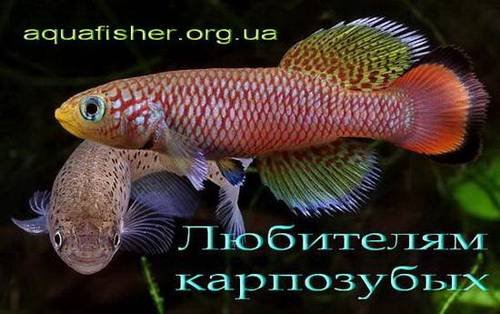
Order Cyprinodontiformes
Superfamily Cyprinodontoidae

They combine 3 superfamilies, of which egg-laying and live-bearing toothcarps are kept in aquariums. They are distributed in stagnant waters of tropical and subtropical regions. Resembling small cyprinid fish in appearance, Cyprinodontiformes differ in having teeth on their jaws, which is never the case in Cyprinidae. Today, most aquarists know them better by the name Killifish. The word “kill” means small ditches in meadows and small water bodies. They were first noticed in ponds and small water bodies around New York. These finger-length fish were called “killifish”. The geographical distribution of these fish is very wide: America, Africa, Asia, southern Europe. Only in Australia have their representatives not been found. The greatest species diversity is observed in Africa and America. About 35 species live in Asia, and 2 species in Europe.
Despite their vast ranges, individual species of Cyprinodontiformes are narrowly specialized to their specific habitat. Ecological specialization is so high that some species are found only in hot mineral springs in the southwest of North America. Others have managed to adapt to living in seasonally drying savanna water bodies. If a body of water is inhabited by seasonal fish and loses water during the dry period, the species composition of a particular year may differ significantly from the species composition of the previous season. The alternate appearance of one species or another in the body of water is often observed.
They are found in a wide variety of places and, depending on the species, prefer salt, fresh, or brackish water. In general, they are all inhabitants of the littoral zone. Most species can be found in shallow waters near the shores, where there are both open spaces for feeding and abundant vegetation, convenient for quickly escaping from enemies.

Annual killifish live mainly in the savanna belt, called the bush in Africa and the pampa in America. Two seasons are usually clearly pronounced here: the rainy season and the dry period. Depending on the amount of precipitation, the savanna is divided into humid and dry. The humid savanna is adjacent to the region of humid (rainy) tropical forests. Most water bodies do not dry up, although their area is significantly reduced. In the dry savanna, precipitation is much less. Local water bodies dry up completely, so only annual species could survive in them. During the dry season, life in these areas completely freezes, animals go where there is water. Plants shed their leaves and enter a dormant period.
The fish wait out this time in the form of eggs whose development has stopped. Their shell is so strong that it can easily withstand not only drought, but also the heavy tread of an elephant. Life returns to the savanna with the first long-awaited rains. In some areas (e.g., Southeastern Africa), two rainy and dry periods alternate throughout the year. From November to May, it rains here, interrupted by a three-month drought from January to March. The equatorial rainforest is characterized by weather changes during the day, which are more abrupt than throughout the year. As you move away from the equator, seasonal differences in climate become more pronounced.
The descriptions of individual representatives of the order provide brief information about ranges and biotopes, which will help select fish for a general aquarium. This information makes it notice that sometimes it is impossible to house two closely related species living in adjacent territories in the same aquarium, since one of them may be an inhabitant of warm swampy waters and the other of fresh mountain streams. And conversely, many South American Rivulidae, African Aplocheilidae, or North American and Middle Eastern toothcarps will get along quite well in the same aquarium, despite the fact that thousands of kilometers separate them in nature.

The adaptability of seasonal fish to existence in temporary water bodies is expressed, in particular, in the fact that, having hatched from eggs, they grow very quickly, mature, and begin to reproduce. During floods, small swamps, ponds, and puddles are filled with rainwater, and the fish spread out into the flooded forest or grassy clearings where they spawn. In the river, they can stay only in coastal areas densely overgrown with aquatic plants. Fish do not swim well over long distances, and therefore full-flowing rivers are insurmountable obstacles for them. Within a few months, the swamps gradually dry up, and eventually, only a small patch of moist soil remains of such a body of water, sometimes with remnants of water in deeper places. In this state, it exists until the next rainy season, and the cycle repeats.
Such unusual living conditions have led to the fact that fish inhabiting such water bodies have developed interesting biological features and an extraordinary life cycle. Firstly, since their habitat completely disappears during the drought period, the fish living there correspondingly die. Their complete life cycle manages to pass in just a few months, which is why they are rightfully called annuals. This implies the very fast growth and early sexual maturity of these species. The fish spawn very intensively, practically every day. To continue the lineage, eggs remain in the moist soil that previously formed the bottom of the water body, and under these conditions, they survive until the next wet season.
Secondly, the eggs remain viable for a very long time (several months, and under artificial conditions up to a year or more) — that is, the development of the eggs is delayed for a long period. The outer layer of the egg is covered with special sticky villae to which sand and dust adhere. Thanks to this, the egg is covered with a protective shell that retains life-giving moisture and withstands significant external loads. In this form, the egg lies in the dust for many months, waiting for the first rain.
Thirdly, the physical and chemical parameters of water in natural water bodies change significantly in different seasons. Water bodies are filled with soft, clean rainwater, and after a few months, due to evaporation, decay processes, and the dissolution of rocks making up the soil in the area, the water becomes hard, rich in organic matter, and often poor in oxygen. Almost all species, when first introduced into aquariums, cause trouble for the first few generations. Then, among aquarium fish, specimens appear capable of living in harder tap water as well.
Fry of seasonal fish are born fully formed, without a yolk sac, and immediately begin to actively swim and grab food. They grow, as already mentioned, very quickly: by three weeks the fish are already colored, and at 1.5 months some (most Nothobranchius) begin to reproduce. In a number of regions of Africa and Brazil, there is not one rainy season alternating with drought in a year, but two or even three. Fish with a shortened egg development period live in such places.
Individual water bodies in these areas may not even dry up — seasonal fish can live longer in them, up to two years or more, and their eggs successfully develop in water without an obligatory dry period. These are already transitional – semi-seasonal species; they are equally adapted to purely aquatic egg incubation and to its development in the air. Seasonal fish can be quite numerous in their habitats.
If you want to spawn killifish in your aquarium and raise the fry, first of all, you must create the same conditions, i.e., imitate a drought after the parents have spawned, placing the eggs in, for example, peat. Thus, they will first “sleep” and then develop slowly, so that with the appearance of water (imitation of the rainy season), they begin to actively develop and grow.

In addition to annual species, there are also species that inhabit non-drying water bodies — rivers of various sizes, streams, lakes, and swamps. Their biology and behavior, as well as their method of reproduction, differ from those of fish from temporary water bodies, although there are common features. The main differences are that the eggs develop in water and the incubation period is not as long. Most often, eggs are deposited on fine-leaved plants or similar substrates.
In most cases, the body shape also differs: in annual species, the body is higher, and the dorsal and anal fins are almost identical in shape and size. The division into two groups based on these features is unclear, since there are a large number of intermediate forms whose reproduction method can be carried out by both methods equally or with the predominance of one of them. These are species that in nature inhabit water bodies that do not dry up every year, or live in both temporary and permanent water bodies.
 Keeping toothcarp fish in the aquarium.


