Order Cyprinodontiformes
Superfamily Cyprinodontoidae
Family Rivulidae
Genus Simpsonichthys. Simp.

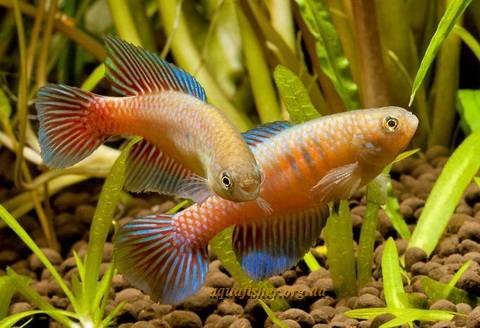
— Simpsonichthys boitonei [Carvalho, 1959]. Code: BOI. Synonym: Cynolebias boitonei. (Eng.: Brazilian Pearlfish, Lyrefin Pearlfish). Brazil – mountain waters of Goiás state (about 1000 m above sea level). Male up to 3.5, female up to 2.5 cm. Males have a particularly exquisite coloration. The upper part of the male’s body is dark olive, the middle and lower parts are intensely red-brown with transverse blue stripes turning into dots towards the caudal fin. Female is brownish-olive with duller spots and stripes.
Active, solitary, relatively peaceful fish. Males are intolerant of each other. Once in a community aquarium, they will not leave their hiding places for a long time, even when hungry, if larger fish of other species, even non-predatory ones, are present at the feeding site. Best kept in a species aquarium. dH 4-15°, pH 6-7, T 20-22°C.


— Simpsonichthys constanciae [Myers, 1942]. Code: CNS. Synonym: Cynolebias constanciae. (Eng.: Feather Fin Pearlfish). Brazil. Male up to 8, female up to 6 cm. Body elongated, slightly compressed laterally. Male coloration is olive-gold, with 2 longitudinal rows of coffee spots running from the middle of the body to the caudal peduncle, forming a marble-like “checkerboard” pattern. The rest of the body and fins are covered with dark brown to black spots. In addition, many small brightly shining specks are clearly visible on the unpaired fins. Flank with a faint green-blue sheen.
The outer rays of the dorsal and anal fins are elongated and filament-like. The ends of the anal and dorsal fins are blackish. An excited male is especially magnificent under lateral lighting. Female is brown with dark spots, among which 1-2 rounded spots in the middle of the body stand out, and shiny colored specks appearing during the spawning period serve as a good distinguishing feature when compared with very similar females. The coloration of the fish, especially under stress, does not look as beautiful as in other members of the genus. Fish are undemanding, rarely sick. Prefer live foods. Spawn in peat. Hardness 4-12°, pH about 7, temperature 20-23°C.

— Simpsonichthys magnificus [Costa & Brasil, 1991]. Code: MGF. Synonym: Cynolebias, Hypsolebias magnificus. Central Brazil. Males are predominantly purple with a green tint on the flanks and reddish in the dorsal area. Blue dots decorate the sides, except for the belly area. There are two or three faint spots below the anterior margin of the dorsal fin. Anal fin slightly elongated, caudal fin rounded. Unpaired fins are red with transverse rows of greenish-blue stripes. Females are light brown with dark spots and specks and a light belly. Unpaired fins are colorless. Adults will eat live and frozen food. Fish can start spawning at the age of four months. pH 7.8-8.0; T 24-26°C.

— Simpsonichthys myersi [Carvalho, 1971]. Code: MYR. Synonym: Cynolebias myersi. Brazil. 6 cm. Along the olive-blue tinted body surface of males run 14 vertical burgundy-brown stripes, extending onto the elongated and filament-decorated dorsal and anal fins. Caudal fin is pointed. Females are gray-brown, with dots on the flanks and at the base of the caudal fin. It is better to keep fish not in community aquariums, but in small species aquariums. These should be shaded waters with a soft dark substrate. Surface-floating plants are very good.

— Simpsonichthys picturatus [Costa, 2000]. Code: MYR. Synonym: Cynolebias myersi. Brazil, São Francisco River basin. 4 cm, females are smaller. Body coloration is beige with several dark spots on the flanks. Males have rounded dorsal and anal fins. Keep 1 male and 2-3 females. Best kept in a small aquarium with light filtration, in slightly soft, acidic or neutral water. Substrate should be soft, preferably peat several centimeters deep. Preferable to feed live or frozen foods such as daphnia.

— Simpsonichthys reticulatus [Costa & Nielsen, 2003]. Code: RTC. Brazil. 4 cm. Dorsal and anal fins are elongated and pointed. Intraspecific aggression is quite high and can lead to fin damage. The aquarium must be tightly covered on top, otherwise the fish will find a large enough gap and jump out. The aquarium should be planted with vegetation, with open swimming space and driftwood shelters. Water current should be weak. Fish can eat many worms without the threat of obesity. They reach sexual maturity in 3 months. They live for about 1.5 years.

 Identification: Genus Simpsonichthys.
 Profundulus punctatus, Valencia hispanica.