


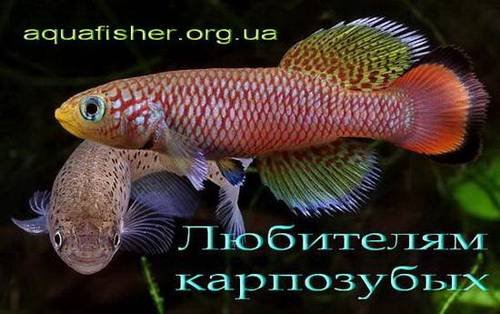
Order Cyprinodontiformes
Superfamily Cyprinodontoidae
Family Nothobranchiidae
To be continued…
Genus Nothobranchius — Nothobranchius. N.

— Nothobranchius thierryi [Ahl, 1924] — Togo Killifish. Code: THI. Synonym: Fundulosoma thierryi. (Eng.: Togo Killifish). Southeastern Ghana, Togo, Mali, Nigeria. Very small species, up to 3 cm, females are smaller. The body of males is colored from metallic blue to dark blue. Depending on the population, a few or many red spots are scattered across the body. Unpaired fins are yellowish with red dots and a red border. The caudal fin is orange and lyre-shaped, with dark edges. Females are monochromatic, light brown to dark brown. Fins are transparent with isolated dark spots.
Keep in a group in a species aquarium with a predominance of females; the background should be densely planted with vegetation to provide hiding places. Regular water changes are mandatory. If the fish begin to look poorly and clamp their fins, salt should be added to the water. Feeding with live and frozen food. According to their mode of reproduction, they belong to the so-called annual species, meaning their entire life cycle takes place within one year. Spawning occurs several times a day for several weeks. Sometimes breaks in spawning occur—the fish rest, but this usually lasts no more than 1–2 weeks. Since spawning takes quite a long time, spawning fish must be fed abundantly. pH 6.5–8; T 20–24°C.


— Nothobranchius ugandensis [Wildekamp, 1994] — Uganda Nothobranch. Code: UGA. (Eng.: Uganda Nothobranch). Africa, Kenya, Uganda — seasonal freshwater swamps and water bodies. Up to 6 cm. Body is elongated. Scales on the flanks and under the eyes have tiny serrations. The origin of the dorsal fin is located slightly behind the anal fin. Mouth superior, large. All fins are rounded. Scales are blue with dark burgundy edges, giving the fish’s body a reticulated pattern. Pectoral fins are transparent, with a blue border on the edges. The dorsal fin is large, yellow-olive at the base, blue towards the end. Dark red spots are present at the bases of the dorsal and anal fins. The caudal fin features alternating stripes (from base to edge): blue-purple, red, and black.
Males are territorial; constant skirmishes occur between them in small aquariums. Optimally, keep one male and 2–3 females in a single aquarium. If the aquarium is large, several males can coexist, provided there are plenty of hiding places and plant thickets. Can be kept with calm, peaceful fish. Occupies the lower water layer. The aquarium should feature dense plant thickets, including floating plants. Lighting should be subdued. Floating plants must shade the aquarium. Aeration, filtration, add salt to the water (1 tablespoon per 4 liters). Perform a 20% water change once a week. Susceptible to oodiniosis. Sexual maturity at 1–3 months. Lifespan up to 1 year. Temperature 24–29°C. dH 10–15°, pH 6–7.

— Nothobranchius virgatus [Chambers, 1984] — Nothobranchius virgatus. Code: VRG. Sudan. 4.5 cm. The origin of the dorsal fin is above or slightly ahead of the anal fin origin; when folded, the dorsal fin reaches the base of the caudal fin. The anal fin almost reaches the base of the caudal fin. Ground color ranges from brownish-green to light yellow. There are 10–14 thin chestnut-red oblique lines on the flanks. Gill covers are edged with red and black, with irregular short lines forming a chevron-like pattern on the gill covers. These strokes do not always extend the full height of the body and are often absent on the dorsal and ventral parts.
The dorsal and anal fins feature a large number of red-brown dots, widely edged with a reddish-brown border. The caudal fin has a black border, with a whitish spot in the center or closer to the edge. Pelvic fins are red with black dots. Pectorals are transparent. The caudal fin is pale with a thin dark border and a white stripe in front of it. In both sexes, a short dark vertical stripe crosses the eye. The female is darker in the posterior part; the ventral side is white. All fins are transparent.
The male from the Fula population has a body coloration predominantly of golden-bronze or shiny light green. 10–14 thin oblique lines directed backwards run across the entire body. The black stripe passing through the eye is absent. Some males have a hump at the transition from head to back, while others have a concave dorsal line. Numerous shiny golden-yellow scales are scattered on the flanks. An orange to bronze-golden spot is present on the edge of the gill cover. The anal fin features a dotted pattern including orange-red spots arranged somewhat regularly. The edge of the anal fin is yellow-orange.
The dorsal fin features a pattern of brown-red stripes. Thin red-brown stripes are separated from each other by whitish to golden-yellow zones. An incomplete light sky-blue zone runs along the edge of the caudal fin, followed by a very narrow red to red-brown stripe. Females from the Fula population are quite plain, varying from gray-brown to light brown with a few sparkles on the lighter flanks. The ventral area is lighter. All fins are transparent. Some specimens have a few narrow stripes running obliquely backwards, but they are lighter and less distinct.
 Scriptaphyosemion brueningi, Scriptaphyosemion geryi, Scriptaphyosemion liberiense.
Nothobranchius rachovii, Nothobranchius rubroreticulatus, Nothobranchius symoensi. 


