Order Cyprinodontiformes
Superfamily Cyprinodontoidae
Family Nothobranchiidae
Continued…
Genus Nothobranchius. N.

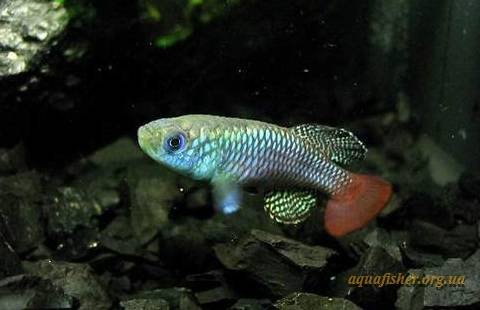
— Nothobranchius kafuensis [Wildekamp & Berkenkamp, 1989] — Kafue Killifish. Code: KAF. Zambia. 6 cm, females are smaller. There are two color phenotypes in males: red and blue. In males of the red phenotype, the main body color is yellow-gray to grayish, and the belly is whitish-gray. The dorsal fin is grayish with a dark gray reticulated pattern.
The caudal and anal fins are also grayish with lighter grayish and black bands. The central part of the scales on the body and the back of the head is sky-blue. The edges of the scales are orange-red, forming a regular reticulated pattern all over the body. The chin, jaws, and upper part of the head are deep red-orange. The outer part of the gill membrane is red with a thin white border.
The dorsal fin is blue to greenish-blue with irregular red to reddish-brown spots and streaks along the base, gradually becoming less intense and smaller towards the outer edge, which is colored in the primary blue color. There is a thin light blue border on the dorsal fin. The anal fin is colored brownish orange-red along the base. Numerous red spots and streaks are also located on this fin.
The caudal fin resembles the anal fin. Along the base, it is blue with irregular red to orange spots. The front part of the fin is darker brownish, followed by a more orange part and a dark band. The pelvic fins are also blue at the base with red spots and a border consisting of a whitish luminous strip framed by black. The pectoral fins are transparent with a white to whitish-blue edge.

Males of the blue phenotype differ from the red one by a more distinct marbled pattern at the base of the anal and caudal fins, followed by a wide blue band and a thin black one. The scales on the body also have a light sky-blue center surrounded by an orange-red border. The reticulated pattern on the body is more irregular than in the red phenotype, forming irregular transverse bars on the body. The chin, jaws, and upper part of the head are red-orange. The gill membrane is red with a thin white border.
The dorsal fin is greenish-blue with a thin bluish band and red-brown irregular spots and streaks. These spots are larger near the base of the fin and smaller near the edge. The outer half of the anal fin is light grayish-blue with a pattern of red irregular spots, followed by a wide white to light blue band and a black border. The caudal fin is also grayish-blue in the front half, followed by a whitish band and a black marginal band.
Females of different populations do not differ from each other. They are lightly colored in yellowish-gray-brown, slightly darker on the back. The scales on the front part of the body and gill cover have a shiny silvery center. All fins are colorless, sometimes slightly brownish and transparent. There is no pattern on the body. Males of this population are very aggressive towards each other. This species is sensitive to Oodinium, to combat which table salt is added (1 teaspoon per 5 liters of water) or a constant weak water current is provided using a small pump.


— Nothobranchius korthausae [Meinken, 1973] — Korthaus’ Killifish. Code: KOR. Tanzania. 4 cm. Found in two color variations, yellow-brown to yellow-green (sometimes bluish) and dark red. The yellow-brown form is better known to aquarists. Both color forms crossbreed, and several intermediate forms are known. The body coloration of the male of the yellow form is yellow-brown or brownish-blue with a metallic sheen, slightly more brownish towards the back. The front part of the body is bluish, more brownish-red in the belly area and on the caudal peduncle. The scales are mostly yellowish with a reddish-brown to tomato-red border, which forms a reticulated pattern over the entire body.
The fins are yellow with numerous black or reddish-brown stripes. The dorsal fin has 12-15 chocolate-brown slightly rounded stripes and a wide band with black dots, while the anal fin has a thin black stripe. On both fins, the outer edge is bordered in white. The caudal fin is also mostly colored yellow, with 6-7 vertical black to dark blue stripes. There is also a pure white edge. The pectoral fins are transparent, slightly amber with white to vaguely blue spots.

In red males, the fins are dark red with darker stripes. Lighter males may have the same, although paler, pattern as the yellow-brown form. The fins are edged with a blue to whitish border. Females are very simply colored, the body is olive-brown, and all fins are transparent. In males, the rays of the dorsal fin diverge towards the free edge, while in females the fin is more rounded. The dorsal fin in males when folded reaches the end of the caudal peduncle and sometimes further, while in females it is no longer than the middle of the caudal peduncle. Pectoral fins are rounded, in both sexes extending beyond the base of the pelvic fins. The rear edge of the caudal fin is rounded.
A comparatively dull fish that requires rich aquatic vegetation when kept in a community aquarium. The aggressiveness of the male depends on its temperament, and quite peaceful specimens are often found. When keeping several males together, they show primitive territorial behavior, but real aggression is usually reduced to timid attacks. A dark substrate is better, preferably with peat. They eat all kinds of live foods of a suitable size. Sex can be determined only at the age of 6-7 weeks.
They reach sexual maturity only at the age of about 12 weeks. Slower growth is also associated with a longer lifespan. Although in nature they are found in fresh, slightly acidic water, they adapt very easily to neutral or even slightly alkaline water. Given their increased sensitivity to velvet disease (oodiniasis), it is recommended to add a teaspoon of salt for every 10 liters of the aquarium. Water is old, peaty, hardness 5-12°, pH 6-7, temperature 21-23°C. Breeding is simple. Fish spawn not only among plants, but also in sand, peat, and even on the bare glass bottom or in the corners of the aquarium.

 Identification: Genus Nothobranchius — Nothobranchius kafuensis, korthausae.

— Nothobranchius kiyawensis [Ahl, 1928]. Code: KIY. Synonyms: Nothobranchius kiyawensis, gambiensis; Fundulus, Pronothobranchius gambiensis, kiyawensis; Aphyosemion seymouri. Senegal, Gambia, Mali, Ghana, Togo, Benin, Niger, Nigeria. 3-3.5 cm. Male bluish-greenish with red dots on the body and fins. Several spots on the flanks. Unpaired fins are red with a blue border, with yellow stripes inside. Female is brown, fins are colorless. Quarrelsome, aggressive, it is advisable to keep 1 male with 2-3 females in a species aquarium with a substrate of peat crumbs 2-5 cm thick and a few bushes of Thai fern.

— Nothobranchius luekei [Seegers, 1984]. Code: LUK. Subgenus Aphyobranchius. Tanzania. 4 cm. The caudal fin is not rounded like in typical Nothobranchius representatives, but pointed, with an elongated middle part. Pelvic fins are very small. In the male, the main body color is metallic blue, brownish on the back, whitish on the belly, and the throat is yellow. A red-brown mesh is noticeable on the flanks. The thickness of the mesh becomes larger towards the back and mainly towards the rear end of the body. At the intersection points, the red color of the mesh becomes darker. On the abdominal side, the main color is lighter, and closer to the back – darker.
Pectoral fins are colorless with a light white-blue marginal band. Very small pelvic fins are green-blue, bordered with yellow and orange-red. The anal fin is brownish with a green-blue sheen. On this fin, you can also notice red and bright yellow streaks coming from the outside inwards, followed by a thin marginal red stripe. This stripe becomes wider from the rear end of the fin to the front, and at the front edge makes up 1/3 of the fin width. In the middle, the fin is slightly curved and behind this stripe goes a red scar.
The dorsal fin is greenish-yellow in the front part with orange-red dots, more sparsely scattered on the back of the fin and irregular in the front part. The orange color is more intense along the edge of the fin, and the orange dots merge into a solid colored line. The caudal fin is red or brownish-red with a thin marginal stripe. Along the upper and lower outer edge, the red coloration may be more intense; some specimens caught in nature even had a continuous red stripe around the caudal fin.
The coloration of the female is uniformly gray with a silvery belly and blue sheen on the gill covers and along the edges of the scales. The fins are transparent. There is no pattern on the fins. In females, just like in males, the middle rays of the caudal fin are elongated, which gives this fin a spear-like shape.
They inhabit the upper water layers rather than the lower ones. The aquarium for keeping them should be densely planted with water fern to provide females and weak males with hiding places. Frequent water changes are also necessary for the well-being of these fish. Males are not aggressive towards each other. Stronger males still push weaker ones into more illuminated areas of the aquarium. If the aquarium is spacious enough, torn fins and beaten fish are rarely observed. In a spacious aquarium, you can keep several males simultaneously if there are 10-15 liters of water per each. You should avoid putting 2 males in one small aquarium; in this case, the stronger male will constantly chase the weaker one or even kill him.
At too high a temperature, lifespan is significantly reduced. Adding salt (1 tsp per 10 l of water) as a preventive measure against oodiniasis. A peculiarity of this species is the fact that the spawners do not go down to the bottom to lay eggs. Spawning can take place anywhere in the aquarium, preferably in open areas in the middle water layers. Thus, this species does not need a layer of peat. In about 3-4 months, males begin to color up, and become sexually mature by 5-6 months. pH 6.8-7.0; dH 9-16°; T 23-25°C.
 Nothobranchius malaissei, melanospilus, microlepis, ocellatus.
Nothobranchius guentheri, Nothobranchius janpapi, Nothobranchius jubbi.