


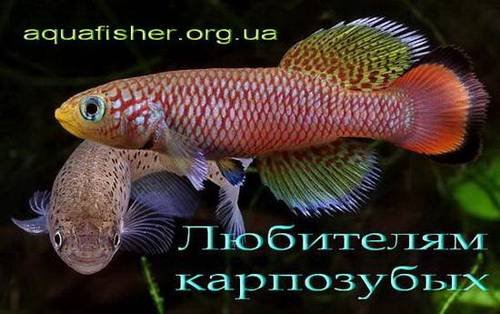
Order Cyprinodontiformes
Superfamily Cyprinodontoidae
Family Nothobranchiidae
To be continued…
Genus Nothobranchius. N.

— Nothobranchius foerschi [Wildekamp & Berkenkamp, 1979]. Code: STN. Tanzania. 5 cm, females 15-20 mm smaller. The main body color is bluish to greenish-blue, brighter near the dorsal side, with a well-noticeable reticulated pattern formed by thin red or dark red scale margins. The body is moderately elongated, relatively high. Scales on the sides and head below the eyes have small teeth. Dorsal and anal fins are rounded, caudal fin is fan-shaped. The back is grey-brown, the belly is whitish. Gill covers are blue with three uneven reddish-brown streaks. The outer tips of the golden-yellow pectoral fins have a bright light-blue to whitish band.
Dorsal and anal fins are golden-yellow with a large number of small, rich-red dots located in more or less concentric circles from the fin base. The tips of the fin rays are black. The caudal fin is semi-transparent at the base and has an olive color with many orange-red dots, which become denser near the margin of the fin and eventually merge from the middle to the edge to form a wide orange-red border. Ray tips are also black.
Young specimens have more purple coloration, while older ones are more green-blue. Females, like males, have a shortened body. Body color is grey to grey-brown with a much lighter belly and a faint golden sheen. The posterior edges of the scales have faint dark borders. Paired fins are transparent to very light brown. The anal fin is usually grey or grey-brown. There is an artificially bred yellow form.
It is best to keep them in relatively small aquariums with a low water level. An aquarium with a volume of about 40-50 liters is quite sufficient for 10-15 individuals, with females prevailing over males. Keeping only 2 males together should be avoided, as the smaller one will be constantly chased by the larger one and will eventually die from stress and hunger. In a large aquarium with plenty of hiding places, groups of males can be kept together, and real fights will occur only in very rare cases.
Fish should be kept in densely planted aquariums, which provide numerous hiding places for females constantly pursued by males. Several males can be kept together in an aquarium with plenty of plants or numerous hiding spots. Males are usually not very aggressive towards each other, but often display. It is desirable to keep one male and 3-4 females.
Fish stay in the lower water layer. They feel more at ease in a dimly lit aquarium with a dark substrate, for which peat is very well suited. There is one point that needs attention: the presence of a sufficient amount of food. Fry must literally swim in a live food solution, otherwise growth retardation and a rapid deterioration of general health are observed—a process that is difficult to reverse once it has started. Fish are susceptible to oodiniosis; as a precaution, table salt is added to the water at a rate of 1 g/l. Lifespan in the aquarium is 1-1.5 years. T 20-25°C.


— Nothobranchius furzeri [Jubb, 1971] — Turquoise Killifish. Code: FUR. Synonym: Nothobranchius kirki. Africa, southeastern Zimbabwe, Mozambique, Kenya — temporary freshwater pools and swamps. Males up to 5.5 cm, females 4.5 cm. Body is slender and elongated. Snout short, flat. Mouth superior. Dorsal fin is located slightly closer to the anal fin. The upper part of the body is bluish, the lower is reddish.
The main background of the body ranges from turquoise to blue-green, scales are colored light green-blue to amber with a carmine-red margin forming a net-like pattern. A black vertical stripe passes through the eye. Gill covers are whitish in the upper part, turning yellowish downwards, and have a glossy black color in the lower part. The dorsal fin is slightly more saturated blue with black rays, dotted with brownish-red speckles at the base which turn into streaks in the upper third. The top of the dorsal fin has a pale blue margin.
Pectoral fins range from light orange to yellow with pale blue edges. Ventral fins are pale blue with brick-red veins. The anal fin is pale blue with many brick-red inclusions, some of which merge together. The diverging rays of the lower half are bright red with a pale blue margin. Red coloration is most intense on the front of the anal fin. The base of the caudal fin glows with a blue main color and brown streaks. The terminal part of the tail is highlighted by a yellow-orange stripe followed by a black stripe, and the entire caudal fin has a black margin.
Males have a higher dorsal fin than females. Females are grey-brown, sometimes with a blue sheen, with reddish scale borders. All fins are light olive or greenish without any pattern, with red borders. Gill covers have a slight golden sheen. Older fish sometimes develop a hump, coloration fades, and the fish become more sluggish and weak.

Males are quite aggressive (towards both males and females) and territorial, and their behavior is sometimes unpredictable. A male can approach a female very calmly and then suddenly rush at her in a strong and impulsive mating urge. During non-breeding periods, males are best kept separately, otherwise their aggressiveness may lead to the death of weaker specimens. When kept separately by sex, they do not show their full magnificent coloration. Lots of free swimming space is required. Lighting is diffused. Temperature should be maintained no lower than 25°C, as at lower temperatures fish feel unwell and begin to die within 2 days.
They eat any live food. Since fish grow very quickly and eat a lot, regular water changes are necessary. Any water pollution must be prevented. It is also recommended to add salt (1 tsp per 5 liters of water) as a preventative measure against oodiniosis. Sexual maturity at 1 month. Growth rate is very fast — at 5 weeks of age, fish grow up to 4 cm. Males stop reproducing at 8 months. Lifespan in the aquarium is about 10-12 months. Water temperature 20-25°C; pH 6.6-8.0; dH 4-10°. At lower temperatures, fish begin to feel worse and start dying on the second day.

— Nothobranchius fuscotaeniatus [Seegers 1997]. Code: FUS. Tanzania. 4 cm. Head is well defined, back is straight from the dorsal fin area to the snout. Ventral fins are small, dorsal and anal are relatively wide, especially the latter. The distal margin of the anal fin is straight rather than convex as in most other species.
This is one of the rare species whose coloration lacks red tones on the body and caudal fin. On the caudal fin, the color of the first transverse stripe located in front of the marginal black border varies: in some specimens it is yellowish, in others greenish-blue matching the body color. Also interesting is the variability of body coloration — depending on the lighting, the male changes from light green to saturated blue. The presence of coloration and stripes in the female is also interesting, immediately setting this species apart from other Nothobranchius.
The coloration of this species is unique. In the male, the main color is bluish-green, slightly lighter near the belly. The back and top of the head are brown. 9-10 reddish-brown stripes are visible on the sides, which can also be noticeable on the caudal and proximal parts of the anal fin. Both fins are bordered with white and have a black submarginal stripe on the distal end, which is not sharply defined. The distal third of the caudal fin is black, closer to the body there is a narrow yellowish or greenish stripe followed by a reddish stripe of the same width. Then follow narrow greenish-blue and brown stripes again. The caudal peduncle is greenish with a dark spot. The color pattern on the female’s body is similar to that of the male.
Can be kept and bred in tap water with pH 7-8 and hardness around 11 dH. For maintenance, the temperature should be around 22-24°C during the day and drop to about 20°C at night.
 Nothobranchius guentheri, Nothobranchius janpapi, Nothobranchius jubbi.
Nothobranchius eggersi, Nothobranchius elongatus, Nothobranchius flammicomantis. 


