



Order Cyprinodontiformes
Superfamily Cyprinodontoidae
Family Rivulidae
Genus Laimosemion.
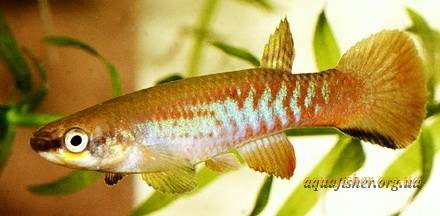
— Laimosemion agilae [Hoedeman, 1954] — Agila Rivulus. Code: AGI. Synonym: Rivulus agilae, manaensis. (Eng- Agila Rivulus). Suriname, small streams of Agila, Guiana, northeastern Brazil. Length up to 5 cm. Depending on the capture location, the coloration varies greatly. Males are generally much more colorful. Beige-pink with bluish sides and 7-8 longitudinal rows of red dots. A blue spot is located behind the operculum. The anal fin and tail have a broad orange border. The female is grayish-brown with light spots and transparent fins. Males are territorial towards males of their own species.
It is best to keep them in a species aquarium, 1 male to 1-2 females. In a sufficiently spacious aquarium, several pairs can be kept. Dense vegetation and driftwood should be provided for shelter, including for harassed females. Generally peaceful, they can be kept with fish of equal size and not too boisterous. They like to jump, so the aquarium must be carefully covered with a glass lid. A sensitive variety that requires good water conditions. Suitable for beginner aquarists. Breeding is possible, but difficult. Temperature 22-25°C; pH 5.5-7.2; dH 4-15°.

— Laimosemion strigatus [Regan, 1912] — Rivulus strigatus. Code: SIG. Synonym: Rivulus strigatus. Brazil (Central Amazon), Bolivia (Beni River, Lake Rogaguaudo). 4-5 cm. Male is olive-green to bluish-green. The male’s back is olive-green with reddish-brown flecks and streaks. Sides are blue with red horizontal lines in the front part of the body. Throat and belly are yellow-orange. Small red dots arranged in rows from the head along the body transition into V-shaped rows at the base of the tail behind the pelvic fins.
Pectoral fins are blue; pelvic, anal, and caudal fins are green with a red border; the dorsal fin is covered with red flecks. The female is brownish-yellow, with speckled sides, but lacks the typical family spot at the base of the tail. A peaceful, graceful little fish. Suitable for a community aquarium without small fish, featuring a dark sandy substrate and driftwood for shelter. The small, graceful female lays very large eggs. Water temperature 25-28°C.

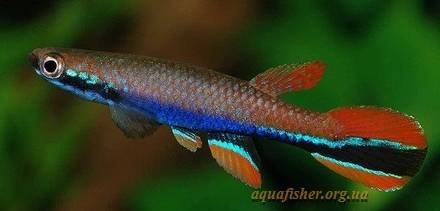
— Laimosemion xiphidius [Huber, 1979] — Black Tailed Rivulus, Blue Stripe Rivulus. Code: XIP. Synonym: Rivulus xiphidius. (Eng- Black Tailed Rivulus, Blue Stripe Rivulus). Brazil, Guiana, Oyapock River. 4 cm. A species with stunning coloration. Male is brownish-orange with a wide blue-turquoise stripe starting from the eyes and extending onto the lower lobe of the caudal fin.
The anal and rounded caudal fins have a white-orange border. Fins are reddish-brown, except for the blue base of the anal fin and the continuation of the black and turquoise stripes on the caudal fin. The female is brown or golden-brown, with a dark stripe running from near the head to the tail.
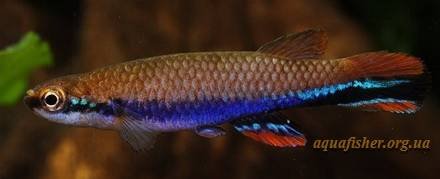
They are great masters of hiding among plants. They exhibit increased intraspecific aggression. Males need plenty of space to establish their territories. Fights between males are usually harmless. They are undemanding regarding maintenance conditions, so they are also recommended for beginner aquarists. A species aquarium for a group of fish of both sexes is preferred. In a general aquarium, keep them only with small, calm, peaceful fish.
There should be areas of dense thickets and tree roots to serve as refuge and shelter for the fish. When floating plants are present, they jump out much less frequently. In dim light, the fish’s coloration is displayed better, which also positively affects their behavior. The water must be “old”. Water should be soft, slightly acidic, with low general hardness. Feeding should be as diverse as possible. Males develop their full coloration at 6 months.
They reach sexual maturity at 8-9 months. Breeding this fish is relatively easy. At neutral pH and high temperature, all offspring may consist of males. Size sorting and regular water changes are essential conditions for the uniform growth of juveniles. Temperature 22-25°C; pH 5.5-6.5; dH up to 10°.

 Identification: Genus Laimosemion — Laimosemion agilae, xiphidius.
 Cynolebias albipunctatus, Cynolebias gilbertoi, Cynolebias itapicuruensis.


