Order Cyprinodontiformes
Superfamily Cyprinodontoidae
Family Rivulidae
Genus Hypsolebias

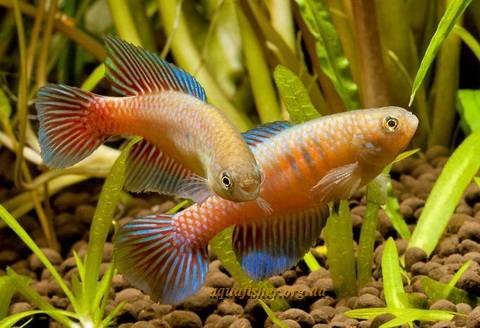
— Hypsolebias antenori [Tulipano, 1973]. Code: ANT. Synonym: Cynolebias antenori, Simpsonichthys antenori. Brazil. The general body color of males is steel-colored, ranging from gray to gray-blue, the back is darker with a bronze and pearly tint. The front half of the body has faint and indistinct vertical stripes. A dark vertical line passes through the eye. Pectoral fins are colorless, other fins vary from dark blue-green to yellow-green, with rows of pearl spots. The anal fin has a black stripe and zones ranging from yellow to intense red-orange. Pelvic fins are red with slight black tips.
Males have elongated dorsal and anal fin rays. Color intensity depends on temperature, age, social status, and sexual arousal. Females are generally light brown with 3-5 rows of dark vertical worm-like stripes. One to three large dark spots are located in the middle of the flanks. There is another black spot on the caudal peduncle. Sexual dimorphism becomes obvious at 30-40 days.
Males can be aggressive, and numerous shelters for females are necessary. Males and females establish dominance hierarchies. Territorial fights among males occur constantly. These are rather hardy and undemanding fish that prefer higher temperatures. Adults feed on frozen and live food, and some will accept dry flakes.

— Hypsolebias hellneri [Berkenkamp, 1993]. Code: HEL. Synonym: Cynolebias fulminantis, Simpsonichthys hellneri. Brazil. 5 cm. Peaceful. Do not tolerate acidic environments. It is necessary to keep a single pair so that the males look better and grow elongated fins. It is good to place floating plants on the water surface, creating a natural twilight in the aquarium where the fish feel better. pH 6.5-7.5; dH up to 15°; T 20-26°C.

 Profundulus punctatus, Valencia hispanica.