Order Cyprinodontiformes
Superfamily Cyprinodontoidae
Family Poeciliidae
Subfamily ( Aplocheilichthyinae )
Genus Aplocheilichthys. Aply.

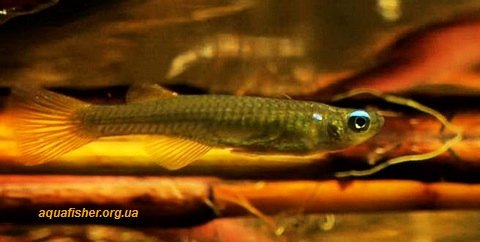
— Aplocheilichthys myersi [Poll, 1952] — Hummingbird Lampeye. Code: MYS. Synonym: Poropanchax, Congopanchax, Micropanchax myersi. (Eng. Hummingbird Lampeye). This is a fish from Zaire, 2.5 cm long. It got its name due to glowing eyes. The head is flattened on top, the mouth is superior. The shining blue flanks of the male are decorated with two horizontal golden stripes, the rays of the dorsal and anal fins are elongated, especially the last ray of the dorsal fin. The female is yellowish with colorless fins. Females are larger than males and less brightly colored.
An aquarium with dense plants, but also swimming space, covered with a lid on top. Driftwood, roots, flat stones, grottoes, and caves can be used as shelters. A schooling fish, so when keeping them in small aquariums, it is recommended to buy one male and two females. They occupy the middle water zone. Peaceful, can be kept with peaceful fish of the same size.
Dark substrate made of a mixture of sand and peat. They prefer live foods. They require very soft, clean, oxygen-rich water. Water changes no more than 20% of the water volume, as they are sensitive to large water changes. Mature at 9 months. They spawn on plant leaves. Life span up to 3-4 years. For the prevention of oodinium disease, sea salt is added to the water (1 teaspoon per 10 liters). dH 4-12°; pH 6.0-7.0; T 22-26°C.

— Aplocheilichthys normani [Ahl 1928] — Norman’s Lampeye. Code: NOR. Synonyms: Aplocheilichthys gambiensis; Micropanchax, Poropanchax normani, macrurus. (Eng. Lampeye Killifish, Norman’s Lampeye). West Africa, White Nile, Lake Chad, northern Nigeria – inhabits the surface of forest reservoirs. 4 cm. The body is fusiform. The mouth is superior. All fins, except the caudal, are undeveloped. The dorsal fin is shifted back. In both sexes, the upper part of the iris has an intense metallic blue reflection, which is why Aplocheilichthys normani is also called lampeye. Newborn fry also have the same blue eye reflection.
The main background of the male’s body is gray-blue with a metallic reflection. The monochromatic silvery coloration of the male is enlivened by bluish highlights. Unpaired fins: yellow, red, orange, or purple. The anal fin in the male is elongated. Individual specimens have yellowish spots on their fins. During the spawning period, the pectoral fins become very dark, and a black border appears on the caudal fin. The female is smaller, paler, with rounded fins.
Schooling fish that feel good in groups of 6 or more individuals. Peaceful, very active. There is no interspecific aggression. An aquarium with a dark substrate, plants in the back, and plenty of root shelters. They occupy the upper water zone. Can be kept with peaceful fish species. It is recommended to keep it with bottom-dwelling species or those living in the center of the aquarium. Prefers a slow current. Likes neutral water. When pH drops due to carbon dioxide, the lifespan is sharply reduced.
Perform a water change of up to 20% of the water volume weekly. Do not forget about good filtration and regular aquarium cleaning. They do not take food from the bottom. Therefore, snails should be present in the aquarium. Mature in 10-12 months. For spawning, they can be left in the same aquarium. They scatter eggs on plant leaves. They live for more than 2 years. Water temperature 20-25°C; dH 8-12°; pH 6.0-7.2.


 Identification: Aplocheilichthys normani.

— Aplocheilichthys pumilus [Boulenger, 1906] — Tanganyika Lampeye. Code: PUM. Synonyms: Micropanchax, Lacustricola pumilus. (Eng. Tanganyika Lampeye). Lakes of East Africa: Tanganyika, Victoria, Kivu. 4.5–5.5 cm. Male is bronze with greenish-blue metallic glints and a yellow-black border along the tail. The upper body surface is light brown. A wide dark horizontal stripe divides the body in half, above it is a strip with a green metallic sheen. Belly is white to light blue towards the tail. All unpaired fins with an orange tint and dark fringe. Female is smaller, silvery with a blue reflection on the rear part of the body, fins are colorless.
A schooling fish, necessarily with a large number of females. Fish are active, keeping in the upper and middle water layers, love light, avoid shady places, often fall ill with tuberculosis in soft water. Kept in a species aquarium. Males can quarrel with each other, but injuries are rare. Along with live food, frozen and dry food are also given. Abundant feeding and regular water exchange contribute to the rapid growth of fish and prompt spawning. Easily bred. The fry have bright blue eyes, which gives this fish its common name, but they lose it after 6 weeks. dH 5-15°; pH 7.0-8.2; T 24-27°C, salinity 2-6%.
 — Aplocheilichthys pfaffi [Daget 1954] — Pfaff’s Lampeye. Code: PFF. Synonyms: Micropanchax pfaffi, longicauda, Aplocheilichthys schoelleri. (Eng. Pfaff’s Lampeye). West Africa, Egypt. Maximum size – up to 3 cm. Relatively inconspicuous coloration of these fish. It has a blue body, scales have a thin black border, dorsal and caudal fins are blue. Males have a red border on the caudal fin, ventral and anal fins are yellow, in females – blue.
It is necessary to keep a school of a dozen or two individuals merrily darting around a brightly lit tank. Their modest beauty will be emphasized by dark decorations, dense thickets, small branching driftwood. The fish are relatively unpretentious, quickly get used to new conditions, do not offend neighbors, although they themselves may suffer from aggressive predators. It is preferable to provide them with a separate tank or keep them with similarly small fish. This is a difficult fish to keep. T 22-26°C; dH 8-15°; pH about 7.0-7.5, regular water changes, effective filtration.

— Aplocheilichthys spilauchen [Dumeril, 1861] — Banded Lampeye, African Lampeye. Code: SLC. Synonyms: Aplocheilichthys typus, tschiloangensis, bensonii. (Eng. Banded Lampeye, African Lampeye). From Senegal to Angola – fresh waters, in the lower reaches of the Congo River – mangroves, lagoons with brackish and sea water. 9.5, usually no more than 7 cm. The body is elongated, cylindrical, slightly flattened on the sides. The dorsal fin is shifted closer to the tail, the caudal fin is fan-shaped. The head is flattened on top.
Male is yellow-green with a bluish sheen, on the gill covers with a bright green spot, the flanks closer to the tail are decorated with five silvery-blue transverse stripes alternating with rows of red specks, which also pass onto the yellow fins. The fins are colored lemon-yellow, at the base of the dorsal and anal fins there are light spots, on the caudal fin there are red-brown transverse stripes. The female is paler, gray to bluish, stripes are practically invisible, with small rounded colorless fins, unlike the male, she does not have red specks, in addition, at the base of her dorsal fin there is a black spot.
Compatible. Fish are active, schooling (at least 6 fish), keep in the upper and middle water layers, love light, avoid shady places. Free swimming space is required. Current, strong aeration, and filtration are necessary. They like salted water, strong movement, and frequent water changes. Can live in both fresh and brackish water (the latter is preferred). 2-3 teaspoons of sea salt are added for every 10 liters of water. In soft water, they often contract tuberculosis.
Kept in a species aquarium. Can be kept with non-aggressive fish of the same size that prefer brackish water. Dark substrate with driftwood, grottoes, and caves. Fish take food from the water surface. They eat live foods (bloodworms, shrimp, daphnia) and substitutes. Mature at the age of one year. Spawns on plants. Spawning occurs in brackish water (usually after a water change). Lifespan 2-3 years. Water: 25-28°C; dH 10-20°; pH 7.0-8.0, addition of table salt (0.6 g/l).
 Procatopus aberrans, Procatopus nototaenia, Procatopus similis.
Aplocheilichthys johnstoni, kabae, katangae, kingii.