



Order Cyprinodontiformes
Superfamily Cyprinodontoidae
Family Nothobranchiidae
Continued…
Genus Aphyosemion — Aphyosemion. A.

— Aphyosemion bitaeniatum [Ahl, 1924] — Two-striped Aphyosemion. Code: BIT. Subgenus Chromaphyosemion. West Africa, Benin, Nigeria, Togo — freshwater habitats and irrigation ditches (forests and savannas) with slow current or standing water. 4–5.5 cm. Non-annual species.
Males are brightly colored with elongated fins. Many isolated populations are found in nature, differing in both fin shape and coloration. The main body background is green, yellow, ranging from red to purple. Both sexes have two longitudinal dark stripes running along the body.

Peaceful little fish. Best kept separately from other large species. Males compete for females using spread fins. The aquarium should have areas of dense vegetation and a dark substrate (peat layer). Open swimming space is required; driftwood and grottoes can be placed in the aquarium. Can be kept in a community aquarium, but without hiding places, they become timid. Inhabit the middle and upper water layers. Prefer standing, old, peat-filtered water. Weekly water change of 20%.
For disease prevention, table salt is added to the water: 5–10 grams per 10 liters. The fish readily eat almost any live food. Sexual maturity at 9–12 months, the first signs of sexual dimorphism appear at 6–8 weeks. In a month and a half to two months, the fish are fully colored, reaching full size by 4–5 months. Reproduction is uncomplicated. Lifespan up to 2.5 years. dH 2–15°; pH 6.0–7.2; T 23–25°C.


 Identification: Two-striped Aphyosemion — Aphyosemion bitaeniatum.
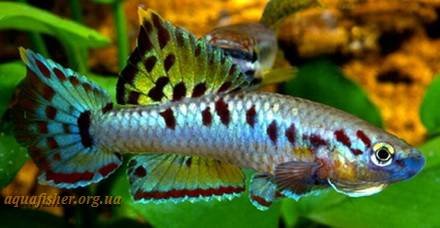
— Aphyosemion bivittatum [Lonnberg, 1895] — Stripe Killifish. Code: BIV. Subgenus: Chromaphyosemion. Synonym: Fundulopanchax, Fundulus bivittatum; Aphyosemion nigri; Panchax unicolor; Fundulus zimmeri. (English: Stripe Killifish, Twostripe Lyretail). Nigeria, Cameroon, Togo. Non-annual species. Body length up to 5 cm. One of the most beautiful, luxurious killifish species. The body is elongated, close to pike-like in shape, the front part is almost cylindrical and flattened laterally towards the caudal peduncle. Many isolated populations differing in fin shape, coloration, and pattern.
The main coloration can range from yellow and green to red and purple. Both male and female have two prominent dark brown longitudinal stripes along the flank. One runs along the middle of the body — from the mouth, through the eye to the upper part of the caudal peduncle base, and the other — from the lower jaw along the lower edge of the body to its lower part.
The main feature of the males is their huge unpaired fins. Males have pointed-elongated large caudal, dorsal, and anal fins with red specks. The caudal fin is elongated top and bottom like a fork.
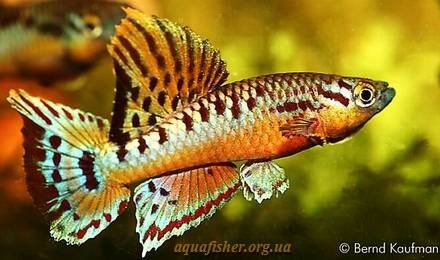
Under normal maintenance conditions and good lighting, the male’s back acquires a brilliant red sheen, and a blue-brown pattern appears on the head and gill covers. The flanks and tail become bright blue. The anal fin is orange at the base transitioning to blue, with a blue-violet border and a narrow blue edge along the outer margin. The small but very bright pelvic fins are colored similarly. Pectoral fins are reddish.
The sail-like dorsal fin features a reticulated pattern of dark brown rays and transverse dashes on a bright red-brown background. The large caudal fin with elongated outer rays forming a lyre shape is colored blue-green, with its lower edge being orange. Males are exceptionally beautiful during aggressive or courtship displays, slowly circling with widely flared fins. Females are olive-brown with a scattering of red specks, the belly is light with characteristic two black longitudinal stripes, with rounded fins.
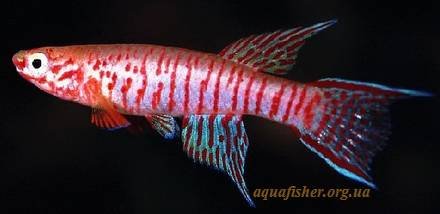
— Aphyosemion bualanum [Ahl, 1924] — Aphyosemion bualanum. Code: BUA. Synonyms: Panchax elberti, tessmanni; Aphyosemion rubrifasciatutn. Cameroon, Central African Republic. 5 cm. Highly variable species. Two subspecies exist. Main coloration — Aphyosemion bualanum bualanum is blue-cyan, — Aphyosemion bualanum kekemense is reddish (yellow). Females are greenish-brown with dark transverse stripes on the front part of the body.
It is better to keep these fish not in community tanks, but in small species aquariums. These should be shaded bodies of water with a soft dark substrate. Floating surface plants are very beneficial. They feel best under subdued overhead lighting, staying mostly near the water surface among floating plants. Regular water changes are necessary, and filtration should not be too strong. pH 5.5–7.0, temperature 20–23°C.

— Aphyosemion buytaerti [Radda & Huber, 1978]. Code: BUY. Congo, Gabon, Ekouma and Sanga rivers. 4.5 cm. Suitable for a community aquarium without small fish, featuring a dark sandy substrate and driftwood for cover. Look very nice in a small species aquarium with additional side lighting. Must not be kept with active and aggressive fish. Regular water changes should be done gradually, as sudden changes in water parameters can lead to shock and death. The fish readily eat almost any live food. Spawn on both plants and peat. pH 6.0.
 Aphyosemion calliurum, cameronense, caudofasciatum, celiae, christyi.
Aphyosemion abacinum, ahli, aureum, australe. 


