



Subclass Bryidae, green mosses ( Bryidae )
Order Hypnales ( Hypnales )
Placing plants on rocks and driftwood.
Placing plants on driftwood: Wood covered with plants looks very natural, and fish love such compositions. Driftwood made from various types of wood, except conifers, is suitable for aquarium decoration. For several years, such driftwood does not require redesigning and only gets better year after year. In aquarium stores, you may be offered three types of wood: Mopani, mangrove, and soft wood. Mopani wood is very dense, almost as hard as stone when wet, and when dry, it becomes two-toned – light beige combined with dark brown. Mangrove roots are hard and tough, with a textured surface, dark brown in color, sink easily without needing to be soaked after purchase. Their textured surface, as well as many various cracks and curves, make them ideal for plants that attach to them using roots. And the dark color of the wood contrasts with the greenery, which looks magnificent. Soft wood can come in various shapes and sizes. Such wood darkens after soaking. If you are going to use this type of wood, I would recommend scratching or making various grooves on its surface so that the plant roots can “grasp” more easily.

Once you have acquired the necessary driftwood, you should decide which plant you want to attach to it to create a hanging garden. We attach plants to the prepared driftwood using fishing line, thread, or thin wire. Java moss can be attached to vertical areas or large surfaces in such a way that it will imitate leaves on a branch. It will also look natural and beautiful on fork-shaped driftwood branches. When decorating driftwood with Java moss, several nuances must be taken into account: first, the moss must be laid out on the surface of the base very thinly, practically twig by twig, avoiding dense clumps. Second, it must be tied tightly to the wood surface, without gaps. You shouldn’t completely “plant” the driftwood. It is preferable to just “catch” the upper part with Java moss. After the plant has “grabbed” the proposed support with its roots, it is advisable to remove the fishing line. Be sure to fill ALL voids under the driftwood with plants such as Java moss, Fontinalis, Anubias barteri var. nana, Microsorum Windlov, Microsorum pteropus. On top, holes can be covered with a stone tied with Riccia fluitans. Tie mosses and ferns to unnatural places on the driftwood, such as cut marks or junctions where one piece of driftwood meets another.

Plants with rhizome roots can also be stapled to the driftwood using a stapler, but in this case, you should make sure that you do not pierce the roots themselves with the stapler. If you are lucky and there are natural depressions in the driftwood, you can place the roots there, making it very convenient to pin the plant. If after all the procedures performed, your Java moss or Anubias does not look very good, do not worry and be patient. It takes about 2 weeks for the plant to recover. Old roots may die off during this process, and new ones will attach to the surface of the driftwood. After a while, you may need to trim the plants to give them a certain shape.

What to look for when choosing driftwood? Driftwood made from various types of wood, except conifers, is suitable for aquarium decoration. When buying driftwood, you often choose from a large number of them. The most important thing at this moment is size. For a standard plant composition, it is inconvenient when the driftwood does not fit into the aquarium. The second important point is the amount of driftwood and balance. Since multiple pieces of driftwood are used together, it is important to choose them for the balance of the assembled shape. If too many pieces of driftwood are used, there will not be enough space for planting. Nevertheless, the greatest attention when choosing driftwood should be paid to the shape of their ends. Some driftwood is artificially cut on one side. If you choose driftwood with a natural-looking thin end, it will bring a sense of naturalness to the aquascape itself. As for the attachment points of aquatic plants, they should be attached at key points of the aquascape, such as the tip of the driftwood and at branch intersections, and depending on the driftwood, at areas with unnatural-looking sections, such as an unnaturally cut end of the driftwood.
Placing plants on rocks: If you want to decorate the aquarium with rocks, there must be at least three of them. A single rock, even a very beautiful one, looks like a foreign object in the aquarium. But a group composition can give individuality to the body of water. If these are quite large boulders, place a group of three so that all rocks are fully or partially visible from any possible viewpoint. If you want to create a “lawn”, use as many small rocks as possible. How many “living compositions” should you prepare for your arrangement? Practice shows that it is better to prepare two to three times more material than planned to be laid out in the aquarium. The thing is that attaching plants to rocks is much more difficult than to driftwood. And if with driftwood we have an almost one hundred percent germination result, with rocks the “yield” is significantly lower.
We will attach Java moss or Riccia. It is not a given that under your conditions these plants will want to attach to the rock. There is a very high probability that some mosses will try to float up. So a nylon mesh or fishing line for “wrapping” is simply essential. If you want to attach Anubias or a fern, also pay special attention to the strength of the attachment. Some time must pass for the plant roots to find micro-cracks. Stable placement will speed up this process. A good result will be obtained if you attach Anubias to the rock, and then cover its roots with Java moss. Naturally, securing both alternately with fishing line.
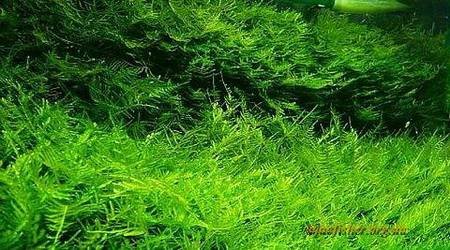
Making the background: One of the most difficult tasks in aquascaping is deciding how the back background of the tank will look. The principle is very simple. From an arbitrary number of bamboo or plastic tubes, we assemble something like a grid to the size of the back wall (double nylon mesh can be used). We fasten them together with wire or fishing line. To keep the grid from floating, we attach it to a strip of plexiglass. Most likely, the standard layer of substrate will be enough so that the base covered by it does not allow our workpiece to move around the aquarium. Well, in extreme cases, a couple of stones placed on the plexiglass will come in handy. It remains only to take fishing line and tie Anubias barteri group or mosses: Vesicularia dubyana, Spiky Moss, Weeping Moss, Christmas Moss to the grid. The technology here exactly repeats the attachment to driftwood.
After a while, all the leaves will orient themselves toward the light, and you will get a magnificent decorative background for the next two to three years. You can also make decorations for the side walls in the same way. The only nuance is that you need to provide places for attaching suction cup equipment to the glass (filters, heaters, etc.). And it’s even better to make a design that will mask your electromechanical helpers. The bottom of the aquarium can be decorated in a similar way. Java moss is laid out between two layers of fine-mesh net and the edges are sewn with fishing line. After a while, the plant will grow and completely hide the base. This is a fairly rarely used, but very effective technique.
 Fontinalis antipyretica, Willow moss, Giant Willow moss, Fontinalis.
Plants and mosses underwater on decorations, Riccia, Anubias, Ferns. 


