Order Siluriformes
Family Callichthyidae
Subfamily Corydoradinae
Continued…
Genus Corydoras
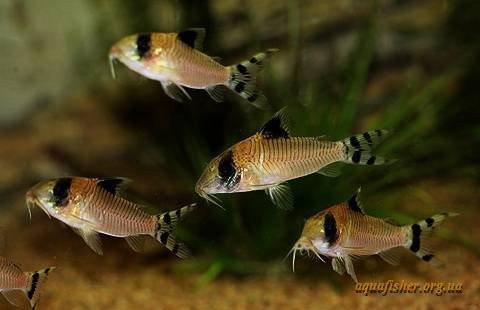
 — Corydoras julii [Steindachner, 1906]. Synonym: C. leopardus. (Eng. Leopard Corydoras). Brazil, Peru, inhabit small streams in the lower Amazon, Parnaíba River, Ucayali. Females 6 cm, males slightly smaller and slimmer. Main coloration is yellowish-gray, close to ivory, with a silvery sheen. Small black spots and black wavy stripes are scattered all over the body (except the belly), forming a beautiful pattern. Belly is light, without markings.
Along the body from the middle to the base of the caudal fin runs a black uneven stripe, in the male it reaches almost to the gill cover, in the female it is interrupted in the middle of the body. Short transverse lines adjoin it from above and below. Below it, each scale is bordered at the rear by a black stripe. Black dots are present in the belly area. Unlike the pointed snout of C. leopardus, C. julii has a rounded snout.
The upper half of the dorsal fin is intensely black, its base is almost transparent, and 5-7 dash-like stripes formed by small dots run vertically along the anal fin. There are several rows of black flecks on the caudal fin, the rest of the fins are transparent. The first rays of the dorsal fin are more elongated in males, and more rounded in females.
Aquarium with rich vegetation, sandy bottom, and good oxygen saturation. The fish are timid and should be kept in groups of at least 4 specimens, otherwise they become too shy; suitable for a community aquarium. They do not like bright light, so floating plants should be added to the surface. More active at night. They generally eat all types of live foods, flakes, pellets, and other aquarium feeds. It is best to feed them after the lights are turned off. They live up to 5 years. T 23-27°С; dH 5-15°; pH 6.0-7.5.
 — Corydoras loxozonus [Nijssen & Isbrucker, 1983]. (C 079, C 082, C 083). Peru, Colombia, Meta and Guaviare River basins. 4-5 cm. A black stripe runs through the eye and along the dorsal ridge, descending to the lower edge of the caudal fin. The body is silvery-white, with a small number of small black spots forming longitudinal stripes. The head and dorsal area are golden, with one black stripe running along the back from the dorsal fin to the center of the caudal fin.
They must be kept in a group of at least 10 individuals (preferably with a preponderance of males). Suitable for keeping in small, well-planted aquariums with swimming space in the middle layer. Plant thickets are planted near the side walls of the aquarium. They create not only shady spots, but also sufficient free swimming space. Aggressive fish or predators should not be used as tank mates. pH 6.0-7.5; T 23-27°C.


 Identification: Genus Corydoras — Corydoras julii, loxozonus.
 — Corydoras melanistius [Regan, 1912]. (Eng. Black Sail Cory, Bluespotted Cory). Synonym: C. wotroi. Guyana, Essequibo River, Orinoco. 6 cm. Body is brownish-pink with a metallic sheen. Numerous tiny black dots are scattered across the body, forming a small stripe in the middle of the male’s body. Females lack this. A wide black oblique stripe runs through the eye.
A large black spot is located at the base of the dorsal fin, extending onto the dorsal fin and occupying a significant part of it. This species is similar to Corydoras ephippifer, but with a shorter and higher body and a short snout. C. melanistius has rows of small black spots on the caudal fin, while the caudal fin of C. ephippifer is colorless.
The adipose fin, anal fin, and especially the caudal fin are covered with several dark vertical rows of spots. All fins are transparent, have a metallic sheen, and are colored to match the body. Females are somewhat larger and fuller than males. The subspecies C. melanistius brevirostris has slightly larger spots on the body and 4-5 rows of black dots on the dorsal fin, forming a lace pattern. They reach maturity at 10-12 months. dH 6-20°; pH 6.0-7.5; T 20-28°С.
 — Corydoras melanotaenia [Regan, 1912]. (Eng. Elongate Bronze Cory, Green Gold Cory). Colombia, Río Meta and Río Magdalena rivers. 6 cm. The upper half of the body is green with a metallic sheen; this coloration does not extend to the back, which is light yellow. A metallic green mask covers both eyes. The lower part is light golden-orange. All fins are bright yellow.
Males are slimmer, with pointed pelvic fins, while in females they are rounded. The coloration is similar to C. aeneus, but noticeably longer, with yellowish-ochre fins. Feed the fish a varied diet containing live and frozen foods, supplemented with flakes and tablets. pH 6.0-8.0; dH up to 20°; T 22-26°C.
 — Corydoras melini [Lonnberg & Rendahl, 1930]. (Eng. False Bandit Cory). Brazil, Colombia, Papuri, Caquetá, Vaupés rivers. 5 cm. A black line on the head runs from top to bottom through the eyes. A wide black stripe runs obliquely from the dorsal fin to the lower part of the caudal fin. Gill covers have a golden sheen. Males look slimmer from above than females.
Peaceful bottom-dwelling fish. Aquarium with vegetation along the side and back walls, but also with “sandboxes” for digging made of fine, non-sharp sand among the plants. Keep in a school; whenever possible, the number of males should exceed the number of females. In an aquarium setting, they accept any aquarium foods. Eggs are attached to plants or aquarium glass. An ideal catfish for beginner aquarists. pH 5.5-7.0; dH 2-10°; T 22-27°С.
Identification: Genus Corydoras — Corydoras melanistius, melanotaenia, melini.
 Corydoras metae, nanus, narcissus, nattereri.
Corydoras eques, guianensis, habrosus, haraldschultzi, hastatus.