Subclass Asteridae ( Asteridae )
Order Scrophulariales ( Scrophulariales )
Family Acanthaceae ( Acanthaceae )
Genus Hygrophila — Hygrophila.
The most well-known synonyms of the genus are Nomaphila, Synnema, Ruellia, Justicia, Heliadelphis. These herbaceous long-stemmed plants originate from the tropical regions of Southeast Asia and Africa. One of the most undemanding aquarium plants, it is especially suitable for beginners because it grows under almost any condition. Plants belonging to the genera Hygrophila and Nomaphila have so much in common that they are often difficult to identify, which is why errors in genus and species determination are frequent. It is best to keep the plant in a tropical aquarium at a temperature of 24-28°C. At water temperatures below 22°C, it grows poorly.
A beautiful appearance of Hygrophila can only be achieved under strong lighting. In the shade, it grows very slowly, and the leaves quickly become covered with algae. With a short daylight hours, it often drops its lower leaves; the daylight duration should be at least 12 hours. Stems must be spaced apart from each other so that the leaves on the lower part of the stem receive enough light. The substrate is soft, weakly nourishing. When the top is removed, it begins to bush out. At each leaf attachment point, the plant is capable of branching. Hygrophilas, like Ludwigia, send out roots along the entire length of the stem. An interesting feature: if a detached leaf or even a part of a leaf is left to drift in the aquarium, there is a probability that it will put down roots and grow into a full-fledged plant.
Green hygrophila, Indian hygrophila. Indian swamp weed — Hygrophila polysperma.
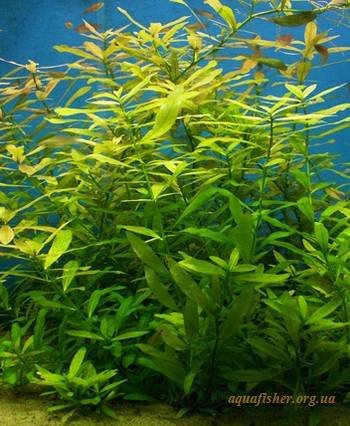
 “1” (Eng- Hygro). Southeast Asia. In nature, it grows in low swampy places. A very popular long-stemmed plant among aquurists with oval light green leaves. Reaches a size of 25-50 cm. Bush width 10-20 cm. Its stems can reach significant length. Leaves can have different shapes and colors, which largely depend on the lighting level. Leaf color can range from green under bright lighting to light brown under moderate lighting. Cross-oriented lanceolate or broadly lanceolate leaves reach a length of 5-7 centimeters with a width of up to 1.5 centimeters and have a bright light-green color, the reverse side is whitish-silvery.
Leaf color can range from green under bright lighting to light brown under moderate lighting. Cross-oriented lanceolate or broadly lanceolate leaves reach a length of 5-7 centimeters with a width of up to 1.5 centimeters and have a bright light-green color, the reverse side is whitish-silvery.
One of the most undemanding aquarium plants, especially suitable for beginners because it grows under almost any condition. Active feeding through the water makes this species very useful at the stage of starting a new aquarium and for maintaining water quality in an old one. It grows evenly throughout the year. In recent years, several garden forms of Hygrophila polysperma have appeared. They differ from the main species in leaf coloration. The most popular forms are those with pink or white leaf veins.
To date, the following forms are known: — Hygrophila polysperma “Rosanervis” differs from the nominal form by bright red leaves with contrasting, lighter veins. Aquarists know them as marble hygrophila. Hygrophilas with white veins need very bright light, otherwise their growth slows down and the marble coloration becomes poorly defined; — Hygrophila polysperma “Broad leaf” differs from the nominal form by larger and wider leaves; — Hygrophila polysperma “narrow-leaved” differs from the nominal form by longer and narrower brownish leaves with a pointed apex and a light central vein. They are somewhat more demanding regarding the lighting regime. The bright coloration of the leaf blade appears only under sufficiently strong and prolonged lighting;
— Hygrophila polysperma “Reddish” – Reddish hygrophila. A small herbaceous plant with a creeping stem. The plant’s leaves are opposite, lanceolate, about 7 cm long and 0.8 cm wide, with each successive whorl oriented perpendicularly to the previous one. Sometimes they have slight waviness along the edges. Leaf coloration varies from bright green to olive-red, depending on lighting conditions, daylight duration, and the spectral composition of light. The reverse side of the leaves is usually whitish-green. Reaching the surface and having a sufficiently strong support, reddish hygrophila easily emerges out of the water; — Hygrophila polysperma “Sri Lanka” – Submerged leaf blade is ribbon-like, up to 10 cm long, 0.6 cm wide, colored light brown to reddish.

“2” The plant is undemanding; it is best to keep it in a tropical aquarium at a temperature of 23-28°C. At water temperatures below 22°C, it grows poorly. High temperatures (above 27°C) promote rapid growth, but with a lack of nutrition, the plant may become depleted. Undemanding regarding pH levels. The plant is very undemanding, but grows better in slightly acidic and soft water up to 8°. At a hardness greater than 8°, growth deteriorates, lower leaves disintegrate, upper leaves become small, and old leaves break down.
Regular water changes are necessary. A beautiful appearance of Hygrophila can only be achieved under strong lighting. Lighting must be intense, as indicated by the light-green leaf coloration. With insufficient lighting, leaves become significantly smaller, and the stem begins to stretch out greatly. In the shade, it grows very slowly, and leaves quickly become covered with algae and nibbled by snails. With short daylight hours, it often drops its lower leaves and the stem stretches out; daylight duration should be at least 12 hours.
 “4” The root system is weak, rooting in the substrate. The substrate is soft, weakly nourishing. For growing Hygrophila polysperma, a lightly silted substrate consisting of coarse sand or very fine gravel is suitable. Tolerates low nutrient levels well. Additional feeding is not required; natural silting of the substrate is quite sufficient for the plant. Due to the fact that the plant likes a lightly silted substrate, pieces of clay should be placed under its roots. If this is done, no additional feeding is needed.
If there are many plants in the aquarium and they grow rapidly, they should be fertilized with complex mineral fertilizers. Feeding fast-growing plants is best done during water changes in the aquarium. Growing hygrophila floating in the water column is not allowed because the plant’s root system participates in nutrient absorption, and in this case, the plant will grow very poorly. Leaves of a floating plant become smaller, and its growth slows down.
“5” Hygrophila can be grown in an aquarium of any volume, placing it in the background or middle ground of the aquarium. Ideally suited as a first plant for an aquarium. In the aquarium, these plants should be kept in groups, planted in a row with shoots of approximately the same length, then they look most effective. Planted singly, they are completely lost against the background of other larger and brighter plants. When the water level in the aquarium is low, it rises above the surface. The plant should be placed in the aquarium so that it receives maximum natural light.
When the top is removed, it begins to bush out. It produces side shoots on the stem. At each leaf attachment point, the plant is capable of branching. It grows evenly throughout the year. It grows fast, 5-10 cm per week. It usually grows so fast that it becomes necessary to prevent this plant from dominating the others, so shoots should be regularly trimmed. When the tips of Hygrophila reach the water surface, they must be cut so that the plant branches out and does not emerge into the air environment. Soft leaves are eaten by fish.
“6” Propagated by cuttings, by dividing shoots. The stem produces side shoots. Forms ground runners. Hygrophila is very easily propagated by stem cuttings. A cutting with 3-4 leaf whorls can be planted directly into the substrate without waiting for the root system to form, by burying the lower whorl. Roots develop quickly. Alternatively, the cutting can be left floating near the water surface until the root system forms and signs of stem growth appear. The plant should not be left floating permanently, as it becomes smaller and bushy. The plant can even reproduce from torn leaves, which, when pressed to the substrate with small stones, easily root.

 Identification: Green hygrophila — Hygrophila polysperma.
Reddish hygrophila — Hygrophila polysperma “Reddish”.
 “1” Reddish hygrophila is not often found in aquariums. It is a long-stemmed plant with narrow, delicate reddish-brown leaves. The plant’s leaves are opposite, lanceolate, about 7 cm long and 0.8 cm wide, with each successive whorl oriented perpendicularly to the previous one. Sometimes they have slight waviness along the edges.
Leaf coloration varies from bright green to olive-red, depending on lighting conditions, daylight duration, and the spectral composition of light. The reverse side of the leaves is usually whitish-green. Reaching the surface and having a sufficiently strong support, reddish hygrophila easily emerges out of the water. Stem length can be significant. In the aquarium, it grows evenly throughout the year.
“2” Hygrophila feels satisfactory at temperatures above 24°C. In colder water, its growth rate slows down, and leaf coloration becomes dull. Medium-hard water with a neutral or slightly alkaline reaction is more suitable for keeping it. In soft, acidic water, leaf coloration deteriorates, and its reddish-brown shade is lost. Old leaves quickly break down in this process. Optimal conditions are water hardness of 8-12° and pH 6.5-8.
The plant prefers fresh, regularly changed water. Special attention must be paid to lighting. With a lack of light, hygrophila stretches out greatly and loses its beautiful coloration. In addition, its lower leaves quickly die off and the stem becomes bare. Overhead lighting, even very bright, is not always sufficient for hygrophila. The daylight duration should be approximately 12 hours.
“4” The nature of the substrate does not play a significant role for hygrophila, as its root system is very weakly developed. The plant can be grown floating in the water column, but in this case, it becomes smaller and its coloration deteriorates, even if the aquarium is well-lit. River sand is suitable as a substrate; natural silting is quite sufficient for satisfactory growth of hygrophila.
“5” Hygrophila can be grown in an aquarium of any capacity, but preferably with a low water level. The plant is usually placed near the side walls of the aquarium, where additional side lighting can be created for it. The plant should be placed in the aquarium so that it receives maximum natural light.
In the aquarium, these plants should be kept in groups, planted in a row with shoots of approximately the same length, then they look most effective. Planted singly, they are completely lost against the background of other larger and brighter plants. When the tips of Hygrophila reach the water surface, they must be cut so that the plant branches out and does not emerge into the air environment.
“6” Hygrophila is propagated vegetatively in the aquarium, usually by stem cuttings. Each cutting should have 3-4 leaf whorls. Such cuttings can be left floating on the water surface until roots form. A plant left floating near the water surface develops somewhat slower than a rooted one. The remaining lower part of the stem should not be removed, as new shoots will appear on it.
 Hygrophila polysperma “Big leaf”, “Rosanervig”, “Ceylon”, Hygrophila guianensis.
Underwater aquarium garden, Live plants in the aquarium.