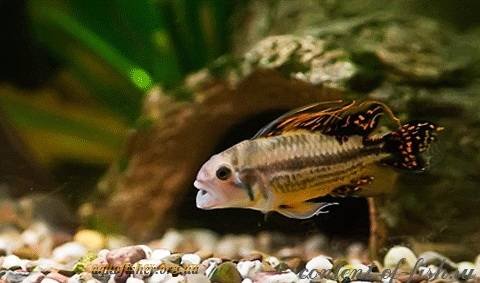
Distribution of the genus Apistogramma into groups.
Continued…
Steindachneri group. A relatively small group. Considered an offshoot of the regani group. Includes medium to large sized species with a moderately high body. Vertical stripes are usually noticeable in frightened or excited individuals. Head stripes are clearly defined. Members of this group are characterized by a large lateral spot, in most cases extending above the lateral stripe in the region of the 3rd vertical stripe. Front and back, this lateral spot usually has lightly colored areas. Head stripes are clearly defined. The lateral stripe is very narrow, often indistinct, and ends quite high above the lower lateral line at the base of the caudal fin in front of the caudal spot separated from the line. The pectoral dot is absent.
In females in spawning coloration, both spots – lateral and caudal – are also clearly visible against a yellow background. The ends of the dorsal fin are not elongated, and the caudal fin ranges from rounded to slightly truncate (in A. hippolitae), slightly truncate (in A. rupununi), and with elongated dorsal and ventral fins (in A. steindachneri). The anterior rays of the dorsal fin are black. They possess a full set of 4 infraorbital pores. The chest region is completely covered with scales. The rear edges of the scales on the back are bordered with black. The iridescent rainbow pattern of the scales is especially noticeable in the upper and lower parts of the scales, whereas in other apistogramma species this pattern usually occurs in the center of the scale. Interestingly, this type of pattern is much more clearly found in species of the genus Gymnogeophagus, which according to Kullander (especially the G. rhabdotus group) is related to the genus Apistogramma.
Having a full set of pores on the head, a narrow and indistinct lateral stripe, small shiny stripes below the preorbital stripe and eyes, apistogrammas of this group are perhaps the most primitive representatives of the genus. They have weak sexual dimorphism. The species is predominantly monogamous in reproduction, but if there are several females per male, he will mate with each female. If there is an equal number of females and males, non-polygamous families are not formed, but only pairs. In this case, there will be no dominant male trying to spawn with a large number of females. Males are noticeably larger than females, and may have moderately elongated dorsal fin rays, which can be even or slightly serrated. Distributed from Guyana to Suriname downstream of the Rio Branco and south to the mouth of the Rio Negro. Also in the Rio Tefé and Rio Madeira.


Pertensis group. The group includes a number of species whose representatives have an elongated fusiform body. Representatives of the group usually lack coloration on the first rays of the dorsal fin. In males, the dorsal fin is high, the anterior rays and membranes between them are elongated, project high, and merge into a sail-like fin. The caudal fin of the male has a dotted pattern and is either round or lyre-shaped. The caudal spot is separated from the lateral stripe. The caudal fin is colored with relatively wide stripes in both males and females. Scales are absent on the anterior part of the chest. It must be said that at present, the absence of scales on the chest part is also found in apistogrammas from another group – A. gephyra and A. pulchra, which previously belonged to the pertensis group, and now belong to the agassizii group. For the most part – strongly monogamous. Possess a full set of cephalic pores.
According to Koslowski (1985), the pertensis group also included the iniridae complex, which is why it was considered unique, containing species with both a full and a reduced number of pores on the head. But in recent years, the iniridae complex has been separated into an independent group. Representatives are found throughout the Rio Negro basin, as well as in adjacent areas of the upper Orinoco River basin and the lower parts of the Amazon River basin. The group includes two complexes:
Pertensis complex. In addition to the characteristic features inherent to all representatives of the group, species of this complex have tails ranging from round to moderately elongated oval and lack black pigmentation on the flanks, except for the lateral stripe. A brightly bordered lateral spot usually stands out prominently on the lateral stripe. The rays of the dorsal fin can be separated at the upper part, unlike species of the velifera complex, which have a membrane between the rays throughout their entire length. In a state of threat, all dark coloration on the body disappears except for the rear edge of the scales, while the caudal spot remains, and the dark stripes on the caudal fin turn ruby red.

Velifera complex. The rays of the dorsal fin are connected by a membrane along their entire length, unlike species of the pertensis complex, in which they can be separated at the upper part. In a state of threat, all dark coloration on the body disappears except for the rear part of the lateral stripe, while the caudal spot remains, and the dark stripes on the caudal fin (as well as soft rays on the dorsal and anal fins) turn ruby red.
Iniridae group. The group includes a number of species whose representatives have an elongated fusiform body. Fishes of this group usually lack coloration on the first rays of the dorsal fin. In males, the dorsal fin is high, the anterior rays and membranes between them are elongated, project high, and merge into a sail-like fin. The lateral stripe extends to the caudal fin, but the caudal spot is absent. Also, several abdominal stripes on the body below the lateral stripe can be noted, which appear in various emotional states. The caudal fin ranges from rectangular or spatulate to lyre-shaped with a faint pattern.
In spawning attire, females often show a second, additional lateral spot against the yellow background in the region of the 2nd vertical stripe. This feature can also be found in representatives of the elizabethae and brevis groups. All species of this complex are more evolutionarily advanced, having 3 infraorbital pores. They are predominantly monogamous species. Habitat range – upper parts of the Rio Negro and Orinoco river basins.
Brevis group. Representatives of this group still do not have clearly recognized characteristic common (synapomorphic) features. However, there are some related traits that distinguish them from other groups. Species in this group have a relatively high, laterally compressed body. All species have noticeable vertical stripes, more clearly expressed on the lower half of the body. Sometimes ventral longitudinal stripes are also visible, although they are mostly inconspicuous. Dorsal fin with high and elongated anterior membranes and rays.
Depending on the mood of the fish, a fairly wide lateral stripe with smooth edges is visible in all representatives of the group. It can end before the caudal spot, extend onto the caudal fin, or form an unevenly bordered pattern at the base of the caudal fin. The caudal fin is lyre-shaped, sometimes (less often) – spatulate. Ventral fins are slightly elongated, unlike the strongly elongated ones in the cacatuoides and trifasciata groups. Lips are thick, but smaller than in the cacatuoides and nijsseni groups, and the jaw is also less developed than in them. During an attack, the mouth opens wide. They possess a reduced number of infraorbital, but a full number of dental pores. Inhabit the Rio Yaupés (Brazil), Rio Vaupés (Colombia), the upper part of the Rio Negro, and Orinoco tributaries up to northern Venezuela.

Cacatuoides group. This group is characterized by robust, slightly elongated bodies, a powerful jaw, and enlarged lips. Unlike other apistogramma species, species of the cacatuoides group can open their mouths wide, lowering the lower jaw as well. The lateral stripe is strongly expressed, with relatively smooth edges. In some species, it ends before the spot at the base of the caudal fin, but in some representatives of the group, it also extends onto the caudal fin. Zigzag abdominal stripes are quite noticeable.
The dorsal fin is high, usually with strongly elongated anterior rays. The caudal fin is lyre-shaped. Ventral fins are elongated. All species have a reduced number of infraorbital pores. Most are clearly pronounced polygamous species. Distributed in the Amazon River basin in Peru, Ecuador, Bolivia, Colombia, and western Brazil.
Nijsseni group. This group is characterized by robust, slightly elongated bodies, a strongly developed jaw, and enlarged lips. Representatives of this group usually lack a lateral stripe. The lateral spot and suborbital stripe are enlarged (mainly in females). Black areas in females are synemorphic. The dorsal fin ranges from uniformly low to high with strongly elongated anterior rays; the caudal fin is round or lyre-shaped with red margins. In most representatives, infraorbital pores are reduced to three, interestingly sometimes on only one side of the head. The number of dental pores is full.
Species of this complex have the ability to flare their gills and branchiostegal membrane on the throat very widely, leading to a “head enlargement” effect – almost twofold. Inhabit blackwaters in the western Amazon River basin in a fairly limited area. Predominantly monogamous species.
Trifasciata group. Representatives of this group are in many respects similar to the species included in the cacatuoides complex, being most likely an offshoot of it. They are characterized by a relatively small, moderately elongated body. In males, the anterior rays (3rd, 4th, and sometimes even 5th) of the dorsal fin are strongly elongated; the ventral fins and the posterior edges of the dorsal and anal fins are thread-like elongated. The caudal fin is round, with a cross-striped pattern. The lateral stripe is wide, with a smooth edge, extending to the tail. There is no caudal spot.
Along the base of the dorsal fin, there is another longitudinal dark stripe. A third longitudinal stripe, running from the base of the pectoral fins to the anus, which was previously considered a diagnostic feature of the group in A. trifasciata, is no longer considered as such, since variations and species lacking it have been found. Vertical stripes are usually noticeable only under certain conditions – stress, aggressiveness, etc. The spawning attire of females is characterized by a relatively dark yellow background and only occasionally a visible lateral spot on the lateral stripe.
The phylogenetic position of the trifasciata group is still unclear. On one hand, its representatives have a reduced number of infraorbital pores – 3, on the other hand – a full number of dental pores – 5. During an attack, the fish’s mouth is closed. A beautiful caudal fin pattern, very elongated ventral fins, identical coloration under certain conditions – these traits can be considered synapomorphic (characteristic shared features). Species of this group share features with both the brevis and cacatuoides groups and the agassizii group (head pattern). The anguloarticular canal is usually completely or partially absent, which is characteristic of another group – borellii. They are distinct polygamous species. Habitat range – Paraguay and Paraná river basins in Brazil, Paraguay, and Argentina, and the Guaporé and Mamoré rivers in Bolivia and Brazil.

Agassizii group. Fishes belonging to this group have an elongated body shape, a pronounced horizontal stripe, weakly pronounced vertical stripes, and a clearly noticeable lateral spot. The pectoral spot is absent. A second horizontal stripe runs along the base of the dorsal fin. The caudal fin ranges from round to lanceolate or lyre-shaped, completely bordered by a dark rim, which in some species borders below with a light submarginal zone. Numerous spangles on the scales are visible in males. They have 3 infraorbital pores.
This group is close to the iniridae complex and may have broken away from it. According to Kullander, A. gephyra is a bridge between the agassizii and pertensis groups. There are many color forms, and if the same criteria are applied to them as when determining the morphology of the regani group, we can talk about a very large number of different species. But to clarify this, it is necessary to have much more information about the habitats of various color forms, as well as the degree of polychromatism and polymorphism within the population. Perhaps genetic studies will bring more clarity. Representatives of the group are very widely distributed along the Amazon River basin, from the lower Ucayali in the east to the mouth in the west. Species belonging to this group are considered polygamous. Subdivided into two complexes:
Agassizii complex. The central rays of the caudal fin are elongated, giving the caudal fin a lanceolate shape. The dorsal fin is low and even. Very widely distributed in the Amazon River basin in Peru and Brazil, in the Rio Negro and Madeira river basins.
Pulchra complex. Representatives of this complex almost always have a round (rarely with rudiments of lanceolate) caudal fin, which has either even interwoven stripes over the entire fin or only in its central part. The posterior margin is usually black. Most often, the lateral stripe reaches only to the lateral spot with small spots in front of it, although there are also variants with a lateral stripe spanning the entire length of the body. The absence of scales on the anterior chest is a trait shared by A. pulchra, A. gephyra, and representatives of the pertensis group. Habitat range – Madeira River basin.
Elizabethae group. Representatives are characterized by the presence of lyre-shaped caudal fins, with elongated rays in the central part (D1, D2 and V1, V2), and one or more stripes on the belly below the lateral stripe can also be noticed. Most have low and even dorsal fins, although A. elizabethae has strongly elongated anterior dorsal fin rays. In a female in spawning attire, there are usually two black spots against the yellow background: in addition to the usual lateral spot, another one on the 2nd vertical stripe. This feature is also observed in representatives of the iniridae and brevis groups. This group shares features with the iniridae, trifasciata, and gibbiceps groups, especially the latter, perhaps serving as a connecting link between them. Habitat range – Rio Negro basin.

Bitaeniata group. Representatives have a lyre-shaped caudal fin. The anterior membranes and rays of the dorsal fin are elongated and serrated. A distinctive feature of the group is a wide longitudinal stripe running parallel to the lateral stripe on the lower body. Habitats – in blackwaters in Peru and Brazil, Colombia – middle areas of the Rio Negro basin, Amazon River basin from Manaus to the Nanay River in Peru, Madeira River basin.
Gibbiceps group. Close to the agassizii and elizabethae groups. Characterized by a relatively elongated body, wide diagonal ventral stripes that stretch across most of the lower lateral stripes below the wide, prominent lateral stripe. The lateral stripe reaches the caudal fin. Males have lyre-shaped caudal fins, and the dorsal fin is low. They have three infraorbital pores and a reduced number of dental pores. Inhabit the upper and middle parts of the Rio Negro basin, as well as nearby tributaries of the Orinoco and Branco rivers.
Previously (Kullander, 1980b; Koslowski, 1985), this group was subdivided into two complexes: gibbiceps and personata, but since representatives of the personata complex had a full set of pores on the head and other features distinguishing them from the gibbiceps group, they are now assigned to the brevis group.
Diplotaenia group. A characteristic feature of the group is the presence of a wide double stripe running along the entire length of the body or most of it against a light beige background. It splits immediately behind the gill covers and then rejoins at the base of the caudal fin. A third longitudinal stripe running along the base of the dorsal fin is also often noticeable, which is also observed in the trifasciata, agassizii, and bitaeniata groups. Most representatives of the group have a reduced number of cephalic pores – 3 infraorbital and 4 dental.
It should be noted that Apistogramma diplotaenia is the only species with a reduced number of dental pores inhabiting the Orinoco River basin. The dorsal fin in the male is low and even. The caudal fin ranges from rounded to weakly lanceolate. The body is small, elongated, slightly fusiform. Sexual dimorphism is negligible. In addition to some features in coloration, males have elongated ends of the dorsal, anal, and ventral fins. In females, the gill covers and chest are usually golden-yellow, and the anterior edges of the ventral fins are black.
Inhabit the Rio Negro and Orinoco river basins. Although representatives of the diplotaenia group show characteristics of members of the agassizii lineage, Miller and Schliewen in their 2005 paper showed that they are not close enough to be in the same lineage. Therefore, the diplotaenia group is placed separately. Distribution – tropical regions of South America. Mostly small streams from the river systems of the Orinoco, Amazon, Paraguay, Rio Negro, Paraná, and Uruguay.
 Introduction of A-numbers for Apistogrammas. List of Apistogramma numbers.
Distribution of the genus Apistogramma into groups.