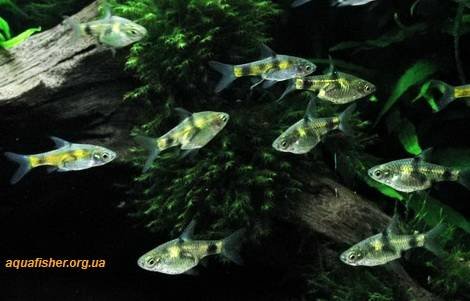
Order Cypriniformes ( Cypriniformes )
Family Cyprinidae ( Cyprinidae )
Subfamily ( Barbinae )
Genus Pethia — Pethia.
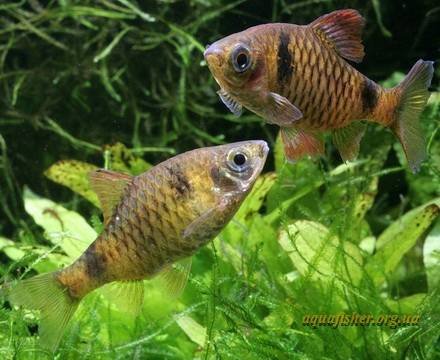
— Cuming’s barb — Pethia cumingii [Gunther, 1868]. Synonym: Barbus cumingii, Puntius phutunio, cumingii. (Eng. Cuming’s Barb, Two Spot Barb). Sri Lanka. 4 cm. No barbels. The body is golden-yellow, the belly is silvery, the upper surface has a brownish tint. The back is pale brown, the flanks are matte, silvery, with a golden sheen. Scales are large. There are two dark oval spots in the shoulder region and near the caudal peduncle.
In females, the fins are colorless, in males they are bright pink. The dorsal fin is dotted with black dots. Specimens caught in different locations may differ in the coloration of the dorsal and ventral fins: they can be yellow-orange or yellow-red. Males are smaller, slimmer than females, and more brightly colored. Fry are translucent, and as they grow, rounded spots appear on their bodies.
This barb is considered a peaceful schooling fish. Very active, they do not impose their company on neighbors, posing practically no threat even to fish with veil fins. It feels good in small schools of 6-8 fish and in the company of equally peaceful fish. It loves aquariums with free swimming space. The coloration is better revealed in a well-established, planted aquarium. Plant hard-leaved Cryptocoryne for shelter and bushy plants like Cabomba with softer foliage so the fish have places to spawn.
It may eat plants, biting off the tips of young shoots, so if you want to prevent damage to plants, it is necessary to include various plant-based foods in the menu. Water rich in organic acids and tannins. Any high-quality food of a suitable size, with the inclusion of plant products in the diet preferred. Spawning occurs on plants. They live up to 5 years. pH 5.5-7.0; dH 4-18°; T 22-26°C.

— Didi barb — Pethia didi [Kullander & Fang, 2005]. Synonym: Puntius didi. (Eng. Didi Barb). Found in northern Myanmar, in the Irrawaddy basin. Body length of the male is 4 cm, female 5 cm. Body high, compressed laterally. No barbels. Back is olive. The body behind the dorsal fin is colored orange. Behind the gill cover, there is a large vertically smeared dark spot. A round-vertical black spot is located on the caudal peduncle. Scales with a strong pearly sheen, silvery.
Fins are transparent, yellowish, with dark strokes on the dorsal fin. Females are somewhat larger and fuller, paler in coloration. Peaceful, active, swim in a school, like to stay in plant-free areas of the aquarium. Do not nip the fins of other fish. Readily eat any live and dry foods. Mature at 8 months. pH 6.5-8.0; T 22-26°C.
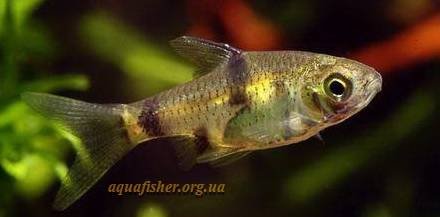
— Dwarf gold barb, golden barb — Pethia gelius [Hamilton, 1822]. Synonym: Puntius gelius, Cyprinus, Systomus, Barbus gelius, Cyprinus, Systomus canius. (Eng. Dwarf Gold Barb, Fleckenbarbe, Glass Barb, Golden Barb). Inhabits streams and rivers of Northeast India, Pakistan, Bangladesh. 4 cm. The “golden barb” is very often called not Barbus gelius, but the golden breeding form of the rosy barb (Pethia conchonius). In this regard, some confusion is possible.
It has an elongated body, the back profile is more arched than the belly, the body tapers towards the caudal peduncle, resembling high-bodied representatives of the genus Rasbora rather than barbs. Small pointed head with fairly large eyes and a terminal mouth.
General coloration is yellow or sandy, turning to silvery on the lower part of the head and belly. The back has a dark olive color, flanks are greenish with a pronounced golden sheen. A longitudinal blurred shiny reddish-gold stripe runs against the yellowish-silver background, shimmering with a soft blue sheen under direct lighting. Irregular black spots are scattered, of which the clearest are on the caudal peduncle, at the base of the anal fin, and on the flank.
The clearest mark can be considered a blurred black teardrop-shaped spot located on both sides of the body at the level of the anal and dorsal fins. The back is darker, olive, the flanks are green with a golden tint. Fins are quite high, held erect, transparent, slightly yellowish. Caudal fin pale pink. Pectoral fins colorless. Males are thinner than females and more brightly colored, their lateral longitudinal stripe is copper-yellow. Females are fuller, somewhat larger, with a golden-red lateral stripe.
There are some differences in coloration and shape that vary depending on the locality. In West Bengal, they most frequently have clear dark spots, while in fish from Assam these spots are much weaker. In Bihar, fish grow significantly larger and have a dark red coloration.
Peaceful, schooling fish, staying in the middle water layer. Aquarium with various shelters, plant thickets, and free swimming space. Lighting is muffled, diffused. Extremely active and usually stay in a school. A school of 5-10 fish can be kept in a general aquarium in the company of small non-aggressive neighbors. In smaller numbers, they are timid and constantly hide in dense plant thickets. Substrate is dark. Lighting is diffused, and the fact that only correctly positioned light will help reveal the full beauty of this spectacular barb should be taken into account.
Reduced water temperature is required (optimally 20°C); at high temperatures, lifespan is shortened. Soft or medium-hard water with the addition of peat extract. Filtration, aeration, and weekly water changes are necessary. Fish eat live and dry foods excellently, as well as tender, soft algae covering plant leaves, stones, and driftwood. All food must be small. Mature at 8-10 months. The female spawns only about a hundred eggs on fine-leaved plants. pH 6.5-7.5; dH 5-12°; T 18-25°C.

 Identification: Genus Pethia — Pethia cumingii, didi, gelius.
 Puntius kuchingensis, Puntius lateristriga.
Puntius fasciatus, foerschi, rhomboocellatus.