



Order Cypriniformes ( Cypriniformes )
Family Cyprinidae ( Cyprinidae )
Subfamily ( Barbinae )
Genus Pethia — Pethia.
Continued…

— Narayan Barb — Pethia narayani [Hora, 1937]. Synonym: Puntius narayani, Barbus narayani. (Eng. Narayan Barb). India, Sri Lanka. 7 cm. Beige-orange. The most characteristic feature is the presence of three (two in other species) dark wide vertical spots on the sides of the fish. The first is in front of the dorsal fin, the second is directly under the dorsal fin, and the third is above the rear part of the anal fin. Transparent fins and tail, except for the dorsal fin, are red. In juveniles, with increasing size, a blue tint appears on the sides and yellow spots appear on the sides and the base of the tail.
Peaceful towards its own species and other species. A very shy fish that is difficult to see in the aquarium. There should be enough space in the aquarium so that the fish can swim peacefully and not get scared. They should be kept in a school of 6 or more individuals. Feed with flakes and all types of live or frozen foods. Spawning is in pairs. dH 5-15°; pH 6.0-7.2; T 21-26°C.

— Spottedsail Barb, Dwarf Barb — Pethia phutunio [Hamilton, 1822]. Synonyms: Puntius phutunio, Cyprinus, Systomus, Barbus phutunio, Systomus leptosomus. (Eng. Spottedsail Barb, Dwarf Barb). Eastern India, Pakistan, Bangladesh, Myanmar. Inhabits streams, swamps, and small water bodies. 3.5 cm. Body with iridescent blue, golden, and silver colors, brownish and greenish shades are also present, belly is white.
On the body of slender and smaller males, black-blue spots located above the pectoral and anal fins clearly appear; at a certain angle of incident light, the spot above the anal fin flashes with a yellow light, and above the pectoral fin – with a yellowish-green light. Pelvic fins are red, pectoral fins are reddish, dorsal fin has a slightly yellowish tint.
In females, the body has a slight brownish tint, the spot pattern is paler and more blurred, and the pelvic fins are yellowish. The male is slimmer and brighter than the female, his pelvic fins are reddish, while the female’s are yellowish. Young individuals have a very weak golden sheen, fins range from yellowish to reddish.
Peaceful, very agile schooling fish, the school should consist of at least 8 individuals. They are extremely active and can be kept with any similar fish. Prone to jumping out of the aquarium. Suitable for keeping in community aquariums with calm fish lacking predatory tendencies. Must always be kept in the company of their own kind. Sometimes become timid.
They like shady areas in the lower third of the aquarium. Dense vegetation along the side and back walls, leaving enough free space for swimming. Soft dark substrate. Fed with live and frozen foods such as bloodworms, daphnia, and artemia, as well as flakes and pellets. Fry grow very slowly. pH 6.4-7.2; dH 4-12°; T 22-24°C.
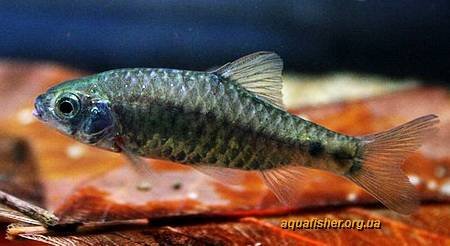
— Pethia shalynius [Yazdani & Talukdar, 1975]. Synonym: Puntius shalynius. (Eng. Shalyni Barb). India, at an altitude of over 1200 meters above sea level, in rivers with cool and well-oxygenated water. 5 cm. Barbels are absent. Longitudinal blue stripes on the body. No dark spot in the front part of the body, two dark spots in a single line on the caudal peduncle, the front one is most clearly visible.
Very peaceful, but in a community aquarium, choose tankmates that prefer lower temperatures. Schooling fish, at least 6-10 fish should be acquired. This will make the fish less timid, and males will display better colors in the presence of rivals. Adult males are noticeably smaller, thinner, and more colorful than females, especially during the spawning period. They look best under subdued lighting and with dense vegetation over a darkish substrate.
Rocks and boulders of various sizes on the bottom, additionally equipped with driftwood and tree branches. Since they inhabit flowing water, they should not be introduced into a biologically immature aquarium as they require stable water conditions; weekly water changes are mandatory. Regular feeding with live and frozen foods such as bloodworms, daphnia, and artemia, with good quality dried flakes and pellets, plus supplementary vegetable matter. Temperature 16-24°C, pH 6.0-7.5.
 Puntius conchonius, Rosy barb.
Puntius oligolepis, phutunio, rohani, sahyadriensis. 


