



Order Cypriniformes
Family Cyprinidae
Genus Oreichthys.
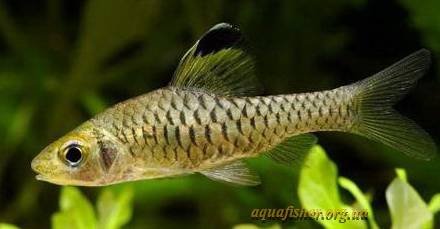
— Oreichthys cosuatis [Hamilton, 1822]. Synonyms: Barbus, Puntius, Cyprinus, Leuciscus cosuatis, Puntius coorgensis, Systomus malacopterus. (English: Kosuati Barb). India, Thailand, Bangladesh. 4 cm. Eyes are large, slightly protruding. The mouth is small and located ventrally. The overall body color is yellowish-grey silver with a black border on the front part of each scale. An inconspicuous vertical black stripe passes through the eyes.
Males are slightly larger and have a larger dorsal fin. The dorsal fin features a yellow spot under a broad arched black border, with a whitish tip, and the lower part is transparent. The anal fin has a small black stripe in the center, forming a triangular spot in adults. During the spawning season, males have red pelvic fins. The female is smaller, paler, and the black spot on the dorsal fin is smaller. It differs from O. crenuchoides by a more conical head shape, slender body, absence of a black spot on the caudal peduncle, and a less extended dorsal fin.
A very active, jumper, timid, and peaceful fish. Keep in a school of 6 or more individuals, otherwise, it becomes withdrawn and hides in vegetation. This species will thrive in a heavily planted aquarium where they can take shelter. They will also appreciate subdued lighting conditions, as they spend most of their time at the bottom of the aquarium. Can be kept with any similarly sized fish that will not harass them over territory or pull on the long fins of the males. Within the school, there is usually a strict hierarchy among males. Males occupy small territories which they defend against conspecifics of the same sex.
The substrate should be sandy and covered with leaves; this species has sensory barbels on the lower jaw, which it uses during foraging. They are very sensitive to fluctuations in water chemistry, so they should be introduced into aquariums with established biological equilibrium. Powerful filtration, aeration, and weekly water changes are required. Omnivorous, accepting dry and frozen foods, as well as plant matter. Sexual maturity is reached at 7-9 months of age. pH 6.5-7.5; dH 3-10°; T 22-28°C.

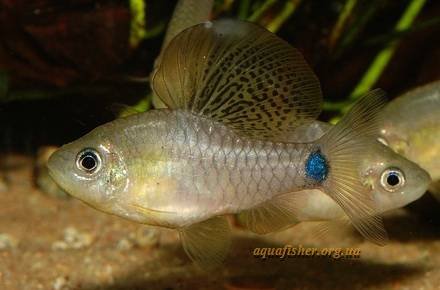
— Drape Fin Barb — Oreichthys crenuchoides [Schafer, 2009]. (English: Drape Fin Barb, High Fin Barb, Indian Drapefin Barb, Sail Fin Barb). India, West Bengal, tributaries of the Brahmaputra. 4 cm. This is an elegant, small schooling fish. The body is elongated, the dorsal profile is more curved than the ventral one, with large eyes and a characteristic profile with a rounded mouth. The caudal fin is bilobed. This species can be distinguished from its relatives by the following features: • blunt snout; • absence of dark stripes and spots on the anal fin; • the black spot on the caudal peduncle is large and clearly stands out; males have a substantially enlarged dorsal fin.
A small-sized fish, distinguished by a large sail-like dorsal fin (in males only) with pronounced black-and-brown mottling on a transparent (posteriorly) and yellowish-golden background (closer to the anterior rays). During courtship, males flare it like a luxurious fan, fighting and biting each other. Subdominant males have small dorsal fins.
The main body color is grayish, sometimes with an olive or sandy tint, and the large-scale pattern is reticulated. The pelvic fins and part of the anal fin are also usually yellowish. A distinct round black spot is present on the caudal peduncle, reflecting a beautiful blue-green sheen in reflected light. Females are smaller and have a normal-sized dorsal fin with two distinct spots — a coal-black one preceded by a whitish-yellow one, with no mottling on the fin. All other fins are transparent.
A very active, jumper, timid, and peaceful fish. When transferred to a new aquarium or upon a sudden movement, it instantly panics and “faints”, but returns to normal just as quickly, so there is no need to worry upon seeing an unresponsive fish carried by the current. After a few minutes, it will explore its new home as if nothing happened. Can be kept with any similarly sized fish that will not harass them over territory or pull on the long fins of the males.
Within the school, there is usually a strict hierarchy among males. Males occupy small territories which they defend against conspecifics of the same sex. If kept in a very small group or cramped conditions, the dominant male will constantly harass the subdominants. In addition to ample swimming space, the rear wall of the aquarium should be well-planted with vegetation, and various shelters provided. The substrate should be partly dark, partly fine sand. Powerful filtration, aeration, and weekly water changes are required.
Omnivorous, accepting dry and frozen foods, as well as plant matter. Due to their shyness, they may be outcompeted for food by larger and more agile tank mates. Sexual maturity is reached at 7-9 months of age. During spawning, they deposit single eggs on the underside of broad leaves. Fry grow rapidly. pH 6.0-7.5; dH up to 12°; T 22-28°C.
 Puntius arulius, Puntius everetti.
Labeo chrysophekadion, cyclorhynchus, forskalii. 
Last updated and supplemented on January 23, 2013.


