Order Cypriniformes
Family Cobitidae
Subfamily Botiinae
Genus Chromobotia

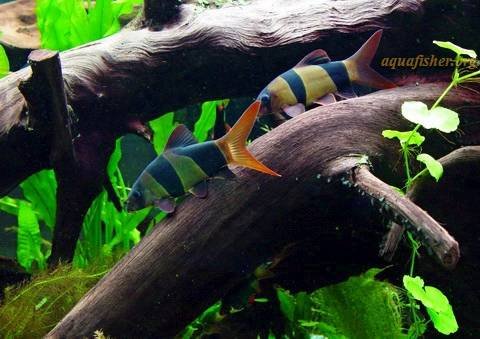
— Clown Loach — Chromobotia macracanthus [Bleeker, 1852]. Synonym: Botia macracantha, macracanthus. Inhabits waters rich in aquatic vegetation in Southeast Asia, Indonesia, Sumatra, and Borneo. Most aquarium clown loaches are wild-caught, living in forest streams and rivers. The body is elongated, torpedo-shaped, and arched at the dorsal part. Clown loaches have large eyes without protective skin, beneath which sharp spines are located. Four pairs of barbels are situated around the mouth.
Two races of clown loaches are known, differing in size. The smaller morph from the islands of Indonesia, not exceeding 15-18 cm, is more commonly found in aquariums. Considerably rarer specimens from the Mekong River basin reach 30-45 cm. Size is heavily influenced by the aquarium volume. In amateur aquariums, the fish grow slowly and rarely reach their maximum size. However, under optimal conditions, they will grow 10-15 cm in a year. The overwhelming majority of aquarists begin their acquaintance with loaches specifically with clown loaches.
Body coloration ranges from yellow to orange-red with a green sheen. Three wide, wedge-shaped black bands cross the body, tapering downward, with the last one extending onto the dorsal and anal fins. One band is located on the head, the second in the center of the body between the head and the dorsal fin, and the third covers the rear part of the body; sometimes other smaller oval black spots are present. The dorsal fin is black with yellow only at the base. Ventral fins are scarlet and black, and the caudal fin is bright scarlet. Specimens from Borneo have dark ventral fins with a red or orange leading ray, while those from Sumatra have red-orange ventral fins.
External sexual differences in individuals are absent. Males have an elongated caudal fin. Females are larger than males. Eyes are large, black, and very mobile, with extremely sharp spines beneath them – one on each side. When the fish is calm, the spines are completely invisible, appearing only during stressful situations. Under stress, the fish become covered with white spots.

Primarily nocturnal; feeding should take place in the evening. Young fish are quite active and open during the day, gathering in large schools, very cheerful and active, showing interest in neighbors and each other. This distinguishes them from adult fish, which form small groups numbering a few individuals. It is best to keep them in a school of 5 or more fish. Peaceful in small schools. They are schooling fish, never swim alone, and constantly communicate with each other.
They tolerate the company of close relatives calmly. They treat each other peacefully, and newcomers usually settle in quickly. Many large representatives can behave very aggressively and engage in fights; such behavior poses a great danger to smaller individuals. When in danger, they produce clicking sounds. These loaches get along with most peaceful fish. A spacious aquarium densely planted with plants is preferred. Numerous hiding places at the bottom are necessary – stone grottos, driftwood, clay pots. When there are many hiding places, the fish hide in them all day long.
They can damage the appearance of plants, leaving many looking tattered with numerous holes. The substrate should be soft and sandy. Lighting should be dim and diffused. Too bright an aquarium is not suitable. When kept in a small tank, they become depressed. Anyone who has kept loaches knows that these fish occasionally lie on their sides, which greatly frightens beginners. But after resting, the fish continue their business as if nothing happened.
They require quite high water quality: nitrate-free, well-filtered, and aerated water. The water should be soft, up to 12°dH, and frequent water changes are needed. It is very important to constantly and clearly monitor water acidity. A drop in pH to 5.8 is dangerous for the fish – they lie on their sides, and it is extremely rare to revive them from this state. They prefer live food, but can also manage with artificial food. They eat snails, including burrowing Malaysian trumpet snails. In nature, the clown loach lives in a very strict social structure, so when one of the adult animals is removed, the sizes, status, and even sex of the remaining individuals change drastically.
If a female dies in the group, the male changes sex and becomes a breeding female himself. The transformation of individual females into males is also observed, especially when kept separate from males. They are very sensitive to Ichthyophthirius and to medications used to treat fish for this disease. They are imported, so it is best to purchase them in April-May, before they become stunted by prolonged, highly crowded conditions during transport. Breeding all species of loaches is extremely difficult. Smooth stones and driftwood installed in the highest water flow areas are used as spawning substrates. They live up to 20 years. pH 6.5-7.5; dH 4-12°; T 24-28°C.


 Identification: Clown Loach — Chromobotia macracanthus.
 Description of the genus Botia, Botia dario.
Description of the subfamily Botiinae, Leptobotia pellegrini, Canthophrys gongota.