



Family Characidae or American Tetras ( Characidae )
Group with uncertain status ( Incertae Sedis )
Genus Moenkhausia.
These are schooling, active, slightly aggressive fish. Plants should not be overly delicate, otherwise the fish will nip at them. It is essential to provide them with both hiding places (among roots) and sufficient open swimming space. These omnivorous, large-scaled fish prefer aquariums with rich vegetation. The pH should be around 7; in more acidic water, their fins may fray.
Other species kept in aquariums: — Moenkhausia bonita (Benine, Castro & Sabino, 2004). Brazil. 4 cm. Caudal fin with a black edge and a diamond-shaped spot on the caudal peduncle; — Moenkhausia gracilima [Eigenmann, 1908]. Synonym: Moenkhausia lepidurus gracilimus. 6 cm, males are smaller. Caudal fin has cherry-colored stripes and a black border. Dorsal, anal, and pelvic fins have white tips. Best kept in a large school; — Moenkhausia georgiae [Gery, 1965]. Brazil. 6.5 cm. Resembles the diamond tetra. Olive-gray with golden scales and black markings through the eye, behind the gill cover, and at the base of the tail. The male has an elongated, streamer-like dorsal fin and a concave anal fin; — Moenkhausia intermedia [Eigenmann, 1908] – Gold Line Scissor Tail. 8 cm. Body ranges from silvery to copper-colored. A blue line with a metallic sheen runs along the lateral line. Unpaired fins have a white edge. A black spot marks the upper and lower tips of the yellowish caudal fin. Requires a tank with dense vegetation and plenty of swimming room.

— Agnes’s Moenkhausia — Moenkhausia agnesae [Gery, 1965]. Brazil, Amazon basin. Females reach 9 cm, males 7 cm. Beige-pink with a bluish sheen and 6–7 reddish lines running along the body. Eyes are blue, fins are pink, with 1–2 black marks behind the operculum. The male is more brightly colored and slender, with a concave anal fin. Relatively large, they require ample space and tend to spar amongst themselves and with other fish.

— Moenkhausia — Moenkhausia ceros [Eigenmann, 1908]. Peru, Brazil, Amazon basin. 5 cm. Elongated body shape. The body is partially transparent with a golden radiance. The caudal fin features a central black spot surrounded by white markings. Other fins are colorless. A golden longitudinal stripe extends from the tail base to the gills. Peaceful. Tank should have dense vegetation combined with open swimming space. To bring out the delicate coloration of the fish, lighting should be subdued. Keep in a school of at least 6 specimens. pH 5.5–7.0; dH 5–15°; T 24–26°C.

— Collett’s Tetra — Moenkhausia collettii [Steindachner, 1882]. Synonym: Tetragonopterus collettii. Peru, Amazon, Orinoco, and Rio Negro basins. 5 cm. A translucent fish. The adipose and caudal fins are orange. This fish lacks vivid colors, creating an attractive contrast with the bright diversity of other characin species. The body is silvery, scales have fine iridescent tones, with a dark humeral spot behind the head and a black line near the anal fin. The caudal fin is red, while the dorsal, adipose, and anal fins carry red or orange pigmentation.
Best kept in well-planted aquariums where this schooling fish can dart into cover and emerge. Floating plants covering part of the surface provide areas of dimmed light. Due to its transparency, it gives the impression of being delicate, but apart from clean water, it poses no complex demands. Regular water changes of up to 25% are recommended. Good aeration is required. pH 6–7; dH up to 12°; T 22–26°C.

— Red-lipped Moenkhausia — Moenkhausia cosmops [Lima, Britski & Machado, 2007]. Central Brazil, Paraguay and Tapajós river basins. 5–6 cm. The fish’s eyes appear divided into two parts, each with a different color: the upper half is bright green with a golden tint, while the lower half is vibrant blue. The upper lip carries red pigmentation composed of pinkish biofibers. Transparent opercula reveal the pinkish-red gill filaments. A narrow dark stripe runs along the entire body. Must be kept in a school. Water should be soft and slightly acidic, closely mirroring native habitat conditions. T 24–26°C.

— Costa’s Tetra — Moenkhausia costae [Steindachner, 1907]. South America, Brazil, São Francisco and Itapicuru rivers. 6 cm. Males are smaller. The body is silvery-greenish. Against the silvery background, a golden line runs along the middle of the body (from eye to caudal fin). Depending on the light, it can appear olive-green. A black band extends from the base of the anal fin along the caudal peduncle into the upper caudal lobe. Fins are translucent. Females are somewhat larger and fuller-bodied. The anal fin is fairly straight in males and concave in females.
Quite gregarious and active swimmers. Schooling fish, maintain in groups of at least 6–7 individuals. The aquarium should be well-planted yet provide sufficient swimming space. Peaceful towards conspecifics and other fish alike. Minor skirmishes involving the dominant male may occur during feeding, but they are harmless. Unfussy eaters that readily take live, frozen, and dry foods. T 22–28°C; pH 6–7; dH 10°.
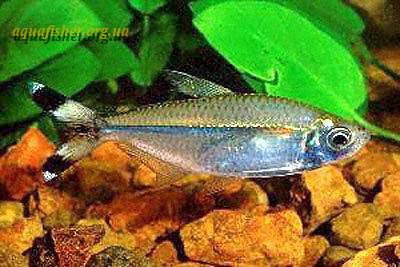
— Bandtail Tetra — Moenkhausia dichroura [Kner, 1859]. Synonym: Tetragonopterus dichrourus. (Eng: Bandtail Tetra, Spot Tailed Moenkhausia, Spottail Tetra). Paraguay, Orinoco and Paraguay river basins. 8–10 cm. Back is olive, belly silvery, with a line running from the gill cover to the caudal fin base ending in a black spot on the fin rays. The caudal fin features black bands in the middle and bright white tips.
A very peaceful schooling fish that is pleasant to keep when provided with attentive care. A species whose true beauty unfolds under subdued lighting. Floating plants are recommended. These fish are very skittish; sudden movements in the room or lights switched on abruptly cause panic among them, sometimes causing them to jump out of the water. Suitable for community aquariums. Peat-filtered water is beneficial. Pay close attention to water quality: it should be soft and slightly acidic, as this fish tolerates hard water rather poorly. pH 5.5–7.0; dH up to 8°; T 22–26°C.
 Moenkhausia grandisquamis, lepidura, oligolepis, pittieri, sanctaefilomenae.
Hyphessobrycon stegemanni, takasei, vilmae, werneri. 


