



Family Characidae or American Tetras ( Characidae )
Group of uncertain status ( Incertae Sedis )
Genus Astyanax — Astyanax.

— Kennedy’s Tetra — Astyanax kennedyi [Gery, 1964]. (Eng. Kennedy’s Tetra). South America, Peru, upper Amazon River basin. 5 cm. The body is translucent silvery-gray, with yellow, green, and purple silvery tints depending on the light. The caudal fin features a black spot, from which a glowing golden stripe extends toward the edge of the gills. Fins are colorless. Aquarium in a typical Amazon River style with a sandy substrate, branched driftwood, twisted roots, and tannin-stained water. Food should contain a large amount of small live and frozen foods, as well as good quality flakes. pH 5.5-7.0; T 26-29°C.
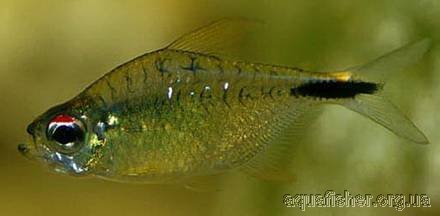
— Leopold’s Tetra — Astyanax leopoldi [Gery, Planquette & LeBail, 1988]. (Eng. Leopold’s Tetra). Guiana, Brazil, most common in fast-flowing water. 6 cm. Iris of the eyes is bright red. The body is silvery with a golden sheen. Golden spots appear immediately behind the gills. At the base of the tail, there is a short black stripe extending onto the central rays of the caudal fin. The anal fin is longer than the dorsal fin. Females are larger than males and have a rounded belly.
Very peaceful and suitable for community aquariums, should not be kept with large and aggressive fish. The aquarium should be densely planted at the edges, with a gravel substrate, smooth stones, and good water quality. Peaceful, keep in a school of 8-10 fish. Tank mates should be peaceful. They mostly prefer the middle water layer, are fast and skillful swimmers, and very active. Will thrive in a water current from a powerful filter. Given their natural habitat, good oxygen saturation of the water must be provided.
During spawning, males show aggression and may bite females and their fins, causing numerous injuries. Therefore, it is important that females can find hiding places. May nibble on plants. Water aeration and filtration are required, as well as weekly partial water changes. Omnivorous, plant matter should make up at least 60% of the diet. pH 6.0-7.0; dH 5-15°; T 23-27°С.

— Blind Cave Tetra — Astyanax mexicanus [Filippi, 1853]. Synonym: Astyanax fasciatus mexicanus. (Eng. Blind Cave Tetra, Mexican Tetra). 8-10 cm. An Astyanax that transformed in ancient times, adapting to life in caves. They inhabit underground rivers flowing through extensive karst caves in the state of San Luis Potosí (Mexico). In some caves, there are also transitional forms with varying degrees of body pigmentation and eye development, most likely resulting from the penetration of sighted fish into underground waters and the subsequent crossing of the two forms. The fish has a high, slightly compressed body.
In adult fish, the eyes are overgrown with a cartilaginous membrane; instead of sight, for spatial orientation, the fish use a sensitive lateral line containing a large number of sensory receptors. Its pores can detect the slightest water vibrations created by a swimming fish or an obstacle. Using this navigation system, which signals any minor movement to the fish, as well as organs of smell and touch, this cave dweller navigates brilliantly, swimming confidently and briskly.
Unable to see the surrounding world, cave fish have also lost their coloration: there is no trace of black spots on their body and fins; the Astyanax have turned into pink albinos with a soft pearly sheen. Fins are colorless or slightly reddish, almost transparent, and become almost red in males during spawning. Females are somewhat larger, fuller, with a sharper lower angle of the anal fin.
Fry have almost normally developed eyes with black pigment, which begin to deform on the 18th day and by 3 months are almost completely reduced and covered with skin. They cannot see moving food and sense it only upon body contact, sharply turning toward it, though they often miss. A faint diamond-shaped spot is visible on the tail base of fry.
Peaceful, slightly timid fish. They mostly swim in the upper and middle water layers. Fish are kept in a species aquarium with hiding places in the form of stone caves. Plants are not mandatory, as any planted plant will be eaten within a short time. Deprived of sight, Astyanax swim erratically and fussily, slightly frightening smaller individuals. Fish react very sensitively to loud noises and can jump out of the aquarium when startled, so it must be covered with a lid.
Not demanding regarding water composition, but water with increased hardness and a neutral (or slightly alkaline) reaction is desirable. Filtration, aeration, and weekly water changes are necessary. Blind fish greedily rush onto any food, live or artificial. They also eat plant matter and therefore damage plants in the aquarium. Sexual maturity is reached at 8 months. T 18-24°С; dH 16-25°; pH 7.0-8.0.


 Identification: Blind Tetra — Astyanax mexicanus.
 Gymnocorymbus bondi, Gymnocorymbus ternetzi, Gymnocorymbus thayeri.
Astyanax aeneus, Astyanax bimaculatus, Astyanax fasciatus. 


