Family Characidae or American Tetras
Group of Uncertain Status ( Incertae Sedis )
Genus Ceratobranchia.
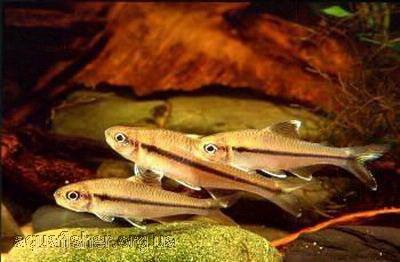
— Ceratobranchia obtusirostris [Eigenmann, 1914]. South America, Amazon River basin in Peru and Ecuador. 5-7 cm. A relatively elongated fish of streamlined form with a moderately high back. A large, forked caudal fin sits on a very strong caudal peduncle. The ground body color is an unobtrusive brownish-beige. Behind the operculum is a comma-shaped spot. A black stripe extends from the eye through the entire body to the middle rays of the caudal fin.
The scales are large, with dark margins that create a reticulated appearance. The rays of the upper dorsal fin are darkly tinted. Pectoral fins have a white border on their leading edge. The tips of the caudal fin lobes are white. Requires a large aquarium with a strong current. Very lively, swimming willingly and tirelessly close to the substrate. Keep in a group in a spacious aquarium with good water flow. Individual fish stake out small territories which they defend against others, though without causing physical harm. Temp: 22-26°C.
Genus Creagrutus.

— Benny Tetra, Goldstriped Characin — Creagrutus beni [Eigenmann, 1911]. Venezuela, Bolivia, Lake Valencia, Tocantins River. 4-8 cm. The body is silvery with an olive-green back, gradually lightening on the flanks. The belly is silvery. A dark lateral line runs from mid-body to the base of the tail; the dorsal and anal fins are pinkish with red-and-black flecks. The anal fin features a white edge on its anterior part. There is a black spot on the dorsal fin and behind the gill covers.
Females are olive-gray with a black-and-silver stripe stretching from the dark humeral spot to the tail. The belly is silvery. Distinguishing sex is quite difficult; the only reliable feature is the female’s heavier, plumper body. Males are smaller and paler. Provide an aquarium partially planted, with plenty of open swimming area and bright lighting. pH 6.2-7.0; dH up to 20°; Temp: 22-26°C.

— Creagrutus bolivari [Schultz, 1944]. Venezuela, Rio Guárico and Orinoco rivers. 5-6 cm. Characterized by a narrow, triangular humeral blotch. There are also dark spots on the caudal peduncle, and the flanks are adorned with a longitudinal gleaming golden or copper stripe, depending on aquarium lighting conditions. The fins carry an orange hue and are edged in white. Males are slightly smaller and more slender than females, but possess larger anal fins.
They always swim with the head tilted slightly upward. These fish are not strictly schooling; both males and females establish territories in the aquarium about 30 cm in diameter and frequently attempt to intrude on neighboring turf. In adequately sized tanks, this display behavior passes without serious injuries. However, overcrowding and lack of space can lead to casualties.
Genus Ctenobrycon.

— Silver Tetra, Sailfin Characin — Ctenobrycon spilurus [Cuvier & Valenciennes, 1850]. Synonym: Tetragonopterus spilurus. South America, from Suriname to Venezuela. 8 cm. The body is deep, almost rounded in profile, and the dorsal fin is relatively short. Coloration is a uniform silver, exhibiting a yellowish to greenish-blue sheen under certain angles of light. A prominent black spot is present at the base of the caudal fin.
Males are smaller, possessing a brighter, longer, serrated anal fin with a broader and more curved anterior margin than that of females. In females, the anal fin is paler with a straighter front edge. Known for its distinct disc-like shape, uniform coloration, and insatiable appetite, with which it eagerly devours aquatic plants. An albino variety has also been bred.
An aquarium should offer ample open swimming space along with tough, hardy plants along the perimeter. It requires plenty of swimming room as it is very active and energetic. A dark, coarse gravel substrate is preferred. Inhabits upper and middle water layers. Coexists well with barbs, catfish, and other medium-to-large fishes, but may act aggressively toward smaller tankmates. Best kept in a school. Not entirely peaceful; males frequently quarrel during the pre-spawning period. Water chemistry is not critical.
Does not tolerate sudden changes in water parameters. Aeration, effective filtration, and regular water changes are desirable. Unfussy eaters that accept all standard aquarium foods, both dry and live. To prevent them from destroying aquatic plants, supplementary plant-based food should be provided. Sexual maturity is reached at 8-12 months. Breeding is not difficult. Eggs are deposited on large-leaved plants. Lifespan is around 4 years. pH 7.0-7.4; dH up to 20°; Temp: 20-28°C.

Genus Exodon.

— Bucktooth Tetra — Exodon paradoxus [Muller & Troschel, 1844]. Synonyms: Epicyrtus exodon, Hystricodon paradoxus. Inhabits waters of Guyana and Brazil throughout the Amazon River basin, Rupununi, and Rio Branco. Prefers weak currents in marginal shallows or near patches of aquatic vegetation. Size: 8-12 cm.
The back is olive-green and the lower body is silvery. In front of the dorsal fin and at the caudal base are large, velvety-black spots bordered in gold, linked by a shimmering lateral stripe that periodically fades and reappears. Dorsal, anal, and pelvic fins are reddish; the adipose fin is yellow, and yellowish tones occur at the base of the caudal fin, whose lobes are pink.
Females are plumper and more pallid in color, generally with a yellowish cast. Males feature a more tapered abdomen, and their dorsal and anal fin rays are longer than those of females. Juveniles are strikingly patterned; coloration tends to dull as fish age.
Particularly in their youth, these are attractive, fast-swimming aquarium fishes that prefer schooling behavior. As they mature, the shoal fragments, larger specimens become solitary, and intraspecific aggression increases. *Exodon* may attack other species; dislodged scales and snout abrasions are common signs of skirmishes. The mouth is notably large, filled with formidable, sharp teeth protruding from the lips, making them unsuitable for standard community tanks.
Should be housed strictly in spacious tanks that provide both ample swimming room and abundant shelter among plants, driftwood, and rocks. They are exceptionally swift swimmers and excellent jumpers. When kept in small numbers, weaker individuals suffer relentless harassment; conversely, maintaining them in large groups significantly disperses and dampens aggression.
They are strictly unsuited for community setups and can be troublesome even in conspecific groups. They are often purchased to accompany piranhas. However, adult piranhas will prey upon them, while introduced with juvenile piranhas, *Exodon* will strip off their scales and can easily kill young piranhas.
Bucktooth tetras are skittish and dislike harsh, bright lighting. Aeration, filtration (preferably with peat media), and regular water changes are required. They feed on shredded meat and fish, large bloodworms, and feeder fry; they rarely take food from the substrate. When hungry, they will bite fins, strip scales, or attack one another. Netting and transferring must be done with caution—they can deliver painful bites. Rarely fall ill; lifespan reaches up to 8 years. Mature at 16-20 months at 8-10 cm length. pH 6.0-7.5; dH 4-15°; Temp: 23-28°C.

 Identification: Bucktooth Tetra — Exodon paradoxus.
 Genus Chalceus, Genus Gymnocharacinus, Genus Hasemania.
Genus Axelrodia, Genus Boehlkea, Genus Bryconella, Genus Bryconops, Genus Brittanichthys.