



Order Atheriniformes
Family Melanotaeniidae
Continued…
Genus Melanotaenia.
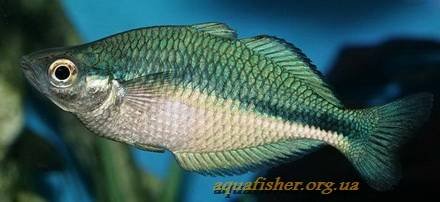
— Lake Kutubu Rainbowfish, Turquoise Rainbowfish — Melanotaenia lacustris [Munro, 1964]. (Eng.: Lake Kutubu Rainbowfish, Turquoise Rainbowfish, Blue Rainbowfish). New Guinea, Lake Kutubu, Soro River, Kikori. 12 cm. Features a large, high body with a narrow triangular head. The coloration of the fish, especially males, is quite variable depending on water quality and keeping conditions. Shimmers in various shades from green to blue. Looking at the fish, it seems as if a blue-violet mantle has been thrown over its silvery body.
However, its special charm comes from the sparkling blue dorsal “crest”, which becomes lighter in the central part of the body and turquoise in the lower part. An electric blue lateral stripe in the front part of the body, which then turns into a very dark blue closer to the caudal peduncle.
The fins have a slight bluish tint, and a black border appears during spawning. The dorsal fin is double, the second is significantly larger and dark blue. Color intensity increases noticeably in hard, slightly alkaline, and slightly salted water. Males are much brighter than females. Their pectoral fins become especially brightly colored during courtship.
During spawning, a bright stripe appears on the head of the most active male, from the upper jaw to the dorsal fin, continuously changing color from bright yellow to yellowish-green. A bright blue longitudinal dash 1.5-2.0 cm long appears on the caudal peduncle, bordered below by a wide golden stripe that continues further along the body (often to the level of the first dorsal fin). The lower part of the body in the anal fin area darkens noticeably. The contrast with the shimmering light turquoise body is very expressive.
At 12-14 months of age, males become increasingly high-bodied. Females, like juveniles, are colored turquoise with almost transparent fins. At the same time, a dark blue stripe is visible along their body, the color intensity of which depends on the fish’s mood. These fish will only show their magnificent colors under good conditions and feeding.
Peaceful, active, schooling, very fond of swimming. Keep in groups in large aquariums. Aquarium with finely divided plants, best planted along the side and back walls. Highly prone to stress from sudden changes in water parameters. Even minor abrupt changes in pH can lead to shock, accompanied by loss of balance, convulsions, and respiratory arrest. Therefore, when transplanting and changing water, it is recommended to handle these beauties with care.
Compared to other rainbowfishes, these fish prefer relatively cool water (20-24°C) and do not like high temperatures (above 28°C). Strong water movement and good oxygen supply are important. They collect food objects in the water column rather than at the surface; it is best to feed them with appropriately sized plankton, adding thawed krill, adult Artemia, and gammarus, and they also accept dry foods. Reaches sexual maturity at 8-10 months of age. The female attaches eggs to plant leaves. Fry grow slowly and turn turquoise no earlier than 3-4 months. Lifespan is 5 years. pH 7.4-8.2; dH 8-12°.


— Lakamora Rainbowfish — Melanotaenia lakamora [Allen & Renyaan, 1996]. (Eng.: Lakamora Rainbowfish). Indonesia, Western Papua, Lake Lakamora, Aiwaso. 6 cm. The body color of adult males is pinkish-lilac, except for silvery whiteness on the chest and lower head.
Four lateral rows of scales in the middle of the body form a wide black to dark blue side stripe, bordered above and below by bright orange stripes. Its color is most intense from the eyes to the pelvic fin and on the tail. Body scales have narrow dark edges, especially pronounced on the lower half of the body, particularly above the anal fin; the lines can be zigzag.
Dorsal and anal fins are bright red. Pelvic fins are slightly orange, while caudal and pectoral fins are mostly colorless. During spawning, males are dark red with a bright white stripe on the forehead. Males are brighter, with a higher body. The first dorsal fin is higher in males, low and rounded in females.
Females are bronze on the upper half and whitish below with a blackish side stripe. They have narrow orange stripes along the upper and lower edges of the side stripe. Fins are colorless to transparent, except for the second dorsal and anal fins, which have a pale orange color. Geographic color variations: — Melanotaenia lakamora “Lake Aiwaso” — Males are pinkish-lilac in the upper half of the body and silvery-white in the lower part with a golden rim on the scales.

— Macculloch’s Rainbowfish — Melanotaenia maccullochi [Ogilby, 1915]. Synonyms: Nematocentris, Rhombatractus maccullochi. (Eng.: Black Lined Rainbowfish, Dwarf Rainbowfish, Macculloch’s Rainbowfish). Found in the water bodies of northern and northeastern Australia, southern New Guinea. 5-7 cm.
This is a very beautiful fish with an iridescent coloration that changes depending on the angle of light from reddish to blue-green. It has a silvery color with a blue-green or bluish tint depending on lighting (hence the name rainbowfish). 6-8 longitudinal stripes run along the body, formed by brick-brown flecks alternating with greenish and yellowish ones.
Anal and dorsal fins are greenish near the back, tips are yellow, and the middle is orange-red or red. The caudal fin is orange or brick-colored. Variations with yellow-orange fins exist. On the gill covers, there is a red spot with a golden-yellow border; the brownish-red caudal fin. At the peak of the spawning period, the male develops a bright canary-yellow stripe running from the forehead along the entire back, and in general, he is brighter and more slender than the female. Females are less brightly colored, although they share the male’s hues, and have a plump belly.
In the male, pectoral and pelvic fins are red-orange with black markings. Unpaired fins in males are brightly colored, with a noticeable dark longitudinal stripe along the edge of these fins, while in females, unpaired fins are transparent. A variable species with many color variations.
Differences lie in the intensity of the dark side stripes on the body and the color spots and stripes on the dorsal and anal fins, as well as differences in the coloration of the males’ nape, from the snout tip to the first dorsal fin, during spawning, which can be white, yellow, orange, or red.

Geographic color variations: — Melanotaenia maccullochi “Behana Creek”; — Melanotaenia maccullochi “Bensbach River”; — Melanotaenia maccullochi “Black Creek”; — Melanotaenia maccullochi “Burton Creek” — Body coloration is silvery to yellowish with a dark stripe in the center. Dorsal and anal fins are transparent to yellowish with a black band and bluish border; — Melanotaenia maccullochi “Cairns Region”; — Melanotaenia maccullochi “Eubenangee Swamp”; — Melanotaenia maccullochi “Elin Beach”; — Melanotaenia maccullochi “Etty Bay”; — Melanotaenia maccullochi “Finniss River”; — Melanotaenia maccullochi “Harvey Creek”;
— Melanotaenia maccullochi “Hope Vale”; — Melanotaenia maccullochi “Jardine River” — Characterized by a series of thin black stripes on the sides, and a black stripe with a yellowish-white border on the dorsal and anal fins. In females, the stripes are usually less pronounced. They are also much smaller than others, both in length and body depth; — Melanotaenia maccullochi “Pandanus Creek”; — Melanotaenia maccullochi “Papua New Guinea”; — Melanotaenia maccullochi “Russell River”; — Melanotaenia maccullochi “Skull Creek”; — Melanotaenia maccullochi “Wallaby Creek”;
Peaceful, schooling, active. The species coexists well with any peaceful fish. Keep in small schools in spacious, elongated aquariums moderately planted with vegetation and brightly lit. Stays in the middle and upper water layers, leads an active lifestyle. The aquarium should have fine-leaved plants in which rainbowfishes like to hide. Since fish tend to move constantly, they should be provided with sufficient space. Fish jump out of the water, so the aquarium must be covered.
Fresh water, rich in oxygen. Sensitive to low oxygen content, aeration, and weekly water changes are necessary. Keep in mind that keeping rainbowfish requires hard and slightly alkaline water. They are undemanding regarding temperature. They can be fed live foods (small bloodworms, corethra, tubifex), plant-based foods, and substitutes.
Sexual maturity occurs at 8-10 months of age. Spawning occurs daily over a long period. The female hangs single or multiple eggs on adhesive threads to plants and hard objects. They live for about 5 years. pH 7.0-8.5; T 20-26°C; dH above 10°.

— Mountain Rainbowfish — Melanotaenia monticola [Allen, 1980]. (Eng.: Mountain Rainbowfish). New Guinea, upper Purari River basin. 8-10 cm. Males have a lilac-blue with a greenish sheen on the sides, and silvery-white on the chest and belly, with a black lateral stripe extending from the eyes to the base of the caudal fin. Scales have a copper-golden tint. During spawning, the upper part of the head and body become very dark, and a bright orange nape flashes from time to time. Females have similar coloration but are not as bright. pH 7.0-7.6; T 18-23°C.
 Melanotaenia maylandi, misoolensis, mubiensis, nigrans, oktediensis.
Melanotaenia fluviatilis, herbertaxelrodi, irianjaya, japenensis, kamaka. 


