



What is a Dutch aquarium?
Currently, there are two main types of plant layout in an aquarium. One models a garden, while the other models nature. The first is called the Dutch style, and it copies the neatness of a flowerbed where plants are organized by color and size. Stem plants are frequently used and look luxurious and vibrant. The natural style is harder to define precisely because different people focus on different aspects of nature. However, one thing is common to all: observing plants in their natural state. This is indeed the fundamental difference between these two styles, apart from the love and care of aquarists visible in the final product.
The term “Dutch aquarium” refers to a body of water lushly planted with aquatic plants according to specific principles. It is a kind of underwater mini-garden, a flowerbed where, combined in a composition, plants emphasize each other’s beauty, complement one another, and create a unique sense of harmony reminiscent of underwater jungles. In terms of intricacy and refinement, creating Dutch aquariums is truly akin to landscape gardening. The composition in such an aquarium is built around a single, highly striking plant, an underwater piece of driftwood, or a stone. Plants are specifically selected by height and color palette. The various forms, sizes, and colors of these plant species allow for the creation of interesting and diverse compositions that give the interior a unique and distinct character.
Plants in such an aquarium must be planted densely, and groups can be isolated from one another using stone terraces or simply by alternating small, medium, and large plants. The species composition of the plants is difficult to specify because their assortment is so vast and varied, and aquarists’ tastes are proportional to their number. Clearings, alleys, paths, and rockeries are arranged at the bottom of the aquarium. The main goal of such a tank is to impress with a wealth of colors and a variety of foliage.

In addition to a specific planting method, it is necessary to consider the dimensions and proportions of the aquarium, its interior design, and its placement in the room. Creating an aquarium requires adhering to strict rules and professional preparation. The basis of its design is the creation of a living painting made of aquatic plants of various sizes, colors, and forms, selected with extreme care. Individual plant species are arranged in large groups and occupy almost the entire area of the aquarium substrate. The only exception is one or two large plants.
This aquarium design involves creating dense multi-tiered terraces with dozens of plant species of various shapes and colors. Terracing is an important component of the Dutch style. Often, the terraced effect is achieved simply by attaching ferns and *Anubias* species to driftwood and stones. This quickly creates the effect of gorges or a smooth elevation of the substrate (usually from the center towards the side glass panes). A more thorough approach to terracing involves constructing actual terraces. Groups of plants are planted on these elevations, giving the landscape a more voluminous, complex appearance.
Substrate selection should be approached selectively: its quality must meet the requirements of individual plant species. If different plant species in a Dutch aquarium require substrates with different characteristics, then each terrace is laid with its own type of substrate appropriate for the plants grown on it. Since different plants require different soils, different soil mixtures of varying thicknesses are poured into the formed compartments. Thanks to this, the thickness of the layer and the composition of the soil in different areas can be significantly varied. Thus, a Dutch aquarium is a technical term for a spacious, low, tastefully arranged tank where the main subject of interest is plants that have grown densely throughout the interior space, carefully selected according to growth intensity, leaf shape, and coloration.
A true Dutch aquarium is the pinnacle of art in freshwater aquascaping. When you look at a photo of a “Dutch tank,” you immediately know it is a Dutch aquarium. Confusing this style with anything else is simply impossible. A classical Dutch aquarium is quite difficult to create; it requires serious maintenance, but in most cases, an aquarium with abundant vegetation and fish is capable of making a stronger impression than just fish alone. This issue needs to be carefully thought out and visualized regarding what you want to create at home. A Dutch aquarium can range from relatively small sizes to very large ones.

A Dutch aquarium is, first of all, a large body of water with an abundance of light and a large number of plants arranged in color patches that complement each other and feature contrasting groups in places. One should not strictly copy the examples found on the pages of numerous magazines in the form of photographs and drawn planting diagrams. These photos are usually staged, meaning the tank is prepared a few days before the photoshoot, and it is almost never about an aquarium that has actually been functioning for several years. Seeing the combination and developmental stage of plants in a photograph, an expert can easily distinguish such an arranged aquarium from a genuine Dutch aquatic ecosystem that has been created and lived for many years.
The overall impression of the aquarium comes from the favorable condition of all its components, which influence general perception and are achieved through experience. One of the sources for combining plants and their compatibility in the aquarium is the study of specialized literature and magazines. Some aquarists believe their aquarium will be beautiful simply because it is planted with rare plants, forgetting that beauty must be maintained over a long period of time. A beautiful aquarium can also be created using common plants grown from young specimens. This will cost less money and bring you no less satisfaction than unique plants available only to a few aquarists due to their high cost.
The basis of a Dutch aquarium is aquatic plants, while living inhabitants (fish, mollusks, shrimp) play a secondary role and serve mainly to liven up the composition. Fish here act perhaps as possible additions in minimal numbers — brightly colored tropical fish swimming among thickets of ornamental aquatic plants. They are needed to slightly animate the landscape, act as natural suppliers of humus and carbon dioxide, and serve as cleaners and algae fighters.
The tank should breathe the calm nobility of *Characidae* and other unobtrusive species of bright, small, schooling fish. Their number should be just enough to make the aquarium a living organism while completely avoiding any ostentatious display. The main thing is that the fish do not damage the aquatic plants, as it is no secret that the delicate foliage of stem plants is a treat for many of them. Everything must be a single, harmonious, natural whole. The number of fish should match the size of the aquarium, with a minimum of 10 fish.
The Aquarium.
Now for the first part about the most important aspect: planning. To achieve a good result, the most important thing is not the selection of plants and fish, nor the water chemical parameters or equipment. The most important thing is to make a good plan for all stages of work, understand what we want to achieve in the end, and finally, execute this plan. Initially, it will be good if the original concept is realized by about forty percent. Planning includes the installation location of the aquarium, its dimensions and proportions, required equipment, substrate, background and other decorations, the development of a planting scheme and decoration placement, planning the species composition and number of fish, and necessary consumables. All of this must be clearly visualized and written down before starting any activities.
Aquarium placement location. It is desirable for the aquarium to stand against a wall, or at least not against the light, so that window light does not shine directly on it, and it can be easily viewed from a distance and up close. The decorative value of the aquarium stand is also of great importance. This can be an open metal or wooden rack or a special cabinet with the aquarium on top and pull-out drawers or closed doors at the bottom. At the same time, the aquarium and stand can be veneered with precious wood or decorative plywood, and the veneer color should not contrast with the surrounding furniture. Special attention is paid to the rigidity of the stand structure, as the mass of the water and the aquarium itself is quite considerable. The height of the stand is very important.
Standard 70 cm high stands are often either too low or vice versa. If we view the aquarium mostly while standing, the stand height can be increased to 110-120 cm. If the primary viewing is from a sofa or armchair, the stand can be 45-55 cm high. In general, assume that the aquarium looks best when viewed perpendicular to the plane of the front glass and slightly from above. Ideally, the observer’s horizontal gaze is directed at the upper third of the glass. In addition to a beautiful interior design, it should harmonize with surrounding objects to emphasize the beauty of the aquarium rather than overpower it or distract attention.

A Dutch aquarium must be rectangular in shape. To create an underwater landscape in the Dutch style, a sufficiently large aquarium is needed — with a volume of at least 200 liters. The peculiarity is that the width of a planted aquarium exceeds its height. The most important parameter is height. From the perspective of a complex of factors: plant physiology, aquarium lighting, and ease of maintenance, the glass height limit is 50 cm. Even then, in most cases, it is better to limit it to a lower height of about 40-45 cm.
Generally speaking, there is no need to economize on the length of the aquarium. In most cases, definitely, the longer, the better, as space allows. A long, relatively low, and wide aquarium looks very beautiful and gives freedom to the aquarist’s imagination. For medium-length aquariums, standard lamp lengths should be considered to use them in the most efficient manner. In addition, the longer the lamp, the better its light output-to-watt ratio and the longer its lifespan.
Thus, the length of the aquarium is best chosen from the following series: 80, 95, 110, 125, 155 cm. Longer bodies of water already require a different calculation of lamp placement, where a strict tie to specific lengths is no longer necessary. The minimum allowable width of the aquarium is 70 cm, but not less than 40 cm. Further increases in width will make proper aquarium maintenance impossible. In general, the height and width of the aquarium should be selected so that any part of the bottom and walls can be reached by hand. Can a relatively small aquarium be made into a Dutch one? There are no rules without exceptions. However, the difficulties in setting up such an aquarium are quite significant, as it must contain only low plants and very small fish.
Dutch aquarists cover both sides of their aquariums, leaving only the front glass open, and even that is partially covered by cladding both at the bottom (up to the substrate level) and at the top (up to the water surface). Polyurethane, Styrofoam, and other materials pre-treated to create the desired relief are glued to the inside of the side and back walls. Plants such as Java moss (*Taxiphyllum barbieri*) and Java fern (*Microsorum pteropus*) are attached to them with plastic pins, which creates a sense of completion in the interior design and prevents the mirror reflection of fish and plants in the aquarium walls.
Setting up the aquarium.
The substrate is usually fine-grained, dark-colored — basalt, granite gravel, or coarse river sand. Soil substrates usually consist of a mixture of laterite, clay, gravel, and iron-containing tablets. Some experts advise installing an undergravel filter system (false bottom) in a Dutch aquarium and pumping water through it so that the substrate remains dynamic. In many cases, an undergravel system provides a wonderful opportunity for the plant root system to develop, which ensures a useful nutrient area. The substrate level near the front glass should be very low.

As additional decorative elements, large stones made of granite or basalt are used, as well as carefully treated, intricately bent driftwood. Driftwood is quite common, but predominantly not massive, branching pieces. Driftwood (mango wood or alder) fits well into the planted composition, onto which Java moss and Microsorum are grown. They are positioned so that only the edges of the wood peek out from the thickets in certain places. A beautiful decorative element is large, irregularly shaped stones, preferably dark in color (granite or basalt are usually recommended). Beautiful stones and other decorative elements complete the composition, filling it with natural harmony and truly Dutch nobility.
There is little doubt that today’s Dutch aquarium is a high-tech object. Additionally, a thermoregulator should be placed in the tank to maintain the water temperature at 24–26 °C. The water must be filtered, preferably through an external filter that pumps approximately double the aquarium’s water volume per hour. Preference is given to external canister filters. Naturally, activated carbon is out of the question in an aquarium with live plants, and even more so in a Dutch one; this filter medium is simply inappropriate. To ensure the current coming from the filter does not disturb the aquarium inhabitants (many aquatic plants dislike strong currents), the water flow should be weakened by almost half.
Ballasts from fluorescent lamps are used as bottom heaters. Moving them from the lighting fixture housing under the aquarium bottom is technically simple, and the effect of such reconfiguration is quite substantial: warm soil provides comfortable conditions for plant roots, which positively affects their well-being and, consequently, their appearance. A CO2 system is a mandatory condition for a planted aquarium’s life.
Decorating the back wall is mandatory. The best background for a composition in such a tank is black, because the plants are planted so densely that the back wall is practically invisible. Therefore, it makes no sense to create any original fragments on the background. Equipment located inside the aquarium (internal filter, thermoregulator, etc.) should be of neutral colors — black, green — and placed so that it does not catch the eye. If necessary, it is masked with decorations.
Lighting.
An aquarium richly planted with plants is installed away from the window, or if this is not possible, the window is covered with curtains during summer afternoons to prevent algae growth. A Dutch aquarium is primarily an underwater garden with an abundance of light, so a special role is assigned to lighting during its design. In most cases, these are fluorescent lamps located along the entire length of the aquarium. However, in deep aquariums, they are used in combination with metal-halide lamps to compensate for insufficient lighting. In the evening, the illuminated aquarium in a dark corner of the room presents a breathtakingly beautiful sight.
Significant attention in equipping such an aquarium is given to lighting, both intensity and spectral characteristics. Plants are beautiful only if they receive enough light of the correct spectral composition, since out of the entire color spectrum, plants only need blue and red light rays, while they reflect green ones, do not perceive others, and some colors are entirely harmful to them. When choosing light sources for the aquarium, it is best to stick to those with increased emission intensity in the blue and red regions of the spectrum.
However, another feature of light’s action must be known. Red light only stimulates plant growth in length, while leaves remain small. Yellow light has the exact same effect. But under the influence of blue light, plants remain small, while leaves become wide and dense. Blue light penetrates deeper into the water column, making the colors of plants, fish, and accessories brighter. The optimal placement of “blue” lamps is at the front plane of the aquarium.

Any cover glasses are unacceptable, as a large amount of condensation can accumulate in the lid. Therefore, it is necessary to provide high-quality waterproofing and prevent condensation from draining outside the aquarium. Ballasts for lamps should naturally be electronic; electronic ballasts have significantly less weight and volume and extend lamp life.
When choosing lamps for the aquarium, we base our choice on the total number of lumens emitted by these lamps. For an aquarium with a large number of plants and intensive fertilization, a ratio of 30–50 lumens per liter of water is correct. From a structural standpoint, this usually translates to at least 1 lamp for every 10 cm of lid width. At the same time, it is better to aim for the upper limit of this range of 50 lumens or even slightly exceed it.
Which exact lamps should be installed? In the professional community, broad-spectrum lamps with high light output and lamps with a special plant spectrum are usually combined in equal proportions. The best of the former in our practice have proven to be Hagen LifeGLO and SunGLO lamps, and Sylvania DaylightStar and AquaStar lamps. Among phytolamps, in my opinion, Sylvania GroLux is beyond competition in terms of price, durability, and decorative qualities. Hagen AquaGlo is slightly worse, but a completely acceptable choice. Hagen FloraGlo can perhaps be placed in third place.
In addition to required illumination, the decorative qualities of specific lamps should also be considered. For example, using SunGLO tubes as high light output lamps will result in the overall color scheme of the aquarium being warm-yellow. Using Sylvania DaylightStar or LifeGLO lamps instead will make the aquarium visually cooler. At the same time, from the plants’ perspective, the illumination will remain practically unchanged, while the aquarium’s color scheme will change quite noticeably. Various lighting effects can also be achieved simply by rearranging the lamps inside the lid, moving them backward or forward. Sometimes, local illumination of the most light-demanding specimens is used, highlighting an individual plant or a small group from the general mass using directional mirror spotlights.
For plants to grow densely planted, lighting in a Dutch aquarium must be bright and uniform. If there is insufficient light, plant internodes will be long, and lower leaves will begin to die off. As a result, miserable stems will grow in the tank instead of lush greenery and crimson colors. The lighting spectrum must stimulate plant growth while accurately rendering fish coloration. As a rule, lighting in such aquariums is combined from different types of lamps, creating different illumination in various areas of the aquarium.
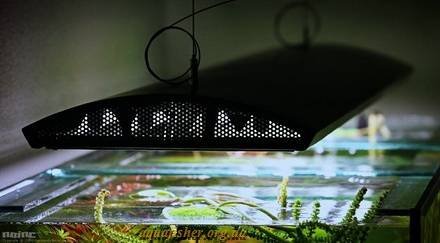
Many lamps have a guaranteed lifespan of 10–20 thousand hours, i.e., up to 5–6 years with a ten-hour daylight period. But using them in a planted aquarium for this entire period is absolutely unacceptable. The fact is that during lamp operation, their light output continuously decreases. Accordingly, in an aquarium with live plants, they should be replaced not as they fail, but when they reach 65–70 percent of their original light output. For simplicity, one can assume that the replacement period in months equals the lamp’s length in decimeters. This works well for almost all lamps, except those with extended lifespans, such as LifeGLO and DaylightStar. For them, the estimated lifespan can be doubled.
Aside from the light composition, quantity is also important for plants. Admittedly, it is almost impossible to create excessive lighting for plants. Most aquarium plants originate from the tropics, where bright sun shines for 12 hours a day, and even in the shade, there is much more light than aquarium fluorescent lamps can provide. Furthermore, in natural conditions, many aquatic plants have adapted their annual development cycle to the seasons: they experience periods of dormancy, flowering, fruiting, active growth, or, in some species, death or winter hibernation.
In the aquarium, the situation changes: here, humans control the daylight length, and if they do it incorrectly, unexpected results may occur. For example, increasing lighting duration may cause some plants to develop floating or emergent leaves, while others might develop floating leaves under a short daylight period. Therefore, it is still best to stick to a universal lighting time of 10–12 hours.
Time relay. The need to use a time relay to regulate the daylight period is so obvious that it is not even discussed, and an aquarium without a time relay is not considered and, in our view, simply has no chance of survival. Over many years of operation, electromechanical timers have proven to be much more reliable than electronic ones. No special bells and whistles, such as programming multiple channels or days of the week, are needed at all.
 Planning a Dutch garden. Plant selection for a Dutch aquarium.
Freshwater crab aquarium. Paludarium. 


