pH – KH – CO2 Equilibrium.
The tripartite relationship between these values means that once the required value of two quantities is reached, a specific value of the third is established automatically. KH and CO2 act as stabilizers, i.e., components of the buffer system in water. If CO2 is removed from the equilibrium system in one way or another, the system will shift to the left, and practically insoluble calcium carbonate will precipitate out of the solution containing bicarbonates. This happens, for example, when water is boiled, producing a whitish turbidity consisting of limestone particles.
However, once all free carbonic acid is removed from the water, the pH inexorably rises. At such an active reaction value, there are almost no carbon dioxide molecules left in the water. As a rule, they cannot raise the pH any further because its continued growth severely impairs the functional state of the plants themselves: photosynthesis, and consequently the removal of CO2 from the system, slows down, and carbon dioxide from the air, dissolving in the water, stabilizes the pH.
Carbonic acid, which forms when atmospheric carbon dioxide dissolves in water, lowers the pH of distilled water to 5.6, while water with a carbonate hardness of, for example,  5° KH, in equilibrium with atmospheric gases, has an active reaction of 8.4. The following pattern is easily observed: the higher the carbonate hardness of the water, the more alkaline it is. Generally, this rule is known to many, but not all aquarists realize that it is precisely carbonate hardness that is at issue. If the carbonate hardness of the water is quite high, this process can lead to an increase in the pH of the aquarium water up to 10, which is dangerous not only for other plants but also for the vast majority of aquarium fish. As the amount of carbon dioxide increases, the pH decreases, and at pH 8.3 it practically does not occur in a free state.
With an increase in carbonate hardness, the CO2 concentration increases as follows: at KH less than 2° up to 15 mg/l, from 2 to 10° – 20 mg/l, above 10° up to 30 mg/l. An increase in temperature decreases the solubility of carbon dioxide from 0.7 mg/l at 10°C to 0.38 mg/l at 30°C. The level of CO2 in water can be determined by simply measuring the pH level. If the pH level is below neutral (< 7), it means there is too much CO2 in the water, and the water is becoming acidic. If the pH level is 7 or higher, it means there is little CO2, and the water is becoming alkaline.
When CO2 dissolves in water, the pH drops, which can lead to disastrous results. If the water has sufficient hardness, control is not strictly necessary, and when CO2 is supplied to the aquarium within reasonable limits—about one bubble per second—the pH will fluctuate within reasonable bounds. By the end of the photoperiod, plants consume the available CO2, and accordingly, the pH rises. At night, when fish and plants release CO2, the pH drops. Smooth changes in pH within 1-1.5 degrees throughout the day are not harmful and occur in nature (sudden spikes in pH values are dangerous).
However, if the pH in the aquarium changes drastically or the CO2 concentration rises to dangerous levels by morning, you need to consider controlling the CO2 supply to the aquarium. One method is to turn on an air pump at night. Intensive aeration and water mixing will lower the CO2 concentration in the aquarium. If you use a gas cylinder, the CO2 supply can be controlled by a timer or a pH controller that operates the CO2 solenoid valve.
At high temperatures, all processes in plants accelerate, requiring more nutrients, including carbon dioxide, which increases the need for brighter lighting. With the intensive development of microscopic algae (water blooming), a large amount of carbon dioxide is released, which leads to fish mortality. CO2 quickly escapes from warm water, and plants begin to starve. The more intensive the lighting, the higher the plants’ demand for carbon dioxide. That is, with high-intensity lighting, it is essential to supply CO2 into the aquarium water from a cylinder so that the plants do not starve.
In some fish, an increase in carbon dioxide concentration causes an increase in appetite, but the food is not digested properly, and the increased food intake is accompanied by a slow depletion of their bodies. Excess free carbon dioxide causes poor fish nutrition, resulting in reduced body condition, lower resistance to unfavorable environmental conditions, and decreased immunity to infectious pathogens. Permissible concentrations of free carbon dioxide in water range between 10-40 mg/l.
How Ammonium/Ammonia and Nitrites/Nitrates Affect pH.
The pH hydrogen ion value largely determines which of these compounds forms in the predominant amount. The higher the ammonia content, the greater the shift of the pH value into the alkaline range (above 7.0) and the higher the toxicity of the water. Ammonia poisoning in fish is among the most unpleasant surprises an aquarist can experience. The toxicity of different elements of the nitrogen cycle varies greatly. Ammonia is the most toxic, but fortunately, at a pH of around 7, it is practically absent in water; at such pH values, ammonia turns into the significantly less toxic form of ammonium.
Thus, the higher the pH, the greater the danger of poisoning. For example, at pH 6.9, water contains only ammonium; at pH 7 = 1% ammonia and 99% ammonium; at pH 8 = 4% ammonia; and at pH 9 = 25% ammonia. Therefore, if the pH in the aquarium does not exceed 7, there is no acute danger of ammonia poisoning in fish, but when changing a large amount of water (up to 1/2 of the volume) with fresh water having a pH above 7, a significant amount of ammonia can form from ammonium, resulting in fish poisoning.
Special attention must be paid to substrate cleaning and partial water changes when the pH is above 7.5. The concentration of ammonia and ammonium ions must be monitored in newly 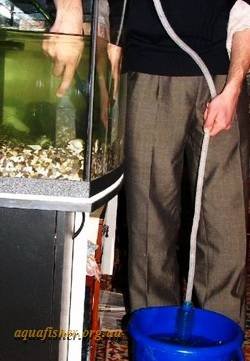 set-up aquariums, in aquariums with a high pH level (7.8 and above), and at high stocking densities of large fish. In the course of their life activity, fish release ammonia into the water. In addition, its concentration in tap water can be dangerously high, especially in autumn and spring. An aquarium with an elevated temperature also requires more attention; for instance, raising the temperature from 15 to 25°C leads to an almost twofold increase in free NH3 content. It must also be taken into account that the higher the temperature, the higher these values become; a dose that is non-lethal for fish at 20 degrees can become lethal at 30°C.
Chronic nitrate poisoning reduces fish’s ability to withstand all other adversities. For nitrate-poisoned fish, even a very minor increase in ammonia concentration is enough to make them feel sick. Good predictions regarding nitrate levels can be made by measuring the pH level. When nitrate levels increase, the pH level decreases; water with high nitrate content has high acidity, meaning that if your pH is 5.0, it indicates high nitrate levels. Nitrates affect pH in two ways. Nitrates themselves are residues of nitric acid. When nitrifying bacteria oxidize organic materials, they consume oxygen and release CO2.
A decrease in pH and water temperature leads to lower ammonia toxicity, but at the same time, the efficiency of ammonia-processing bacteria drops. The pH level plays a crucial role in nitrification: this process proceeds more intensively at a pH above 7.2 and reaches its maximum at pH = 8.3. At a pH below 7.0, the nitrification rate is 50%, and at pH = 6.5, it is only 30%. The optimal conditions for them are neutral water (pH 7.2) and a temperature of about 30°C. Excessively acidic water can limit the efficiency of biological filtration. At a pH below 5, their activity practically ceases.
Determining the Active Water Reaction Indicator – pH.
Obviously, a home aquarium is immeasurably smaller than most natural water bodies. The living world known as the aquarium is very fragile. And not only because its walls are made of glass—the main reason lies elsewhere: an aquarium, even a large one, is too small to be a stable ecosystem. Any unskilled interference on your part in its life can prove fatal. That is why the aquarium ecosystem is subject to rapid changes. It simply lacks internal resources to maintain a steady state.
Parameters vital to fish health, such as water acidity (pH), ammonia, and nitrite content, can change significantly not just over a day, but in a matter of hours! This will affect fish health very badly. And no medications will help you here; on the contrary, you will only worsen the unfavorable situation by further disrupting the ecological balance in the aquarium. When interfering with the aquarium’s life, you need to know what processes are taking place in it and what results they have led to, and without diagnostics, this is simply impossible. By monitoring pH values, you can take timely measures and prevent the death of fish and plants.
The system used to express the pH level has international application, so pH measurement data given in aquarium literature can be considered universal, unlike hardness measurement data. pH is the hydrogen ion exponent of the medium. In relation to the aquarium, it is an indicator of the acidity (or alkalinity) of the water. The pH value is measured on a scale from 0 (very acidic water) to 14 (very alkaline water); a value of 7 corresponds to neutral water. If we measure the pH level and get a result from 1 to 7, it indicates an acidic medium (meaning hydrogen ions H+ predominate in it). If we get a pH from 7 to 14, the medium is alkaline (meaning hydroxyl ions OH- predominate in the water).
This scale is logarithmic, meaning each adjacent division represents a tenfold increase or decrease in the pH level. For example, if pH = 4, this water is 10 times more acidic than water with pH = 5, and 100 times more acidic than water with pH = 6. That is, the pH level is usually measured in integers and tenths. For example, the pH of tea is 5.5 (five point five), the pH of seawater is 8.0 (eight), and the pH of bleaching chlorine is 12.5 (twelve point five).

pH measurements are carried out using two methods: colorimetric (the simplest) and potentiometric. In the first case, the color change of an indicator added to the test water is compared with a specially calibrated color chart. These can also be paper indicators—a strip of paper moistened in the water is compared with the corresponding color pH values. The second method is based on the direct measurement of the electrical potential difference by special devices, electronic pH meters, registered by an electrode system immersed in the analyzed water. However, its weak point is the electrode with a diaphragm, which gets clogged. Cleaning agents do not help much. Its normal service life is 1.5-3 years.

Determining the pH value is quite easy. Industry produces special indicators for aquaristics, with which you can establish the necessary data effortlessly. These reagents are sold in pet stores. For determining acidity in aquarium practice, indicator (litmus) paper strips are quite suitable. More accurate litmus pH indicators with a scale from 1 to 13 with an accuracy of 0.3 degrees are produced in Czechoslovakia. The color of the indicator dipped in aquarium water must be compared with the standards on the color chart. The pH value is determined according to the color. It is also important to mention that the pH value for demineralized tap water or natural water with a very low content of mineral salts is extremely difficult to determine.
When using an indicator (measuring with “pH strips”), the results are often incorrect, and the danger of error is greater the lower the salt content in the water. 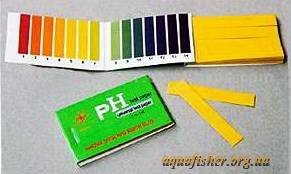 Before checking the pH, the water must be aerated for 2 hours so that it is saturated with oxygen. Liquid imported pH indicators measure some from 6.0 to 7.6, and others from 7.2 to 8.8, allowing up to 250 measurements. Measuring pH is easiest using drop tests. pH determination is carried out as follows: a few drops of the indicator are added to a small volume of the analyzed water poured into a clean glass container with transparent, uncolored walls. Drops are added until the color of the solution becomes intense enough to be compared with a special color chart.
Just as you have a medical thermometer at home, you need to have at least a minimal set of aquarium tests if you are an aquarium owner. Among them, tests for determining water acidity (pH test), ammonia (ammonia-ammonium test), nitrites (nitrite test), and nitrates (nitrate test) should be especially highlighted. In addition, it is useful to know the general and carbonate hardness of the water (dH and KH tests). Together, these tests are that very same “thermometer,” the necessary diagnostic kit with which you can detect problems in the aquarium ecosystem and quickly rectify the situation.
 Buffer Capacity and Buffer Collapse.
Water Acidity, Active Reaction of Hydrogen Ions, pH Value.