



Aquarium hoods with lighting equipment.
When buying an aquarium, you should pay attention to the light source. In most aquariums, both imported and domestic, the standard light source is sufficient for keeping fish, but insufficient for growing plants. Modern aquariums are usually already equipped with a pair of fluorescent lamps built into the hood. Therefore, it is worth paying attention to the possibility of installing additional lamps and reflectors in the hood. And do not listen to the seller who tries to convince you that the light under the hood is enough.
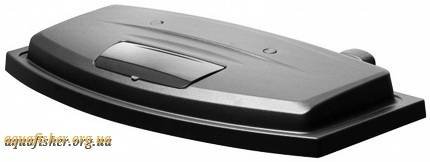
Aquarium lighting fixtures are placed in light boxes of various designs and shapes. The optimal setup for a freestanding aquarium is when all electrical appliances are built into the aquarium hood, and the hood covers the entire upper area of the aquarium along the perimeter. An essential condition is their reliability and good electrical insulation. The light box is securely fastened to the aquarium. There should be a maintenance area at least 10-15 cm high above the cover glass.
The lamp installation design can be anything, but the good reflective capacity of the inner surface of the box must be taken into account. Not all light from the lamps enters the aquarium – some goes to the sides and upwards. To reduce light losses, it is necessary that the inner surface of the light fixture (aquarium hood) is covered with aluminum foil or self-adhesive “mirror” film. It is even better if the lamps have a special reflector, as they reflect up to 95% of the light.
Fluorescent lamps work well at a temperature of 25°C. At higher temperatures, the luminous flux decreases; ventilation holes in the hood will help here. Ballasts should not be located inside the reflector because they heat up significantly; it is better to install them outside the aquarium, most optimally under the aquarium where they will warm the substrate, which is beneficial for plants. If you are not the lucky owner of a hood, I advise you to try at least to craft one from available materials if you cannot buy it.
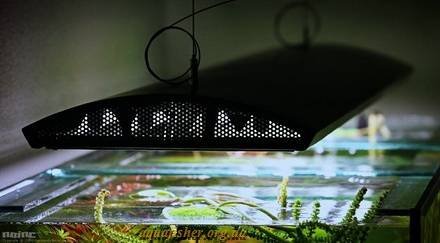
Top lights are especially important where floating emergent plants are cultivated or terraces for bog plants are arranged. In this case, the lights should be placed in high hoods so that the light source is raised 20-30 cm above the water surface. Such hoods are best made with a transparent front wall to view the water surface. Aquariums that do not necessarily require a top hood can be lit using pendant lights.
When installing a pendant-type light fixture, the space above the aquarium remains open, and you can see the water surface. This makes it possible to have an open aquarium with driftwood and aquarium plants sticking out above the water surface. Since the water surface is visible, it not only creates a sense of openness, but also facilitates daily aquarium maintenance, such as feeding fish, fertilizing, water changes, and pruning.

If we look inside Dutch aquariums, densely planted with vegetation and known for their special lighting intensity, we will be amazed by the number of fluorescent lamps under a single protective hood – it turns out they can be arranged in such a way when deemed necessary. Aquarium hoods or lighting caps should always have a large surface area, which requires using the entire surface of the top of the tank. Too narrow reflectors only partially reflect light. If you illuminate the aquarium with just one tube, you should shift it so that the plants are fully illuminated.
Remember, electricity in water is dangerous! Therefore, pay special attention to wire insulation and well protect lamp sockets from water. When installing lamps, it is especially important to protect the lamp holder from moisture, otherwise a short circuit may occur or corrosion will destroy it. There are various protective devices for tubes. Of course, branded products come equipped with them, but if you buy products from an unknown manufacturer, you should carefully inspect them from this perspective. Special plastic waterproof cuffs should be put on the lamps at the ends of the incoming electrical wires.
Increasing aquarium lighting.
Manufacturers of both aquariums and custom hoods usually equip them with lamps of minimum illumination. In most store-bought aquariums, lighting is organized on a “minimally sufficient” principle, meaning that if you are going to create a plant “lawn” in the aquarium, standard lighting in most cases will not be enough. Their light will not be enough for most light-requiring aquatic plants.
Under such lighting, plant shoots become thin, begin to rot, and change their natural color. Perhaps manufacturers expect that you will not grow more light-demanding plants or will abandon them altogether in favor of artificial ones – let this remain on the conscience of the manufacturers. One way or another, you will somehow have to upgrade the hood.

How to add extra light to the aquarium? The main ways to fix a lighting deficiency are as follows:
• Lining the inside of your hood with self-adhesive foil or self-adhesive mirror film. Self-adhesive foil is sold by advertising companies. The technology is simple: light is reflected from the foil and goes back into the aquarium. As a result, the light increase is up to 20%.
• Installing special reflectors that hang over the lamp and bounce light back into the aquarium. As a result, the light increase is up to 30%.
• Installing additional lamps. Here everything depends on your imagination and capabilities. Not all hoods allow this. You can replace your regular fluorescent lamps with compact fluorescent lamps and double the illumination due to the shorter length of such lamps compared to regular fluorescent ones. You can add more lamps or increase their wattage if space permits.
• You can adapt more powerful energy-saving fluorescent lamps with a standard incandescent lamp socket (E27) under the hood. Installing the latter allows you to almost double the illumination level while maintaining virtually the same dimensions, which cannot but affect plant growth.
• Assembling an additional light fixture yourself; this will require waterproof lamp sockets, a control gear (ballast), and space to place it inside the aquarium hood.
• Abandoning the hooded aquarium option in favor of an open aquarium with a pendant metal halide (HQI) light fixture. This option requires a radical intervention in the aquarium structure and is far from always possible.
For a densely planted aquarium, it is mandatory to use a light fixture with 3-4 lamps. Just do not forget that simply increasing lighting without adding fertilizers and nutrients will not yield the expected results. At the same time, you also need to purchase equipment for CO2 injection into the water.
 Light reflectors, mirror reflectors. DIY reflector.
Lamp connection diagrams – via ballast, with starter, without starter. 
Last changes and additions made on November 16, 2012.


